Showing posts with label lamb. Show all posts

Sunday, April 25, 2010

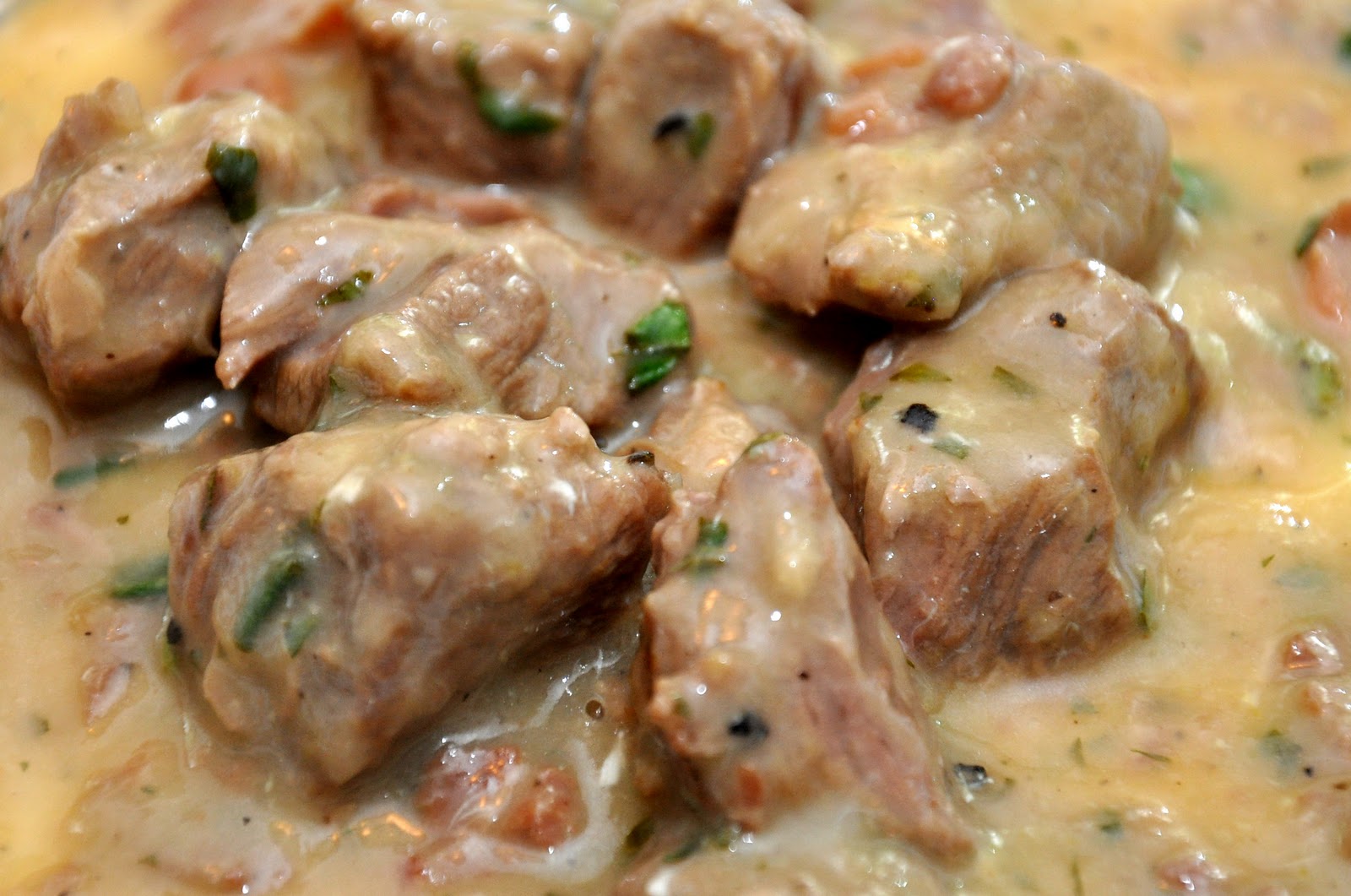
Agnello brodettato


In Italy, as elsewhere, lamb—especially the milk-fed baby lamb called abbacchio—is strongly associated with the Springtime. Roman cookery has some wonderful lamb dishes, such as the grilled rib chops known as scottadito (see this post) and lamb roasted with potatoes known as abbacchio al forno con le patate (see this post for something very similar) as well as lamb braised with rosemary, vinegar and finished with a touch of mashed anchovy called abbacchio alla cacciatora (this one is still to come). 

Slightly less usual but equally good is this dish of braised lamb with lemon and egg sauce. The term 'brodettato', literally 'in a little broth', is more or less synonymous with the term 'fricassea'; they both refer to braises that are thickened just before serving with a lemon and egg finish. The technique is wonderful with lamb, but it is widely used with vegetables, too (as in this post on green beans in fricassea). 

This dish is traditionally eaten at Easter, lamb and egg being symbols of the crucifixion and resurrection, but in my book it is too good to reserve for a single day of the year. The truly authentic version, by the way, is capretto brodettato, made with baby goat (aka kid) but since neither baby goat nor baby lamb is very common these days, at least here in the US, I have prepared the dish with good old fashioned lamb stew meat. 

The recipe is simple but a bit tricky at the end. You begin with a soffritto of an onion and 50g (2 oz.) of rather fatty prosciutto (or pancetta), chopped together finely and gently sautéed in olive oil or, if you want to be truly authentic, lard. Then add 1 kilo (2 lbs.) of lightly floured cubes of lamb meat and turn up the heat a bit. Allow the meat to brown lightly—taking care not to burn the onion—and season with salt and pepper. Then add a splash of dry white wine and allow it to evaporate completely. Add enough water to almost cover the meat, lower the flame and cover. Let the lamb braise until tender, normally about an hour but the time will vary depending on how young your lamb is and how big your cubes of meat are. 

Shortly before the meat is done, beat two egg yolks in a bowl and mix with the juice of a freshly squeezed lemon and finely chopped parsley. When the meat is fork tender, remove from the heat. Add a spoonful of the cooking liquid to the egg and lemon mixture to temper it, then pour the mixture immediately over the lamb and stir, until well incorporated. Return to the burner over very low heat and keep stirring gently, until the egg has thickened the cooking liquid into a smooth, silky consistency. Serve immediately.


NOTES: The trickiest part of the dish is the final addition of the lemon and egg mixture. If you let it cook too long or get too hot, the egg may curdle and the sauce will 'break', so let it just thicken to the point where the sauce will coat a spoon and remove it immediately from the heat. (NB: The residual heat from the pot will continue to cook the egg and thicken the sauce, so allow for that.) If things seem to be getting out of hand, add a few more drops of lemon juice, which should cool the sauce enough to prevent it from separating. If you are using a terracotta or enameled cast iron cooking vessel, you may well find that the pot retains enough residual heat that you need not put it back on the heat at all. 

The cut of lamb is usually the shoulder or some other tough stewing cut, but this time I used some leg of lamb that I had left over from the tagliata d'agnello from the other day. 

Some recipes for this dish, including the one in La cucina romana e del Lazio by Livio Jannattoni, from Newton & Compton's wonderful Quest'Italia series, call for braising the lamb meat until only a minimal amount of liquid is left in the pot—but I prefer 'brothier' version, so I add a bit more water if need be during braising, which gives you lots of delicious sauce to fare la scarpetta.

Post scriptum: The slaughtering and eating of baby lamb for Easter is an age-old tradition in Italy and one that the first generation of immigrants to America maintained—or at least they did in my family. According to family legend, in the old days, my great aunt would buy a live baby lamb in the market, still baaing, bring it home and keep it in the bathtub. Then, the day before Easter, she would take a sharp knife and…. well, you can imagine the rest of the story.

Sunday, April 11, 2010

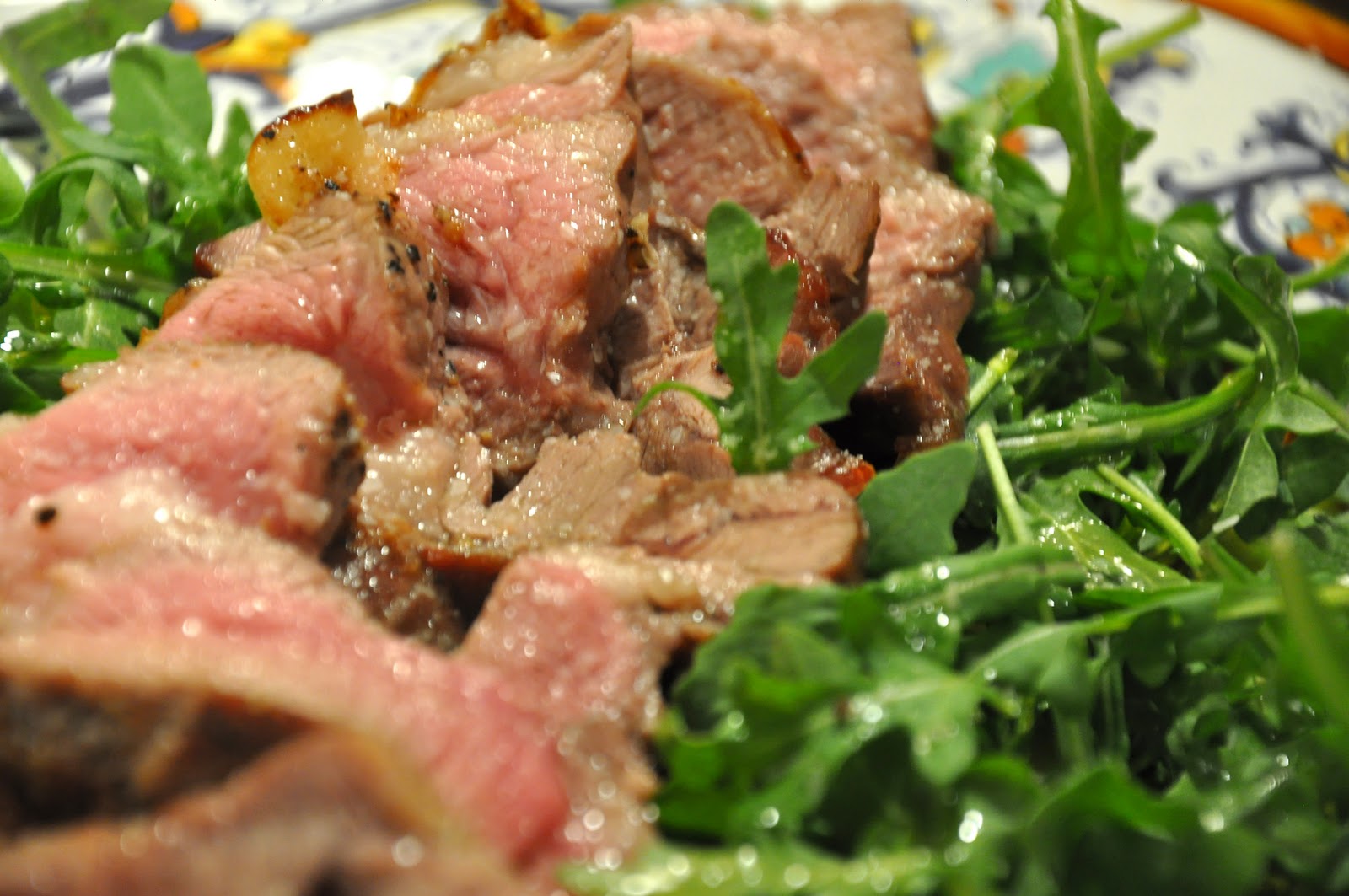
Tagliata d’agnello


One of my favorite ways to make steak is called tagliata or, to be more precise, tagliata di manzo. The word 'tagliato' means simply 'cut' or 'sliced', and manzo means beef. The dish is, quite simply, sliced steak, grilled rare, arranged over a bed of arugula and dressed with olive oil, salt and pepper and, if you like, garnished with parmesan shavings. (See this post for the recipe.) Well, the other day I saw a nice piece of butterflied leg of lamb at the market, perfect for an early Spring cookout, and the thought occurred to me: why not make a tagliata of lamb instead of beef? An unorthodox idea— in Italian cuisine leg of lamb is usually either cut up for stew or pot-roasted—but that is what I did, and I actually rather liked the result. 

Here's what you do: Marinate a nice butterflied leg of lamb in a mixture of olive oil, salt and pepper to taste, two crushed garlic cloves and a sprig or two of rosemary. You can either whizz these together in a food processor or simply sprinkle them directly on the meat, as you prefer. Obviously, the first method will result in a more assertive flavor. For best results, let the lamb marinate overnight in the fridge, wrapped in plastic (a plastic freezer bag also works nicely). If you don't have that much time or haven't planned ahead, no worries; even an hour or two will lend flavor. If you've refrigerated the meat, take it out of the fridge and allow it to come to room temperature (this should take about a half hour or so). 

Grill the lamb directly over a hot fire, about 10-15 minutes per side, depending on the thickness of your meat, until nicely crusted on the outside and pink, or medium-rare, on the inside. Allow the meat to rest for a good 10-15 minutes, then slice it against the grain and place the slices over a bed of baby arugula. Season the whole liberally with salt and pepper, then drizzle with olive oil and, if you like, a few drops of lemon juice. If you like, some parmesan shavings would not hurt. 

NOTES: The degree of doneness is, of course, a matter of taste, but I find that grilled leg of lamb tastes best 'pink', or medium-rare, in the French manner. (If you want to be sure, check for an internal temperature of 130F/55C with a meat thermometer.) A classic tagliata di manzo is usually serve very rare—red, not pink inside—but lamb does not really lend itself to serving truly rare. On the other hand, while lamb is usually cooked well-done in Italian cuisine, I can't imagine a well-done tagliata, so I opt for the French way, however unorthodox it may be. 

Once ready to go, it is best to serve your tagliata immediately, as otherwise the arugula will wilt and the meat will get cold.

Friday, January 15, 2010

Agnello e patate al forno


Lamb and potatoes have a natural affinity, as we saw in the elegant côtes d'agneau Champvallon. Here is a more rustic dish, made with seasoned chunks of lamb and potatoes baked in the oven until nicely browned on top. Simple, hearty and satisfying.

Take some thickly cut shoulder lamb chops, one or two per person depending on whether you are serving other courses and the appetite of your dinner companions. Bone and trim the chops of excess fat. (NB: Don't try to remove all the fat, just the really thick swaths of it. You want some fat to moisturize the meat during its rather long cooking time.) Cut the meat into cubes and add to a large mixing bowl. Then add a healthy splash of white wine, a pour of olive oil, one medium sliced onion, fresh rosemary, salt and pepper, and mix the ingredients well. If you have the time, allow the meat to marinate in this mixture for at least an hour and up to a day ahead.

When you are ready to cook, add chunks of potato, about the same size of the lamb cubes. Use as much potato as you like; I find that a 1:1 ratio of potato to lamb meat by weight produces a fine result. Mix the potatoes and lamb meat, then pour the entire mixture into a baking dish large enough to hold it all without it coming, say, any more than 5cm (3 in) up the sides of the dish.

Bake in a hot oven (200°C, 400°F) for about a half an hour covered, then remove the cover, raise the heat a bit and allow the casserole to continue cooking until the lamb and potatoes are tender and nicely browned, about 30 minutes more. The lamb will have shed quite a bit of water in the first half of cooking; the liquid should evaporate, but not quite completely, by the time it is done. Mix the lamb and potatoes from time to time to baste and allow the pieces to cook evenly, but leave the dish alone for the last 15 minutes or so, so a nice brown crust forms on top. If you find that the lamb has given off a lot of grease, you can skim the excess off with a spoon but, once again, do not skim all of the fat off, as it provides both moisture and flavor.

When the dish is done, remove it from the oven and allow it to cool and settle for a few minutes before eating. It can be made ahead and re-heated as well, and only improves if you do so.

NOTES: If you don't want to take the trouble to bone lamb shoulder chops, you can, of course, simply buy pre-cut lamb 'stew meat' (about 250g or 1/2lb. of meat per person should do) but try to ascertain whether the meat is shoulder or leg. Shoulder has more marbling and is far better for long cooking. Leg of lamb tends to be too lean for stewing, in my opinion, and is best roasted. And it costs more as well. The potatoes need to be the firm fleshed 'waxy' kind, or all-purpose. Avoid baking potatoes, which will fall apart in the cooking and turn to mush.

Otherwise, the recipe is just about foolproof. The dish is usually served as a secondo but is hearty enough to serve as a piatto unico, rounded out with just a salad and a piece of fruit. This dish was a great hit at a recent dinner at our place--even some finicky kids and adults who usually don't like lamb, loved this dish!

Angelina made a similar lamb and potato dish, but using shoulder chops with the bone still on, mixed with a bit of tomato and pecorino cheese—and omitting the white wine or rosemary. Cut up chicken is wonderful made the same way.

Post-scriptum: For yet another wonderful lamb and potato dish, check out this Lancashire Hotpot from Gourmet Traveller. It's a thing of beauty!

Saturday, December 19, 2009

Côtes d’agneau Champvallon


This dish brings me back to my Paris days, when I took a couple of years off from the law to teach English.  Hearty but easy on the pocketbook, it was just the ticket for a temporary bohemian. These days my pocket are a bit deeper, but I still enjoy it from time to time, when in the mood for something filling and savory. 

You fry some lamb chops (one per person) in olive oil in a skillet until golden brown on each side, and season well with salt and pepper. Remove the chops from the skillet and place in a gratin dish which you will have rubbed well with a garlic clove.

In the same skillet, sauté some finely chopped or thinly sliced onion until translucent, then add peeled and thinly sliced waxy potatoes (one or two per chop should do, depending on the size and your appetite). When the potato slices are just beginning to brown, add to the gratin dish and arrange the slices around and over the lamb chops.

Deglaze the skillet with a bit of white wine and pour over the lamb and potatoes. Add enough broth or water to come up, say, halfway up the potatoes. Nestle a sprig or two of fresh thyme and a couple of bay leaves among the lamb and potatoes. Bring the broth to a simmer on top of the stove (if your gratin dish is flameproof) and then place in a hot oven (200C, 400F) and bake for about 45 minutes or so, until the broth has nearly evaporated and the potatoes are tender and have nicely browned on top.


NOTES: For this dish, I like to use shoulder lamb chops, which are very economical and stand up well to the long cooking. For the potatoes, you want firm, waxy, yellow-fleshed ones like Yukon gold, not too large or too small. And for the broth, the light taste of chicken is best but a light beef broth would do as well.

The cooking times varies considerably among recipes. Some call for a much longer cooking period (an hour to an hour and a half) at a somewhat lower temperature (180C, 350F), most of which tell you to cover the dish with aluminum foil to avoid the broth evaporating too quickly and the potatoes from over-browning. For these recipes, I'd add a bit more broth as well. These recipes generally have you add the potatoes raw into the gratin dish, as the extra cooking time is more than sufficient to cook them without the initial browning.

But I like to save time, which you can accomplish by two 'tricks' mentioned in the above recipe: sautéing the potatoes before adding them to the gratin pan and bringing the broth in the gratin dish to a simmer on top of the stove before putting it in the oven. Just make sure you have a gratin dish that will not crack when exposed to heat in this way—like the ones made of enameled cast iron, stainless steel or copper.

The dish makes a lovely piatto unico. Last night we followed it with a green salad, a  delicious creamy cheese named Chaource and nice ripe pear. All washed down, of course, with a few glasses of red wine.

According to the Larousse Gastronomique, this classic dish dates from the reign of Louis XIV. It was supposedly invented by one of his mistresses, who supplanted the Maquise de Maintenon for a time in his affections by indulging the gluttony of the king. But why the name? Perhaps this dish was named after the archbishop of Paris during Louis XIV's time, François de Harlay de Champvallon? It seems like the most logical explanation but, if so, it is rather ironic, since the good prelate witnessed Louis' secret marriage to the marquise. Or did the mistress herself carry the name? Not impossible—it is said that the archbishop's life was filled with scandal. Champvallon is also the name of a town (pop. under 500) in the region of Bourgogne, but why this tiny town should have given its name to this way of making lamb chops, I have no idea. Perhaps some gentle reader could enlighten us...

Lamb Chops Champvallon on Foodista

Thursday, August 6, 2009

Costolette d'agnello «a scottadito»


There is surely no meat more typical of the Mediterranean basin than lamb. Sheep husbandry began in pre-historic times­ and which is fairly unusual in Italian cooking, although I understand that it is used in Tuscan cookingg'. avorites) but, thetatoeis thought to have gotten its start in Mesopotamia, quickly spreading to Asia Minor and southern Europe—it played a major role in the ancient civilizations of the Mediterranean, including the Romans, who did much to spread sheep husbandry and introduced it into the British Isles. And it is still going strong today. When we moved outside the centro storico to the nearby countryside, near a small town called Castel di Leva, the sight and sound of flocks of sheep grazing below our house was a daily occurrence. (Our dog would go crazy!) And from these sheep we got not only wonderful meat but lovely pecorino and ricotta cheese from their milk that we could buy just down the road and—I have to assume—wool, as you would occasionally see a few in the flocks with 'crew cuts'.
In Rome, they sell a wonderful baby spring lamb called abbacchio. If you are ever there, you owe yourself to try it, either grilled (as in the recipe I am about to explain), breaded and fried, stewed with anchovies, rosemary, garlic and vinegar (abbacchio alla romana or abbacchio alla cacciatora) or roasted with potatoes (abbacchio al forno). Abbacchio is practically mandatory for Easter dinner in Rome. But these dishes can be made with regular Spring lamb with excellent results.
One of the most typically Roman ways to prepare lamb is costolette «a scottadito», or 'finger burning' lamb chops, a humorous reference to the fact they are generally eaten with your hands--a rarity among Italians, who even eat pizza with a knife and fork. The preparation is remarkably simple, typical of the Italian approach to grilling meat but also to secondi in general: you slather rib lamb chops with lard and season them generally with salt and pepper. (You can allow them to marinate for 30-60 minutes, but this is not essential.) You then slap them on a hot grill. A wood fire is the traditional way, but I use a gas grill. Personally, I use a vegetable grate over the grill grates, as the parallel grill marks so beloved by barbecue mavens is the US and elsewhere is not typical of Italian grilling. (It is, admittedly, a small and purely aesthetic point.) In any event, continue grilling, turning the chops from time to time, until they are well done and nicely browned on both sides. Although I generally like my lamb pink, Italians in general do not, and it would be uncharacteristic of this dish. Serve nice and hot—remember the name!—with a green salad and, if you like, some pan-roasted potatoes. Beans or green beans would also be lovely accompaniments (will post recipes soon). Have lemon wedges on the side for those who want them.
NOTES: Use rib chops for this dish. Look for some that are nicely marbled with fat--the relatively long cooking process would otherwise dry out the meat. For the same reason, avoid loin chops, which are far too lean for this kind of treatment. Loin chops are, admittedly, quite expensive. If you like, you can substitute shoulder chops (Angelina's favorites) but, in that case, don't use your hands!
Lard is quite hard right out of the refrigerator, so let it come to room temperature before you attempt to spread it on the chops. (It is an operation best done with the hands.) If you're skittish about using lard, you can substitute olive oil or even, if you prefer, use no fat at all. But a bit of fat does help the meat to brown nicely, and the lard gives the meat that extra 'something'.
You will occasionally see recipes--particularly non-Italians ones—that call for rubbing the chops with fresh chopped herbs, including tarragon, which is fairly unusual in Italian cooking, although I understand that it is used in Tuscan cooking. Other variations call for marinating the chops in wine and herbs. I've never tried these variants and, frankly, they don't much interest me. I am firm believer in leaving good enough alone—and these are actually far better than 'good enough'. The genius of this dish lies in its utter simplicity.
Speaking of abbacchio, there is another classic Roman pasta dish that is, unfortunately, impossible for me (or, probably, you) to reproduce in my kitchen, called rigatoni alla pajata. The 'pajata' of the title is the intestine of the slaughtered baby lamb. It has an 'interesting' taste and texture, but the most intriguing part is that since these baby lambs are entirely fed on their mother's milk, then you bite or cut into the pajata just a little bit of milk squirts out... it is enough to turn some people into vegetarians.

Barbecued Lamb Chops on Foodista