Showing posts with label fritti. Show all posts

Sunday, January 9, 2011

Zeppole


Zeppole are so easy to make—after all, they are basically just fried pizza dough balls—it is almost embarrassing to post about it, but since it was one of my favorite snack foods that Angelina made, it deserves pride of place on this blog. And, in any event, who doesn't like fried dough?

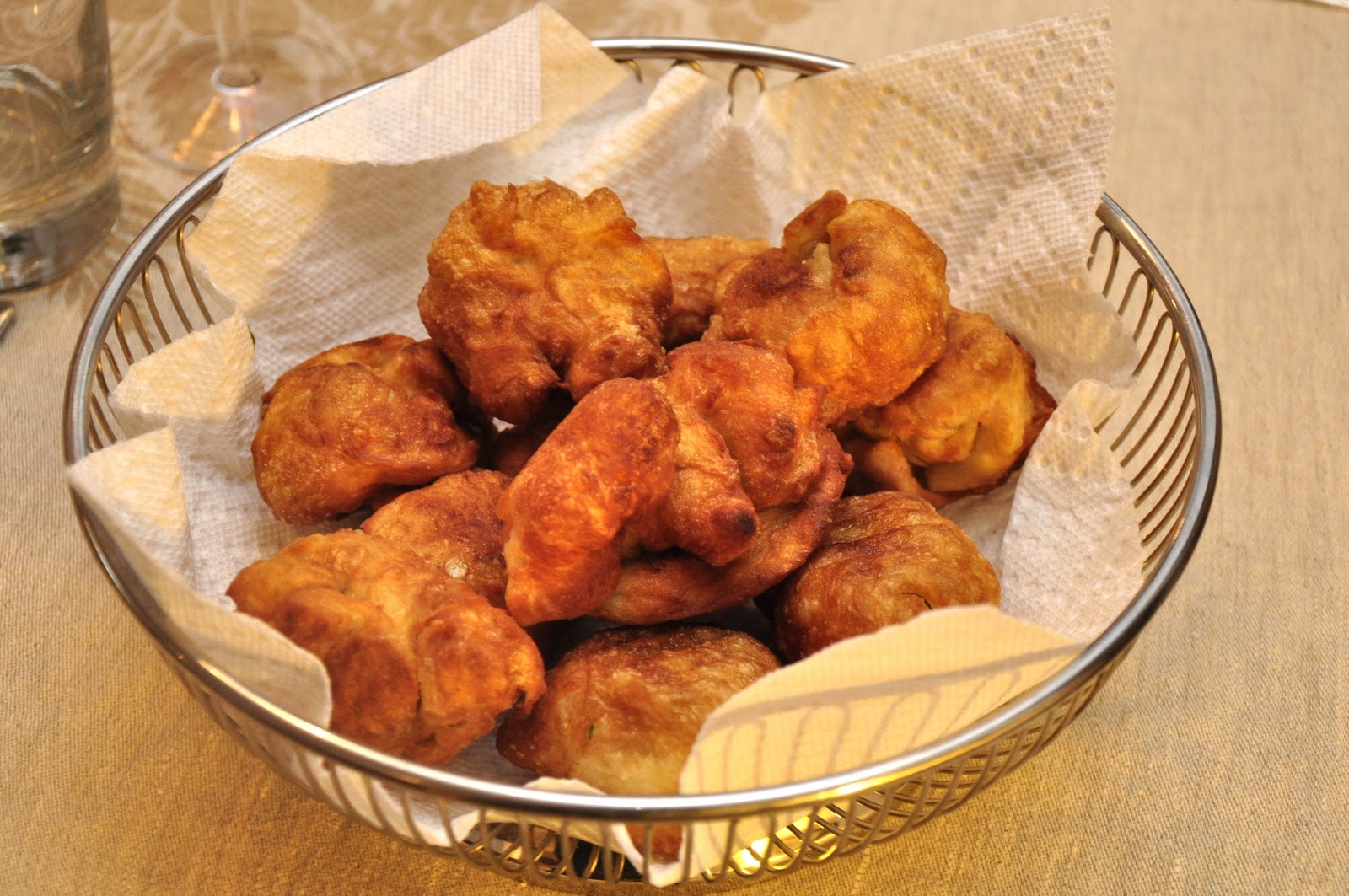
Zeppole can be sweet or savory. Angelina would make the savory variety. Simply make a regular batch of pizza dough (see my post on Angelina's pizza casereccia for the recipe) and, grabbing a walnut-sized ball of dough, make a well in the middle of the ball with your finger and place a single anchovy fillet inside. Then bring the sides around the fillet to cover the well and form a nice ball. You may need to roll the dough around in your hands a bit to make sure the opening is well sealed. Continue in the same fashion with the rest of the dough.

Now fry them gently in olive oil, or a mix of olive and canola oil, until they are nice and golden brown on all sides. It will take no longer than five minutes or so. Regulate the temperature so they do not brown too quickly, before the insides have a chance to cook. They will swell up as they fry, which is exactly what you want. Drain them on paper towels or on a rack.

Zeppole are really best eaten right away, but you can keep them warm in a slow oven, on a baking rack placed over a cookie sheet, or even reheat them later. They will lose a bit of their crispiness but none of their goodness.

NOTES: There seems to be some confusion, let's call it, about the name these little guys. That's not surprising, since it is common in Italian cooking, which is still highly regional, for the same dish (or with slight variations) to change name from region to place to place. According to Neapolitan gastronome Jeanne Caròla Francesconi, the 'official' name for what Angelina—and many others—call zeppole is pasta cresciuta, with the name zeppole reserved for the sweet variety. Readers have told me that they would call this dish pettole, which is apparently the name given to them in Puglia and Basilicata. Other there are still other names, depending on where you go: sfingi, fritelle... Well, this being Angelina's blog, I'll keep calling them zeppole.

The more common sweet version of zeppole are usually filled with crema pasticcera or sweetened ricotta mixed with some chocolate bits, or just the dough. Sweet zeppole dusted with confectioners' sugar before serving. Of course, all kinds of other fillings, both sweet and savory, make for many variations. Without a filling, they can be shaped into rings rather than balls. Some variations are made from choux pastry and baked. But these savory, anchovy-filled fried zeppole are the ones I remember from my childhood and will always be my favorite.

Zeppole are traditionally eaten in Naples on St. Joseph's Day, March 19. In Rome a very similar fried pastry is, in fact, called bignè di san Giuseppe and eaten the same day. But apparently in other parts of Italy, such as Calabria, zeppole are traditional around New Years, which makes them timely around now. But, honestly, these are so good you won't want to limit your zeppole making to one time of year. 

A wonderful snack food, zeppole can also be used as a kind of antipasto, either alone or as part of medley of different offerings. Just remember to make enough: like potato chips, no one can eat just one!

Post-scriptum: One reader (my mother!) informs me that, yes, Angelina also made the sweet variety of zeppole, too. Funny I don't remember that too well. But then, I was an unusual child in that I didn't have a sweet tooth. I would eat sweets, of course, if there were given to me, but I didn't seek them out. Nor, apparently, did I find them all that memorable. 

Friday, November 5, 2010

Fried Catfish


While Italian or other European dishes appear on our table most days, once in a while I do like to cook a dish from the New World, too. American food has a less than stellar reputation abroad. For many Europeans, it usually brings to mind junk food, fast food and just plain bad food. The stereotype is not totally unjustified—like many stereotypes there is some truth behind the caricature—but what most non-Americans and even a lot of Americans don't realize is that the US does have its own repertoire of wholesome, authentic traditional dishes. And not all of them are heavy, either, like this simple but tasty Southern dish: fried catfish.

In this recipe, catfish fillets are simply dredged in seasoned cornmeal and fried in vegetable oil. Since catfish, a bottom-feeder, can have a slightly gritty flavor, it benefits from pre-soaking in buttermilk (or just plain milk) before frying.

Ingredients (for 4 servings)

4 catfish fillets
Buttermilk (or milk) to cover the fillets
Cornmeal for dredging
Salt and pepper
1-2 tablespoons of Old Bay seasoning (optional)
Vegetable oil
Lemon wedges (for garnish)

Directions

Place the catfish fillets in a wide bowl and cover with the buttermilk or milk. Let it soak for about an hour (although even 30 minutes will improve the flavor).

Remove the fillets from the milk and dredge them in the cornmeal. Pat them on both sides to make sure the cornmeal coating adheres well.

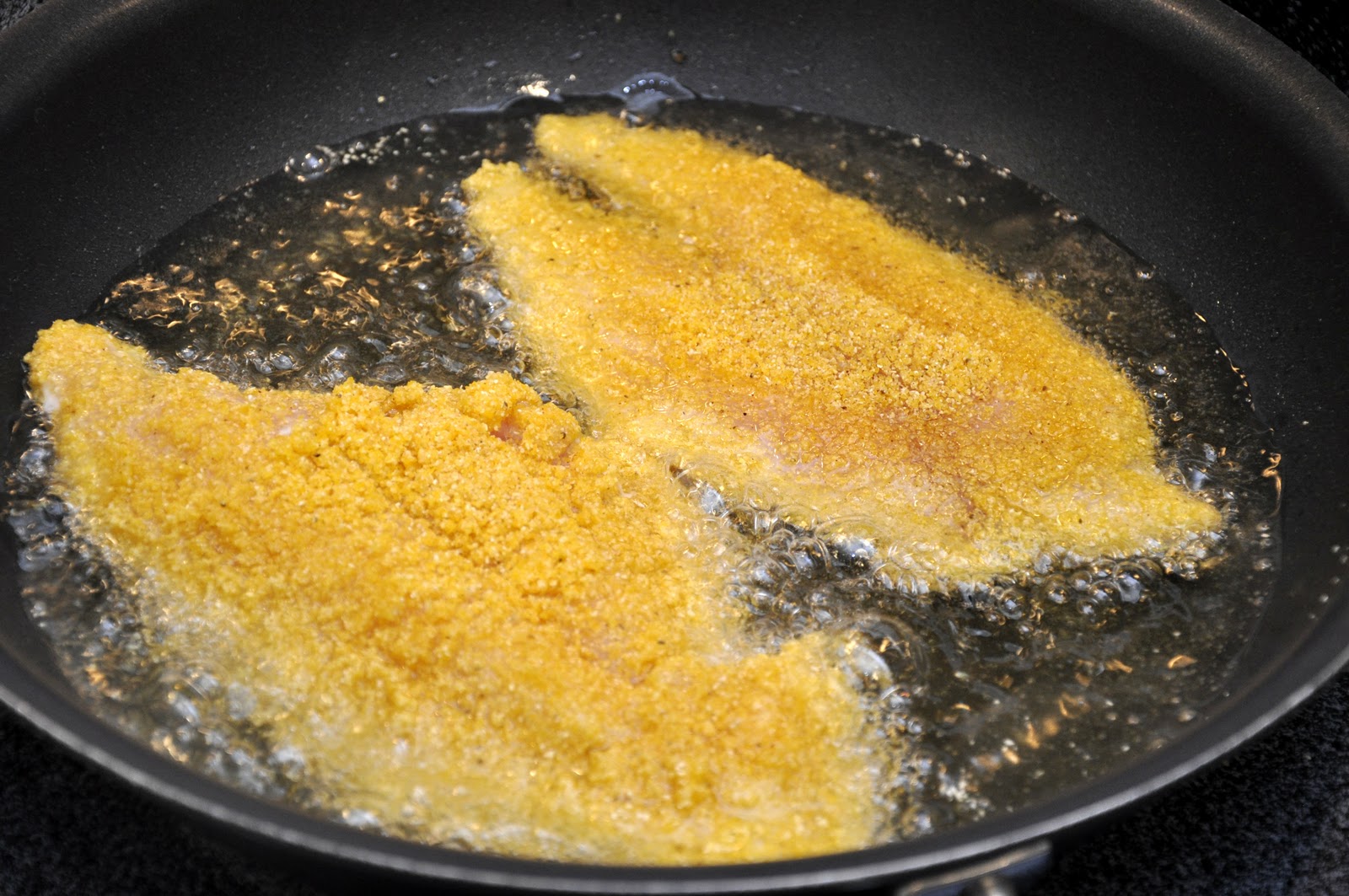
Fry the fillets in about an inch of moderately hot oil, about 5 minutes per side, until nice and golden brown. Serve hot with lemon wedges.

Lively but gentle bubbling is a good sign...

NOTES: As you can see, the recipe is simplicity itself. Like all frying, though, you do need to take care to regulate the temperature of the oil: too hot, and the coating will brown too quickly or even burn, not hot enough and your fish will turn out greasy. Your temperature is right when the oil bubbles in a lively but gentle fashion around the edges of the fillets.

The simplest recipes call for seasoning the cornmeal with just salt and pepper, but living as I do on the shores of the Chesapeake Bay, of course I add a dash of Old Bay seasoning. Many southern recipes I've seen, on the other hand, call for Lawry's Seasoned Salt, cayenne pepper, paprkia or Cajun seasoning. Some recipes will tell you to mix flour with the cornmeal and/or add some baking powder, which I assume will give you a 'puffy' crust—although I have yet to try it.

The frying medium, too, can vary. While most recipes call for vegetable oil of some type, you will see recipes that use butter or another kind of oil (even olive oil, which I assume is a modern adaption) or—and I tend to think this is the most traditional—bacon drippings. Many (perhaps most) recipes call for deep frying but I think shallow-frying works just as well.

I like simplicity, so for me this dish needs nothing more than some lemon wedges as garnish, but, of course, some people will want to use 'tartar sauce', a combination of mayonnaise, capers, and finely chopped pickles and shallots (or onions). As a side dish, to keep it simple, I find a rice pilaf goes very well, followed by a simply dressed green salad. More classic accompaniments include 'hush puppies', deep-fried cornmeal beignets, braised collard greens and—what else?—macaroni and cheese. Any of these will make for a much more substantial meal.

Sunday, August 22, 2010

Pollo fritto alla toscana


Is there anyone who doesn't like fried chicken? Nice and crispy on the outside, tender and juicy on the inside… I can get hungry just thinking about it!

Tuscans have a particularly savory and simple way to fry chicken: you cut up a young frying chicken, called a pollo novello in Italian, into smallish pieces, making sure to cut the breasts in half and split the thighs from the drumsticks. If you like, you can bone the pieces, which is relatively easy to do when the chicken is cut up.

You then dredge the pieces lightly in flour, then in beaten egg and shallow-fry them in olive oil over moderate heat. When they are nice and golden brown, season them with salt and serve them right away, with lemon wedges if you like.

And that's all there is to the basic recipe! It could hardly be simpler.

NOTES: Of course, this kind of simplicity relies on the best quality ingredients for success. The chicken, in particular, needs to have great flavor. Modern chickens, as we all know, can be pretty flavorless, so if you're not working with a fine, organic free-range chicken you are confident about, although it is not part of the original recipe, you may want to marinate the chicken beforehand. My favorite marinade for chicken includes salt, pepper, a finely chopped garlic clove, chopped fresh rosemary, freshly squeezed lemon juice and a good splash of olive oil. Leave for an hour or so before proceeding with the frying.

You can use pre-cut chicken pieces, of course, which saves time. This time, I happened to have some chicken 'tenders' (cut up and boned chicken thighs) on hand, and they worked very well indeed.

The main alternative to this version of Tuscan fried chicken is to substitute a pre-made batter for the usual flour and egg. The batter is made with flour, salt, olive oil and egg, then thinned out with some white wine. It needs to rest for an hour or two before using. You can also add some seasoning to the beaten egg, some grated cheese, chopped parsley, salt, pepper, although these additions are definitely heterodox. In fact, many traditional recipes admonish you not even to add salt to the egg, but to salt the chicken when serving, to keep the batter crisp and the tastes 'clean', in true Tuscan style.

In Italy, fried chicken is typically accompanied by fried vegetables appropriate to the season. For this meal, some nice fried zucchine 'sticks', dipped in the same flour and egg, went very nicely. And you can add to that other fried meats, typically chicken and calves' brains, for a fritto misto.

The trick to making fried chicken lies in maintaining the oil at the right temperature while you fry. If the oil is too hot and the chicken will brown before it is fully cooked inside; if it is not hot enough, the chicken will turn out a greasy mess. Keep your flame moderate, adjusting it up or down as needed while the chicken fries so that the oil bubbles up around the chicken pieces in a lively but not furious manner. If you have any doubts about the chicken being fully cooked, you can pop them in a hot oven for a few minutes as well—which you should do anyway to keep the chicken warm if you need to fry in batches, or to keep the chicken hot while you enjoy your first course. I find a rack is perfect for the task; it allows the hot oven air to circulate around the chicken pieces, ensuring they stay nice and crispy.


Pollo fritto alla toscana is, in fact, very similar to—albeit a bit more austere than—the Jewish-style fried chicken for Hannukah that I blogged about back in December. 

Friday, February 12, 2010

Angelina's Fried Vegetables


I was feeling sort of nostalgic today for the fried vegetables my grandmother used to make. They were almost always the start of our family's six-hour Sunday dinners, laid out (along with a big wedge of provolone) on the table to pick on as we played cards and waited for the main event. Hmmm, they disappeared fast! There's a saying in Italian: fritte son bone anche le scarpe, even shoes taste good when they're fried. And it's so true.

Fried vegetables are not at all hard to make, but they can be time consuming, as the various vegetables need to be peeled and cut up, then parboiled, and then fried. One way to cut down on this work is to use frozen vegetables, which respond very well to this treatment. And, in the US at least, the quality of frozen vegetables is often comparable, in some cases superior, to that of fresh ingredients (see below). Today we had artichoke hearts, cauliflower florets and asparagus, all of which come already parboiled and cut into pieces. All you need to do is let them defrost, then roll them in flour, dip them in a mixture of eggs beaten with finely chopped parsley, salt, pepper and just a bit of grated pecorino cheese. Shallow fry them gently in a mixture of olive and canola oils (or in a light olive oil) until they turn a light golden brown.

The oil should be about 1/2 inch (1 cm) or so deep, or enough to come about halfway up the pieces. Make sure that the oil is just hot enough so that it gently bubbles around the pieces as you place them into the pan. If the oil is not hot enough, the vegetables will turn out greasy; too hot and the egg batter will brown before the insides of the vegetable pieces are fully cooked. (It is a bit like making fried chicken, if you've done that.) You then drain the vegetables, either on a plate lined with paper towels or--my preferred method--on a cooling rack placed over a baking sheet to catch the oil and stray bits of batter. You'll need to fry a few pieces at a time, as many as will fit comfortably in your frying pan without crowding. (If you crowd them, they will steam, and get soggy and greasy.) Keep your already fried vegetables warm in the oven while you are frying the rest.

Sprinkle the fried vegetables with salt and serve either hot or at room temperature. I promise, they're addictive!

NOTE: The vegetables mentioned above were the ones that Angelina made most often. But other vegetables are also great fried like this, including broccoli, peppers and--my personal favorite--eggplant. In fact, this is the way you fry eggplant to make a parmigiana di melanzane, eggplant parmesan, or at least the way Angelina used to make it.

As mentioned, however sacrilegious it may seem, when I don't have access to best quality fresh vegetables, I am a fan of using frozen vegetables for this dish, especially for the ones that require parboiling and cutting up, like cauliflower, artichoke, broccoli or even asparagus. (Vegetables like eggplant and peppers, of course, are another story.) Frankly, I find that, in the US at least, frozen vegetables can equally good, if not better, than 'fresh' vegetables that have been picked before they are ripe, shipped across country and force-ripened by gas or whatever other artificial means modern industry has devised, and then left to sit on a supermarket shelf for however long. Frozen vegetables are picked at their best and freezing preserves them that way. Of course, not all vegetables freeze well. Eggplant and peppers, and summer vegetables in general, are not very good frozen. Potatoes take on an 'off' flavor when frozen. But for many other vegetables, frozen are a viable and practical alternative.

Another way to fry vegetables is to substitute parmesan for the pecorino and, after the egg bath, cover the vegetables pieces in bread crumbs. It produces a more 'refined' dish--but I like this way better. It brings me back to my childhood.

If you have any of the egg mixture left over, by the way, don't throw it out. Mix it with some breadcrumbs and pour into the pan like so much pancake batter and fry until golden brown. It's the best part!

These fried vegetables are basically a kind of vegetarian fritto misto, as befits a modest country gal like Angelina. Italian cuisine abounds in fritti misti--the 'fried course' was once a standard part of a complete Italian dinner--and there are many regional versions of the fritto misto. My personal favorite, found  in coastal areas all over Italy, is the fritto misto di mare, which we have already featured here. In Rome, they make a wonderful fritto misto alla romana with calf's brains and artichokes. In Piemonte, they make an elaborate fritto misto with many different meats, crochette and vegetables. In Bologna, the gran fritto misto features bits of mortadella, cheese, semolina croquettes and even 'fried cream' (pastry cream enriched and thickened with egg yolk). 

Monday, December 14, 2009

Pollo fritto per Chanukà


Continuing with our Italian Hannukah dinner, after the first course of riso coll'uvetta, proceed to the second course of chicken which is, of course, fried in olive oil. This dish is popular in Rome and all over Italy for Hannukah.

The day before, cut up your chicken into ten pieces (two wings, two drumsticks, two thighs, and the breast cut into four pieces, in half along the breastbone and then in half again across). Place in a large bowl and marinate with the juice of a whole freshly squeezed lemon, salt, pepper, a finely minced garlic clove or two, a generous grating of nutmeg (very unusual!) and a good pour of olive oil. Let it marinate in the fridge overnight. Mix at least once during this period to ensure even marination.

The next day, when you are ready to cook, let the chicken come back to room temperature by removing it from the fridge about an hour ahead of time. In a large, heavy skillet, heat enough olive oil to come at least 2cm (3/4 inch) up the sides until it is quite hot (but not smoking). Then take each piece of chicken (tongs are very useful here) and dredge it successively in flour and then in beaten egg, and then immediately into the hot oil. Fry over moderate heat until the chicken is golden brown on all sides. This should take about 15-20 minutes. If you are not ready to eat the chicken right away, you can keep the pieces warm, on a baking rack set over a cookie sheet in the oven.

Serve hot, sprinkled with additional salt (preferably some fine sea salt) with some lemon wedges on the side, and accompanied by a nice green salad.

NOTES: The dish is not at all difficult to make and, aside from the overnight marination, is quite quick. For the really impatient, some recipes say that one hour's marination is enough. The main 'trick' of this dish is to regulate the heat of the oil so that the chicken pieces cook at the right pace—not too slow, or the result will be greasy, but not too fast, either, or the outside will brown before the inside is cooked. If the oil bubbles up gently around the edges of the chicken pieces as you are frying, but does not 'boil', then you are on the right track:


It also helps to use a small chicken, so that no piece is too large and will cook through in a shorter period of time. If you are serving a crowd, you may want to buy more than one small chicken rather than one big one. If, for whatever reason, it seems that the chicken is done on the outside but not yet cooked through on the inside, a brief spell in a moderately hot oven will help.

I have to say, this dish was quite a revelation. The taste was hard to describe—both familiar as an Italian dish yet somehow... different. Among other things, the nutmeg gave it an usual, almost 'oriental' taste. But it was very good. In fact, even after a primo of riso coll'uvetta, two of us managed to polish off a whole chicken...! Dessert, on the other hand, was just a few pieces of fresh fruit.

By the way, I wanted to include a third recipe this week, one for what is probably the most famous Italian Jewish, and more specifically Roman Jewish, dish—carciofi alla giudia, or Jewish-style artichokes. It is one of the signature dishes of Roman cuisine. But the artichokes in the market looked pretty sad, so I gave up for now. But perhaps later on this week or, if not, in the Spring when artichokes will be back in season.


Thursday, August 13, 2009

Angelina's fiori di zucca ripieni e fritti


Summer is here and along with an abundance of zucchini in my folks' backyard garden has come a treasure trove of zucchini flowers. Here is the way Angelina would make them, stuffed with mozzarella and anchovies and fried in a light flour-and-egg batter.

Take your zucchini flowers and cut off the stem. Clean them gently with a towel and then gently open them up just enough to allow you to reach in and remove the pistil. Be careful not to damage the delicate petals--and try not to separate them if you can, but it is no disaster if the flower opens a bit, as the batter will keep the flower together.

Take a small bit of mozzarella and stuff it into the flower, then a bit of anchovy, then another bit of mozzarella. (Obviously, we are talking about very small bits here that can fit inside the flower!) Then close the flower up, pressing it together gently with your hands, and pass it through flour and then an egg-and-cheese mixture as explained in the recipe for Angelina's Fried Vegetables.

Fry the zucchini flowers in light olive oil until golden brown. Drain them on paper towels or on a baking rack and serve still warm, sprinkled with salt and accompanied by lemon wedges.

NOTES: These fried zucchini flowers can be eaten on their own as an antipasto or as a delicious snack, or or with other fritti as a secondo.

If you are using zucchini flowers from your garden, be aware that you should use the flowers that grow on a stem. The flowers that grow at the end of the zucchini themselves can be used in a pinch, but they will not be as flavorful, and they will have a hard end (where you cut off the zucchini) that will be less edible. And be careful as you open the flowers--you may find a bee or other insect inside!

While I would venture that mozzarella and anchovy is the most common stuffing for zucchini flowes, as with other stuffed vegetables, there are variations: ricotta and ham, ricotta and mozzarella, capers instead of or in addition to the anchovies, mortadella and fontina, tuna mousse... the possibilities are endless, but the inclusion of some sort of soft cheese that melts and binds the stuffing together seems to be a constant.

And, of course, it is possible to enjoy zucchini flowers fried without any stuffing at all. They are very tasty on their own. The flavor is really unique and hard to describe.

The frying method can also be varied--the most common variation being dipping the flowers into an actual pastella, or batter, of which there are many versions, giving a lighter or heavier texture depending on the ingredients. (One of these days, I will do a post on different batters.)

Fried Zucchini Flowers With Alici E Limone on Foodista

Monday, July 13, 2009

Mozzarella in carrozza


What could be more primordially satisfying than the combination of bread and cheese? Well, frying them together makes them even more satisfying. And if you add a bit of anchovy to the mix well, you're in heaven!

Mozzarella in carrozza, literally "mozzarella cheese in a carriage", is one of the rustic glories of Neapolitan cuisine. It's a kind of savory French toast, or a kind of grilled cheese sandwich, only fried. You take slices of bread, remove the crust, then place a slice of mozzarella cheese between two of the bread slices. You dip this 'sandwich' in milk until nice and moist, then in flour, then beaten eggs seasoned with salt and pepper, making sure it is well impregnated with the egg. (It helps to have each of these lined up in separate dishes or bowls.) Then fry each sandwich in light olive oil on each side over moderately high heat until golden brown--a few at a time so that you don't crowd the frying pan. Drain them on paper towels or, even better, on a baking rack while you are frying the rest. When they're all done, sprinkle them with salt and serve immediately.

Mozzarella in carrozza is traditionally served just like this, perhaps with a lemon wedge. But I like to gild the lily by serving them with a bit of anchovy sauce on the side: you empty a tin of anchovies with their oil in a saucepan over moderate heat. Stir until the anchovies have broken up and are sizzling, then add a tablespoon or so of water. The anchovies will almost instantly form a smooth sauce. Add finely minced garlic (a garlic press works well here) and parsley. Stir once, then remove from the heat immediately.

NOTES: The dish is actually fairly easy to make., if a bit messy. The only trickiy part is making sure the sandwiches don't fall apart in the frying process. First, make sure not to overstuff the sandwiches with cheese. If you do, the slices of bread will not make contact and adhere one to the other. Then you need to make sure that the egg--which will bind the bread slices together--impegnates the bread well. Then allow the sandwich to fry until golden brown before turning it over:this will 'set' the egg. Finally, turn the sandwiches carefully, using a flat spatula and a fork or spoon to support the sandwich as you turn it. Then let it cook thoroughly on the other side.

There are various ways to dip the sandwiches. The ingredients are always the same: milk, flour and seasoned egg. But some recipes call for mixing the egg and milk together: you dip the sandwich in the egg and milk, then in the flour, then back in the egg and milk. Or, you can actually mix all three ingredients to make a kind of batter--or pastella, as they call it in Italian, in which you dip the sandwiches. See which way suits you best.

There are some variations. You can add an anchovy filet on top of the mozzarella as part of the 'stuffing' or you can add a slice of ham. In either case, omit the anchovy sauce, which would be redundant in the first case and discordant in the second.

Mozzarella in carozza is usually thought of as an antipasto, but I find it satisfying enough to serve as a piatto unico, or one dish meal. Follow it with a green salad and some fruit. Accompany with a robust wine, either white or red.

Mozzarella on Foodista

Thursday, July 2, 2009

Fritto misto di mare


There's a saying in Italian: fritte son bone anche le scarpe, meaning "even a shoe tastes good when it's fried". Well, I couldn't agree more--and seafood tastes especially delicious when it's fried--good enough to convince even the piscatorially challenged.

There are several different ways to make fried fish. The simplest (and my personal favorite) is simply to cut up pieces of seafood and lightly coat them in flour seasoned with salt and pepper (and, if you like, a bit of paprika for color). Then deep fry them --I like to use light olive oil--until golden brown. The fritto misto pictured above was made with a light batter of flour, olive oil and enough water to make a cream-like mixture. Some batters call for adding egg to the batter, which you can add whole or, if you want to get fancy, add the yolk and then (just before frying) fold in the egg white, which you will have whipped into a foam. Egg batters, however, especially if you whip your egg whites, will be quite thick. You need to let any batter sit for about an hour before using. Make sure you're seafood is quite dry before coating with your batter, or the batter will tend to slip off in the frying.

How much you fry is a matter of taste. I like my fried foods 'medium', neither very dark nor very light. But follow your own preference. The main trick to frying is the correct temperature. You want the fish to fry until it is entirely cooked (but not overdone) inside and nice and crisp outside. If you fry the fish at too high a temperature, it will brown on the outside before it is fully cooked inside (although this is less of a problem if you cut the fish into small pieces). Conversely, if you cook the fish too slowly, it will tend to get soggy and greasy... and some seafood like calarmari will become quite rubbery if it's not cooked quickly. As in so many things culinary, practice makes perfect.

Sprinkle your fritto misto di mare with salt and serve with lemon wedges. It is important to serve fried foods as soon as possible after they're done, while they're still nice and hot and crispy. As they say in Naples, frijenno e magnanno--which, loosely translated, means "fry it and eat it!"

Finally, for the choice of seafood. The mixed fry pictured above features shrimp, calamari and scallops--a wonderful combination. In Italy, whole small fish (such as fresh sardines or the tiny fish known as paranza, which I have never found outside Italy) are also typically included. Small crabs (or even better, soft-shelled crabs) make for wonderful additions as well. But let your own taste be your guide.