Showing posts with label cheese. Show all posts

Saturday, July 31, 2010

Tonnarelli cacio e pepe


 Cacio e pepe, literally 'cheese and pepper', is a very typical Roman dish, usually made with spaghetti, bucatini or—for the ne plus ultra version of this dish—tonnarelli, a kind of square spaghetti made with egg pasta popular in Lazio and Abruzzo, as well parts of  Molise, Puglia and Le Marche. At its simplest, literally all you do is boil the pasta in well salted water, drain it (but not very well) and pour it into a heated bowl. Then add a generous amount of pecorino cheese and lots of freshly ground pepper, and mix well. The hot water that clings to the pasta should meld with the cheese to make a kind of creamy sauce. If the dish is too dry, you can add a bit more of the pasta water. If, on the other hand, you can still see water at the bottom of the bowl, add more cheese. Then top with more pecorino and another healthy grinding of pepper. That's it!


 NOTE: Like many simple dishes, cacio e pepe is easy to make passably well, but hard to master. You need to mix the pasta quickly but thoroughly, making sure that the cheese melts properly into a cream rather than clumping up into bits. The key is to balance water and cheese—and that can only really be done by eye as you mix. What I like to do is to keep a generous amount of grated pecorino on hand, about half as much as there is pasta by weight, and use as much as I need. Any leftover cheese can be sprinkled on top or kept for another use. But as often is the case with this sort of thing, no amount of coaching will substitute for practice, practice, practice.

There are some other ways to make cacio e pepe. A common modern variation, a bit more elaborate but less tricky than the traditional method, is to mix cheese and pepper with pasta water in a separate skillet and allow that to meld together over gentle heat until it forms a creamy sauce that you pour over the pasta. Some recipes also recommend adding a bit of butter or un filo d'olio before (or after) you mix the pasta, for a creamier texture. And finally, some people mix pecorino with the milder parmigiano-reggiano. To me, however wonderful parmigiano is, the salty 'bite' of pecorino is one of the attractions of the dish, so I wouldn't dilute it with anything else. But, as they say, les goûts ne se discutent pas. If you like the idea of any of these variations, by all means try them and let us know how you like them!
 
*             *               *
 
On making tonnarelli: 

In Rome, pre-made tonnarelli are sold in any supermarket but elsewhere, you may find you have to make them yourself. That makes this dish considerably less quick, of course, but I think it's worth the extra effort. Tonnarelli really are the best pasta for this dish—being an egg pasta, it absorbs the sauce more readily than either spaghetti or bucatini. At the same time, due to its thickness (and the optional use of semolina flourt) it provides more 'bite' than your average fresh pasta. 

To make tonnarelli, you need a special instrument called a chitarra, or guitar, which is why tonnarelli are also called spaghetti alla chitarra. Here's a picture of a pasta 'guitar': 


The guitar is fitted with wire 'string's top and bottom that are used to cut the pasta. The strings are narrowly spaced on one side, and widely spaced on the other. For tonnarelli, you want to use the side with the narrowly spaced strings. 

To begin, make some fresh pasta dough in the usual way—adding just a tablespoon or two of semolina flour per egg if you like for extra 'bite'—and roll it out quite thick. The pasta should be as thick as it is wide, so you can be guided by the strings of your 'guitar'. (Using a KitchenAid mixer attachment, use Setting 1 or 2.) Let the pasta sheets dry out for a good while (at least 20 minutes) so they will not stick too much as they are cut by the guitar. 

Cut your pasta into sheets about as long as the chitarra, leaving some room on each end for the pasta to stretch out, which it will as you proceed. 
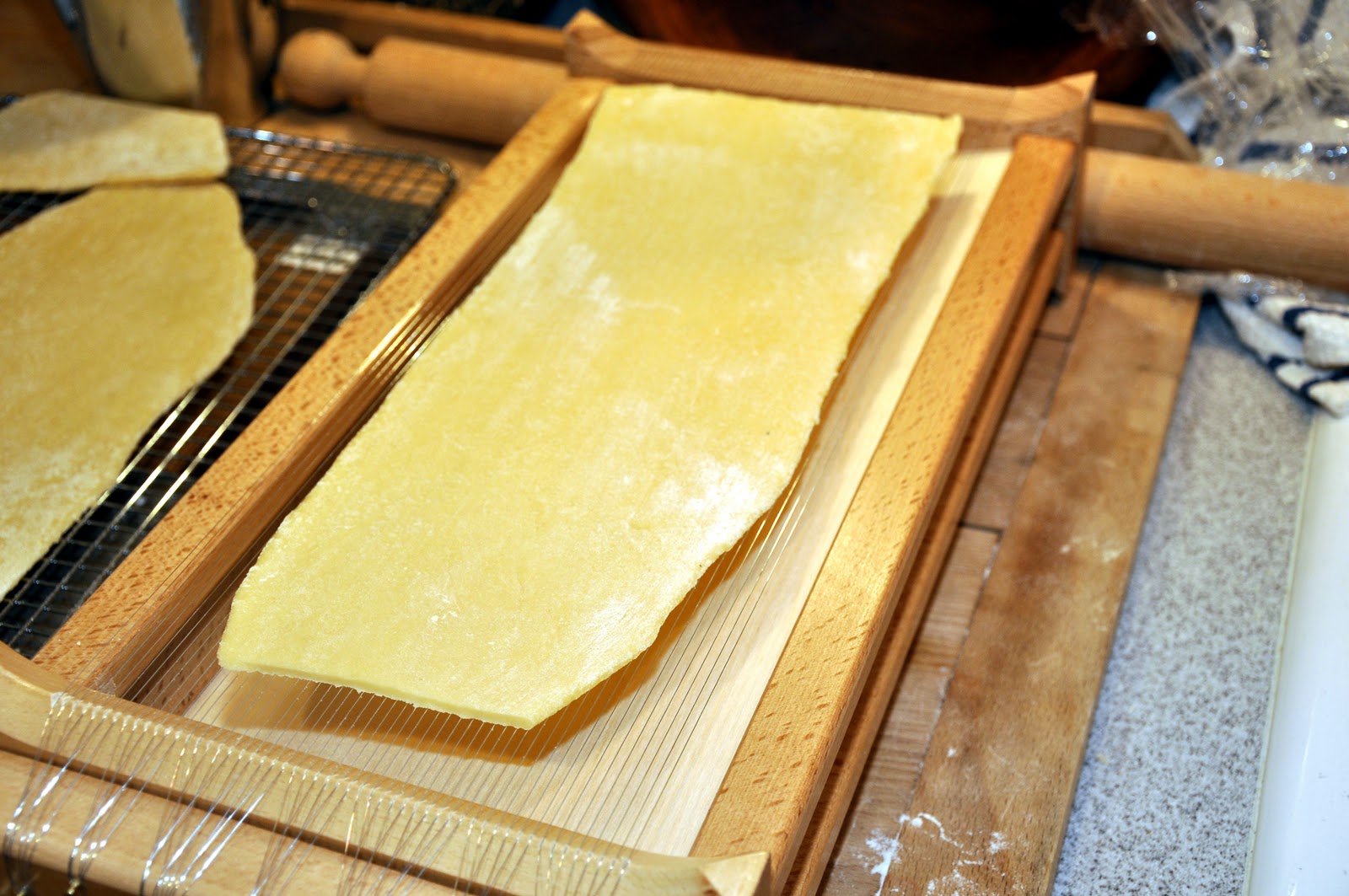

Then, with a rolling pin, begin to flatten the pasta against the strings.


Very soon, the pasta will have passed between the strings, but will still cling to them, so that they will show flush with the pasta like this:
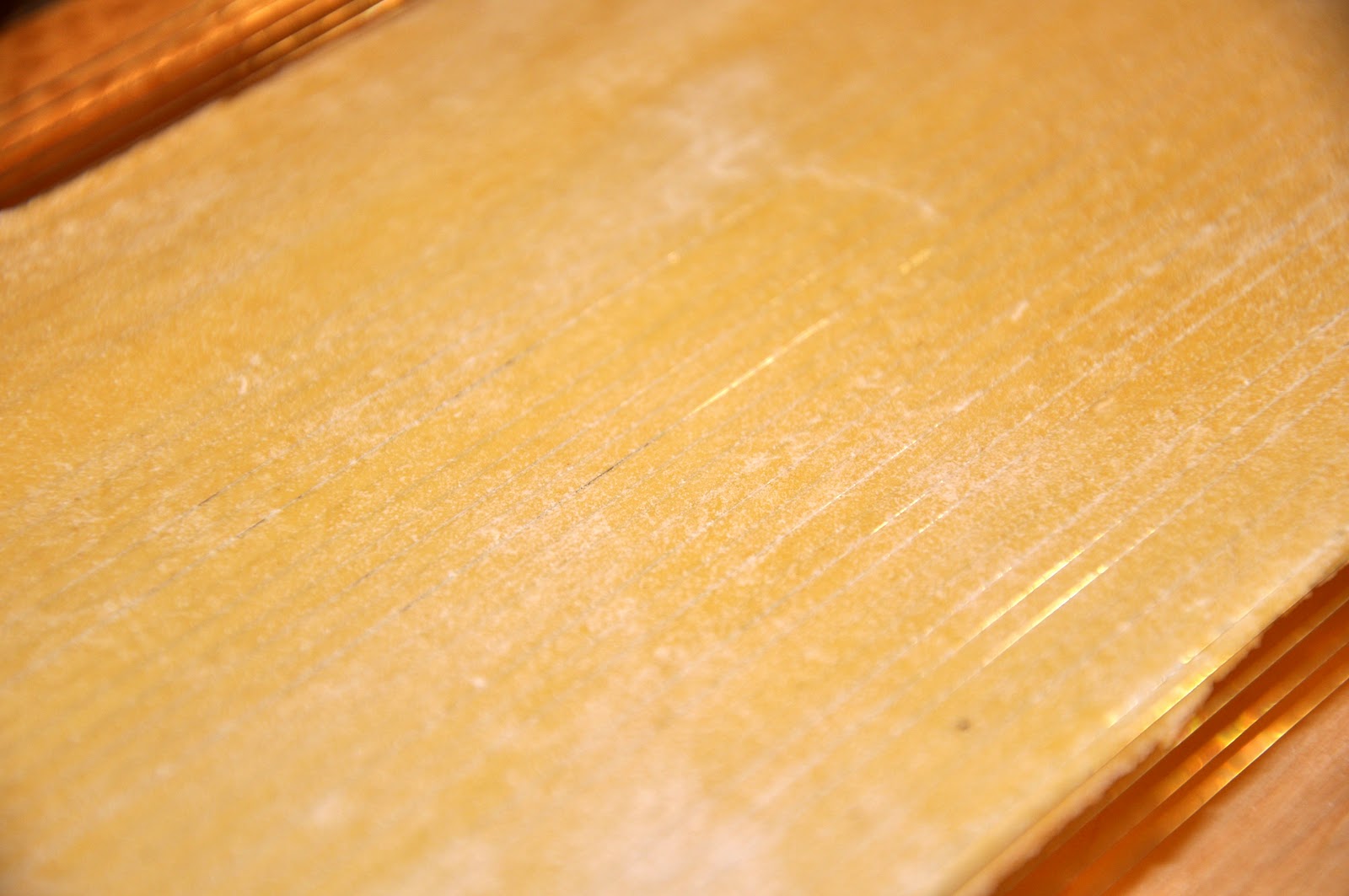

Now it's time to 'play' your guitar. Run your fingers along the length of the strings until the pasta begins to detach from the strings:


Continue playing your guitar until the pasta has detached completely and fallen into the tray below: 
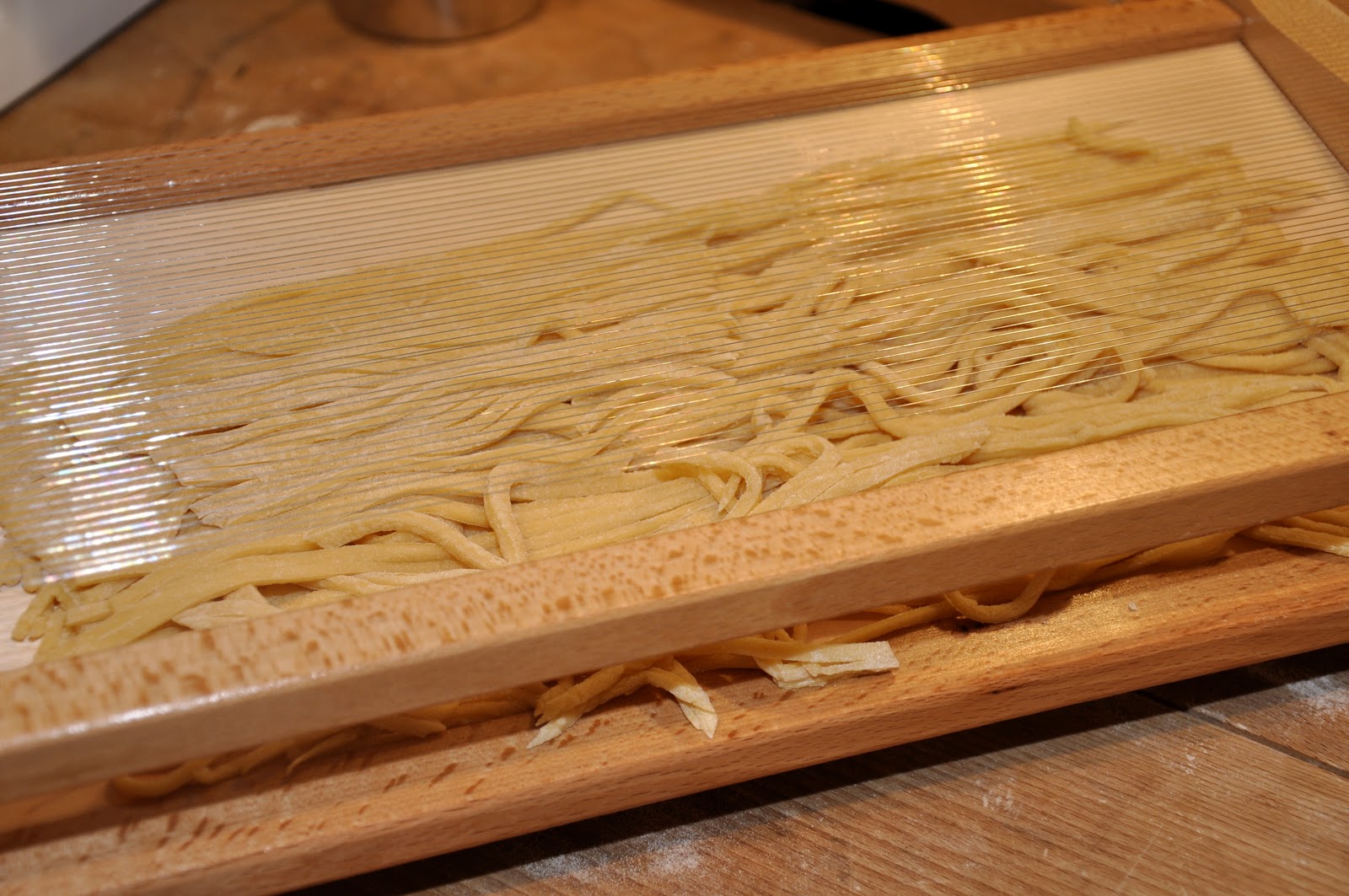

Slide the tonnarelli out of the chitarra and lay them out to dry on a wooden board or towel. Repeat the operation with each additional pasta sheet. (NB: Depending on how dry the pasta sheets are, you may need to separately some of the strands by hand.)

Due to its thickness, tonnarelli take a bit longer to cook than other kinds of fresh pasta, as long as 5 minutes or more depending on how long it has been drying.

NOTES:  Tonnarelli as sometimes made exclusively with hard durum wheat flour (semolina) and sometimes just with "00" flour, which changes the character of the pasta considerably. I prefer neither 'extreme' and use mostly "00" (or simply all-purpose) flour with just a spoonful of semolina. 

Besides their use in the Roman classic cacio e pepe, in the cooking of Abruzzo,  spaghetti alla chitarra (as tonnarelli are called there) are typically dressed with a lamb-based ragu.' Tonnarelli are also very good with shellfish sauces. Indeed, they are extremely versatile and lend themselves to all sorts of sauces and condiments. 

De Cecco makes a dry pasta version of spaghetti alla chitarra, which is available through amazon.com. I have not tried it, but I have to imagine that the dry version, while surely good, will not give the same results as the fresh.

Saturday, May 1, 2010

For a May Day Picnic: Fave e pecorino


Fave e pecorino is not really a "dish" at all, you just set out the fava beans, in their pods, and a hunk of pecorino cheese. Each diner opens the pods for themselves and eats the raw fava beans they find inside with a bit of pecorino, washed down with a well-chilled dry white wine. Odd as it may sound, it is a combination that was just meant to be. 

Romans traditionally eat fave e pecorino on May 1, preferably while they picnic fuori porta, or literally 'outside the gate' meaning outside town. Romans will pick up and find any green spot (even city parks if they can't get out of the town) to set out their picnic lunch. When we were living in downtown Rome close to the Campo dei fiori, we'd often go up the Gianicolo, a high hill just across the river, for our May Day picnics. When we moved to a country setting on the outskirts of town, we could just sit outside on the terrace; and we would often come across strangers picnicking down the hill from our house!

If you want to get fancy, you can de-pod and shell the fava beans, cube the cheese and combine the two with a bit of oil, salt and pepper to make a salad. That is how I had this once in a tony restaurant in Florence. But personally I like the rustic informality of eating the raw ingredients.

Fava Beans on Foodista

Monday, January 18, 2010

Pizzoccheri alla valtellinese


Nothing says 'winter' to me like this Alpine buckwheat pasta dish oozing with melted cheese and winter vegetables, a typical dish of the Valtellina in the uppermost stretches of Lombardia, a fairly narrow valley region running northeast from the Lago di Como along the border with Switzerland.

You make the pizzoccheri as you would any fresh pasta, but using 2 parts of buckwheat flour to one part regular wheat flour. (Buckwheat flour lacks gluten and needs some help to form a workable dough. Some recipes call for less regular flour, but the 2:1 ratio works well for me.) I use egg (and a bit of water) to bind the dough, but the original recipe (see below) calls for water only. You roll out the pasta rather thicker than other kinds of fresh pasta (I use setting "3" on my KitchenAid pasta roller) and let the rolled pasta sheets dry on a towel. Once dry enough, cut the sheets into strips, as wide as fettuccine or tagliatelle, say about 1 to 1.5cm (1/2 inch) wide and about 5-7 cm (2-3 in) long. Allow these little strips to dry out further while you prepare the rest of the dish (see photo above).

While your pizzoccheri are drying, prepare the vegetables that will accompany them, typically potato and a leafy winter vegetable, most often Savoy cabbage. Slice or cube the potato, as you prefer (I like them sliced) and immerse them in cold water. Shred your cabbage and add it, too, to the water. Instead of Savoy cabbage, you can also use spinach, swiss chard leaves or—as I did this time when I couldn't find Savoy cabbage at the market—coste, or the stalks of swiss chard, trimmed of their leaves and cut into lengths about the same size as the pizzoccheri. Precise proportions are not critical in this kind of dish, but I like to use about one smallish potato and say 100g (4oz.) of leafy vegetable per serving. Bring a large pot of water to the boil, salt generously, and add your vegetables.


While the vegetables are cooking, melt a nice big piece of butter—at least 50g/2oz. per serving to which you add a clove or two of garlic and a sprig of fresh sage. Allow the garlic and sage to simmer very gently in the melted butter until the butter is infused with their flavors. Do not allow the butter to brown; the garlic should brown, if at all, only slightly. Remove the garlic and sage when you're done.


While the butter is simmering, either slice or shred some mild, semi-soft cheese, the most classic choices being the local cheeses bitto or Valtellina Casera. But since these cheeses are hard to find, even in Italy, outside their zone of production, fontina is often substituted. And if you can't find fontina, I'd recommend staying in the Alps and using either Gruyère or Emmenthal. Grate about half that amount of parmesan cheese or grana padano. I like to use a lot of cheese as well, say 50g/2 oz. per serving, although you can use much less if you prefer a lighter dish.

After the vegetables have been boiling for about 5 minutes, add your pizzoccheri and lower the heat a bit and continue cooking for another 5-7 minutes. Pizzoccheri take surprisingly long to cook for a fresh pasta—if you taste after about 5 minutes, you may see that although the pasta is already al dente, there is a raw quality to it, due to the particular qualities of buckwheat.


While the pizzoccheri are cooking, warm a serving bowl in the oven. When you are ready to serve, take your serving bowl out of the oven and, fishing them out of the water with a large slotted spoon, add a layer of well drained pizzoccheri and vegetables, then top with some of the cheeses, seasoning if you like with salt and pepper:


Working quickly, repeat until you have used up the ingredients, then pour over all the melted butter (which should be hot). This will partially melt the top layer of cheese. Then toss to mix the ingredients (don't overdo it) and serve immediately, while the pasta is still hot.  


NOTES: There are various theories about the origin of the rather odd name of this pasta. According to some, 'pizzoccheri' comes from the local dialect word piz, meaning a 'little bit'. Others say it comes from the verb 'pinzare' or to pinch, others from the dialect word bizzo, meaning a mouthful. Buckwheat, by the way is called grano saraceno—Saracen grain—in Italian. It was introduced into the Valtellina in the early 1600s, it would seem (judging from the name) having come from the Ottomans, although the historical record is apparently very sparse. These days, local production has practically disappeared and most buckwheat in Italy is imported from China. Russia and the US are also major producers.  Besides pizzoccheri, buckwheat is used to make another typical dish of the Valtellina called sciatt, a kind of fritter.

The Valtellina is these days a popular tourist destination, known for its excellent skiing and other snow sports but also for thermal spas. (I rather like the idea of soaking in a hot spring surrounded by snow-peaked mountains!) Pizzoccheri are said to come from one of the larger towns in the valley called Teglio, where they have established an academy dedicated to this dish. The Academy has established an 'official' recipe, which you can read here, which is a bit different in some details from the recipe given above. In particular, the Accademia recipe calls for cutting the pizzoccheri much thinner (the recipe says 5mm, although I wonder if that isn't a typo; perhaps 50mm or half a centimeter was meant.) In addition, 'real' pizzoccheri are made only with flour and water, no egg. The addition of egg is a common modern heresy, however, as it makes the pasta easier to work with and improves the texture. Some modern recipes also call for a bit of milk, rather than water, to round out the dough. Marcella Hazan, in her Essentials of Italian Cooking, has a recipe for pizzocheri that calls for a short baking period just before serving to warm the pasta and melt the cheese. It's not a technique that I've found from any other source, but not a bad idea. The result is a bit more 'solid', if I can use the term, than the traditional method outlined above.

Although originally a very local specialty, pizzoccheri have become popular all over Italy, and can be bought in a box like any other pasta, which make them very easy to make. (Here's a video of them being made in a factory.) I have not found them sold commercially outside Italy, so you'll have to make your own. Not such a terrible sacrifice, however, as they are actually quite easy to make. But the dough does take a bit of getting used to, as it is not nearly as pliable as normal pasta dough, even with a fair amount of wheat flour. Knead the dough especially well to bring out the maximum amount of gluten.

Although I haven't done so, you might want to experiment with other winter vegetables. Kale, for example, could make for a nice (if unorthodox) change, regular cabbage strikes me as too tough for this dish, but might be work a try. If you use swiss chard stalks, don't throw out the leaves whatever you do! They can be used like spinach in any number of dishes—among my favorites, in padella (sautéed in olive oil) as a side dish, combined with ricotta as a stuffing for ravioli, crespelle or cannelloni, or as a dressing for pasta.


The town of Teglio, where 
pizzocheri originated.


Pizzocheri alla valtellina on Foodista


Tuesday, December 8, 2009

Tubetti cacio e uova


Here's a great spur-of-the-moment Neapolitan pasta dish for a quick weeknight dinner or perhaps a midnight snack:

Boil some tubetti (the small tube-like pasta also known as ditali or ditalini) in well-salted water. When the pasta is done, drain (not too well) and add back to the pot. Mix in a heaping tablespoon of butter or lard per serving of pasta (100g, 4 oz.) and stir until the fat has completely melted. Then add a mixture of egg (1 per serving) beaten with grated parmesan and pecorino cheese (1 spoonful each per serving), a handful of chopped parsley, and salt and pepper to taste. Stir briefly over low heat until the egg has solidified and serve immediately with some additional grated cheese (of either kind) for those who would like it.

NOTES: The mixture of egg, cheese and parsley is a common one in Neapolitan (and other Italian) cooking. It is mixed with ricotta as a stuffing for ravioli or lasagne di carnevale, and it is used as a kind of  condiment or vegetables like zucchini, chicory or peas. It is also added, as a final florish, to lamb or capretto (baby goat) stew. Here it 'stars' on its own as the condiment for pasta.

The use of lard (called strutto in Italian) in this dish may surprise and even dismay some readers, but in fact lard, not olive oil, was the predominant traditional cooking medium in much of Campanian cooking, including many of its most famous dishes. It is the traditional fat for making ragù alla napoletana and for making pastry dough, making 'lard bread' known as casatiello, for sartù di riso. In the old days, even pizza was traditionally slathered with a bit of liquified lard. It is also excellent for deep frying. Olive oil is used in seafood dishes and, of course, in salads, and these days lard is giving way to olive and other oils for health reasons even in these traditional dishes.

Tubetti are usually considered a kind of 'soup pasta', and are commonly used for dishes with legumes, such as pasta e fagioli, pasta e ceci, pasta e lenticchie and pasta e piselli—all of which are either soups or 'soupy' dishes. (The exact demarcation between a thick soup and a soupy pasta dish is always a bit hazy). It's use here as a true pastasciutta is fairly unusual. Besides tubetti, I would venture that this dish would work well with just about any short, stubby pasta. If using a 'soup pasta' like tubetti, the dish is best eaten with a spoon rather than a fork.

This recipe is based on one found in La cucina napoletana by Jeanne Carola Francesconi (recipe no. 114).

Monday, September 21, 2009

Al contadino non far sapere...

In our house dessert is usually a piece of fruit. But now that the weather is turning cooler, cheese, especially aged cheese, is making a reappearance on the dinner table. It's a great way to end off a meal and, of course, fruit and cheese are a divinely inspired combination. And by far the best fruit to eat with cheese are pears. In fact, the combination is so good that there is an old saying in Italian that goes:
Al contadino non far sapere,
Quant'è buono il cacio con le pere!
which means, "don't let the farmer know how good cheese is with pears!"--the idea being that, if the farmers knew, they'd keep all the cheese (and pears) for themselves! The saying, by the way, is cited in John Dickey's fascinating and provocative Delizia! The Epic History of Italians and Their Food as an example of how, despite its rustic reputation, Italian cooking is essential urban in its origins. (By therein lies another post...)

In any event, tonight's delightful conspiracy against the peasantry consisted of some beautifully spottled, sweet pears from the farmers' market and a wedge of St. Agur, a fabulous blue cheese from Auvergne. I adore blue cheeses, especially creamy blue cheeses, but this was the first time I had tasted this particular one. It was not too mild, not too sharp--and with pears it was truly sublime.

All sorts of aged cheese go well with pears. I particularly like blues, and until tonight my favorite was gorgonzola. Parmesan is a classic with pears. Personally, I would avoid cheeses that are either too mild like fontina, which would not provide sufficient contrast with the subtle sweetness of the pears, or too sharp, like pecorino romano, which would overwhelm the pears. (On the other hand, a less salty pecorino, like the percorino toscano, would be lovely.)

When fresh walnuts in the shell appear in the markets, they make for a perfect complement to both cheese and pear. After eating just those three, simple things and sipping a round red wine, I would be perfectly happy to bid farewell to this vale of tears...


Pears and Blue Cheese on Foodista

Tuesday, July 21, 2009

Chiocciole con salsiccia, piselli e ricotta


This was a dish I made up on the spot today, finding a stray single link of Italian sausage, some leftover ricotta and some frozen peas at the bottom of the freezer. The result was very good indeed--I thought I had stumbled on a new classic, until I check it out on internet and found that, yes, the dish, or something very much like it, does indeed already exist. The dish, rigatoni alle salsicce e ricotta, is from Molise, one of the less known regions of Italy, on the Adriatic coast, south of Abruzzo and north of Puglia. I hadn't been so disappointed since I had thought I had 'invented' whitefish brandade...

In any event, you saute some thinly sliced onion in olive oil and, when it is soft, add crumbled sausage meat and allow it to insaporire for a few minutes over gentle heat. (The meat should not caramelize.) Season well and add frozen peas and crushed tomatoes (or chopped fresh tomato if you have it) and allow that to simmer until it has well reduced and the tomato has separated from the oil (see photo).


Boil the chiocciole in well salted water until al dente, then add to the sauce. Mix well, over low heat then add a healthy dollop of fresh ricotta and just a bit of grated pecorino. Mix again and serve, topped with additional pecorino for those who like it.

NOTES: You would normally add a ladleful of the hot pasta water to a sauce mixed with ricotta cheese to loosen it a bit and smooth it out. But the pasta shape here--chiocciole, or little snails, are one of the those pastas (like shells) that tend to carry water in their insides, so simply don't drain them too well and you should have enough liquid to form a nice, smooth sauce.

Of course, you don't have to use chiocciole. Other forms of stubby pasta will do--the molisani themselves use rigatoni. But I think that some kind of concave shaped pasta would be best, as they tend to 'catch' the bits and pieces of sausage and peas within their cavities.

Wednesday, July 15, 2009

Cacio e pepe


When you're in a real hurry or just too tired to cook anything too elaborate, here's a great solution: cacio e pepe, literally 'cheese and pepper'. Cacio e pepe is a very typical Roman dish, usually made with spaghetti, bucatini or--my personal favorite--tonnarelli, a kind of square spaghetti made with egg pasta. Literally all you do is boil the pasta in well salted water, drain it (but not very well) and pour it into a bowl. Then add a generous amount of pecorino cheese and lots of freshly ground pepper, and mix well. The hot water that clings to the pasta should meld with the cheese to make a kind of creamy sauce. If the dish is too dry, you can add a bit more of the pasta water. Then top with more pecorino and another healthy grinding of pepper. That's it!

Tonight I committed sort of culinary heresy. Rather than spaghetti, bucatini or tonnarelli, I made my cacio e pepe with pappardelle. Well, pappardelle are not Roman. They're a sort of extra-wide fettuccine from Tuscany or, according to some, Emilia-Romagna. They are not usually paired with cacio e pepe, but often with hearty meat and tomato based sauces. One of my favorites--and probably the most famous--is pappardelle sulla lepre, a Tuscan dish made with hare. In any event, heresy notwithstanding, the result was very satisfying. (And, btw, although it is not very typical, I find that short pastas like rigatoni take very well to a cacio e pepe treatment.)

Here's an short but interesting article (in Italian) on pappardelle, with links to a recipe for pappardelle sulla lepre .

NOTE: There are some other ways to make cacio e pepe. Some recipes call for you to mix the grated cheese and ground pepper in the bowl before adding the pasta. But in my experience, this leads to too much of the cheese clinging to the bottom of the bowl rather than the pasta. Some recipes also tell you to add a bit of butter or un filo d'olio before (or after) you mix the pasta. I haven't tried either variation, but personally I like the austere (but very tasty) simplicity of just pasta, cheese and pepper. And finally, some people mix pecorino with the milder parmigiano-reggiano. To me, however wonderful parmigiano is, the salty 'bite' of pecorino is one of the attractions of the dish, so I wouldn't dilute it with anything else. But, as they say, les goûts ne se discutent pas. If you like the idea of any of these variations, by all means try them and let us know how you like them!

Monday, July 13, 2009

Mozzarella in carrozza


What could be more primordially satisfying than the combination of bread and cheese? Well, frying them together makes them even more satisfying. And if you add a bit of anchovy to the mix well, you're in heaven!

Mozzarella in carrozza, literally "mozzarella cheese in a carriage", is one of the rustic glories of Neapolitan cuisine. It's a kind of savory French toast, or a kind of grilled cheese sandwich, only fried. You take slices of bread, remove the crust, then place a slice of mozzarella cheese between two of the bread slices. You dip this 'sandwich' in milk until nice and moist, then in flour, then beaten eggs seasoned with salt and pepper, making sure it is well impregnated with the egg. (It helps to have each of these lined up in separate dishes or bowls.) Then fry each sandwich in light olive oil on each side over moderately high heat until golden brown--a few at a time so that you don't crowd the frying pan. Drain them on paper towels or, even better, on a baking rack while you are frying the rest. When they're all done, sprinkle them with salt and serve immediately.

Mozzarella in carrozza is traditionally served just like this, perhaps with a lemon wedge. But I like to gild the lily by serving them with a bit of anchovy sauce on the side: you empty a tin of anchovies with their oil in a saucepan over moderate heat. Stir until the anchovies have broken up and are sizzling, then add a tablespoon or so of water. The anchovies will almost instantly form a smooth sauce. Add finely minced garlic (a garlic press works well here) and parsley. Stir once, then remove from the heat immediately.

NOTES: The dish is actually fairly easy to make., if a bit messy. The only trickiy part is making sure the sandwiches don't fall apart in the frying process. First, make sure not to overstuff the sandwiches with cheese. If you do, the slices of bread will not make contact and adhere one to the other. Then you need to make sure that the egg--which will bind the bread slices together--impegnates the bread well. Then allow the sandwich to fry until golden brown before turning it over:this will 'set' the egg. Finally, turn the sandwiches carefully, using a flat spatula and a fork or spoon to support the sandwich as you turn it. Then let it cook thoroughly on the other side.

There are various ways to dip the sandwiches. The ingredients are always the same: milk, flour and seasoned egg. But some recipes call for mixing the egg and milk together: you dip the sandwich in the egg and milk, then in the flour, then back in the egg and milk. Or, you can actually mix all three ingredients to make a kind of batter--or pastella, as they call it in Italian, in which you dip the sandwiches. See which way suits you best.

There are some variations. You can add an anchovy filet on top of the mozzarella as part of the 'stuffing' or you can add a slice of ham. In either case, omit the anchovy sauce, which would be redundant in the first case and discordant in the second.

Mozzarella in carozza is usually thought of as an antipasto, but I find it satisfying enough to serve as a piatto unico, or one dish meal. Follow it with a green salad and some fruit. Accompany with a robust wine, either white or red.

Mozzarella on Foodista

Monday, July 6, 2009

Linguine con zucchine e ricotta


Here's another quick pasta and zucchine dish. While tagliatelle alle zucchine is delicate and refined, this dish--using similar ingredients--has an entirely different character, rough and ready and full of flavor.

Fry zucchine sliced into disks in olive oil with a slightly crushed clove of garlic and a few fresh bay leaves. Season with salt and pepper. When the zucchine slices are lightly browned (see photo below left) turn off the heat and remove the bay leaves. In the meanwhile, boil your linguine in well salted water. When done, turn them into the pan with the zucchine and add a generous dollop of ricotta cheese and abundant pecorino cheese. Mix well, adding a ladleful of pasta water to make a 'sauce' that will coat the linguine well. Serve immediately topped with some more pecorino.

That's all there is to it, but the result is incredibly satisfying.

Fried zucchine, ready for the pasta

NOTES
: I 'invented' this dish at the spur of the moment, using things that I had on hand: zucchine, some ricotta left over from making the gnocchi nudi last Thursday, a bit of pecorino cheese--which I always have around--and the fresh bay leaves, which caught my eye while shopping. Of course, this dish isn't really original--the combination of pasta, zucchine and ricotta is a classic. But my riff on the classic recipe was to substitute linguine, fresh bay leaves and pecorino for the usual penne, basil and parmesan. Shows you what you can do at the spur of the moment, with a bit of imagination and some knowledge of classic dishes.

Sunday, June 28, 2009

Insalata Caprese

It's a warm, wonderful Summer-like day, and I didn't feel like doing any 'real' cooking (yes, even I feel lazy about cooking sometimes) so I just threw together--almost literally-- a typical summertime salad that we're all familiar with: alternating slices of tomato and mozzarella, some fresh basil leaves, salt and a generous amount of fruity olive oil poured over the top. (Some people add a bit of vinegar--but don't do it, it overpowers the delicate flavor of the mozzarella.) This is a 'composed' salad like the salade nicoise, meaning you do not toss the ingredients but arrange them on a plate.

Italians call this an insalata caprese, or just caprese for short, after the island of Capri, off the Amalfi coast in the southern Italian region of Campania. Of course, mozzarella comes from the Campania region, as do the best tomatoes in Italy. But apparently it is wrong to think that this salad actually comes from Capri. Here's a story I found on the internet:

"Probably like many people, I assumed (apparently incorrectly) that insalata caprese originated on Capri, or at least nearby in Campania, since the ingredients- tomatoes, mozzarella di bufala and basilico are so good there. In the latest issue of Gambero Rosso magazine, there is a little piece about the origins of the salad whereby a native of Capri, Constantino Moffa, who worked as a maitre d' in a Swiss hotel had it for himself so often, and people took to it asking for what the person from Capri had. It made itself to the menu, and the rest is history."

NOTE: This is an extremely easy dish to make, obviously, but it can be difficult to find the right ingredients. Unless you use top quality ingredients, you will end up with a dish that is almost entirely uninteresting, which is why I never order this in a restaurant (outside of Italy, at least). You need the best quality olive oil--and only the deep green fruity kind, from southern Italy, will do. You also need ripe, deep red, tasty tomatoes, which is another challenge. In the US, you'll need to either grow them yourself or buy them from a farmer's market. Tomatoes are in season in the summer, as is basil, which is why this is a summer salad. I wouldn't even attempt to eat this out of season. But yesterday I found some Mexican tomatoes in Whole Foods and, in fact, they were not half bad. And, although unorthodox, you can use cherry tomatoes, which tend to have more flavor.

And, finally, last but definitely not least, you need top quality fresh mozzarella. This is perhaps the biggest challenge of all. Even in Italy, it can be difficult to find top quality mozzarella outside of its production zone, which extends from Campania up through the southern part of Lazio. We had some friends that live in Latina, not far from Rome but within the production zone, and they would serve the most wonderful mozzarella I had ever tasted, better than anything I could find in Rome, just a few kilometers away. Outside Italy, of course, things get even more challenging. In the US, the most common type of "mozzarella"--although I hesitate to even call it by that name--is the kind that is packed in plastic wrap. It has nothing to do with real mozzarella. You can use it for certain cooking tasks, but it is too tasteless and rubbery to eat raw. You can buy imported mozzarella but somehow more often than not, the texture is not quite right. Rather than being rubbery, the texture is too soft. Best quality mozzarella has a texture that is hard to describe, neither hard nor soft, almost 'spongy', and oozing with milk. Probably the best bet for those in the US are some of the new artisanal cheesemakers here, who make a decent imitation. In New York, the best place I know of for mozzarella is Joe's Diary on Houston Street. Haven't been there in years, but back in the day they made superb stuff on the premises. Their smoked mozzarella was to die for!

Mozzarella comes in two basic types: the 'real' mozzarella is made from the milk of water buffalo, and is called mozzarella di bufala and cow's milk mozzarella, called fior di latte. If you can find the real kind, by all means use it for this dish. But I find that quality is more important. Mozzarella can be smoked, and I love the smoked variety when it is well made. Close to mozzarella, and very popular in Rome, is scamorza, which is also smoked. Unusual for cheese, it is usually not eaten raw but split in two and browned over a grill or on a griddle, either plain or topped with a slice of prosciutto or anchovies, it's great.

Post-scriptum: A friend of mine who works at the Italian embassy recently told me that Costco carries fresh mozzarella flown directly from Caserta. Well, I tried it and, indeed, it is very, very good. The brand is fattorie Garofalo.

Insalata Caprese on Foodista

Saturday, June 27, 2009

Rigatoni con spinaci e ricotta

Here's another quick and easy pasta dish. Ricotta and spinach is a classic combination, typically used as a filling in stuffed pastas like cannelloni and ravioli and also as a pie filling popular at Eastertime. Here the combination appears on the outside, as a kind of sauce, instead of on the inside.

Blanch some spinach in salted water, drain, run under cold water and squeeze dry. Chop the spinach finely. Saute chopped onion in a mixture of olive oil and butter in a skillet or braising pan, the add the chopped spinach and let it braise, covered, so that the spinach becomes well flavored. In the meanwhile, cook the rigatoni and when done, add to the spinach in the pan and mix well. Add a healthy dollop of ricotta and parmesan cheese. Mix again, adding some of the pasta water to loosen the mixture so that it coats the pasta well. Adjust seasoning and serve immediately with additional grated parmesan.

NOTE: You can use frozen spinach if you like. Just defrost, squeeze out the extra water and chop, then proceed as indicated in the recipe. I like to use white onions for this dish, as they have a more delicate flavor than either yellow or red onions, but it's not a must.

Given the simplicity of this dish and the subtle flavor of both spinach and ricotta, the two main flavor ingredients, you'll need to be generous with the salt or the dish may turn out pretty bland.

TIP on creating a flavor base or soffritto: Sauteing onions can be a bit tricky. It's important that they not brown or--God forbid--burn. To help prevent this minor misfortune, add a little salt to the onions as you saute. This helps draw out the water in the onions, which both concentrates the flavor and helps prevent browning. Then add a tablespoon or so of water, which will help prevent burning and also help soften the onions. It is important that the onions become quite soft and lend their sweet flavor to the oil before you proceed to add the spinach. This technique of preparing a 'flavor base' is the starting point for many, many sauces, soups, stews and countless other dishes in Italian cooking (as in French cooking as well). Besides chopped onion, there are also bases of onion and garlic and, the most classic of all, chopped onion, carrots and celery (to which chopped parsley, garlic and/or pancetta can be added, depending on the dish). The chopping of the vegetables can be accomplished using a knife or a food processor (using the 'pulse' function so that it does not turn into mush) or, in the traditional fashion, with a half-moon shaped instrument called a mezzaluna (see photo below). Italians call the raw chopped vegetable mixture a battuto (in French, mirepoix) and the cooked flavor base a soffritto.


VERSIONE ITALIANA

Una pasta molto veloce e decisamente gustosa.

Cuocere gli spinaci ben lavati e puliti per pochi minuti in abondante acqua salata. Scolarli, sciaquarli con acqua fredda e strizzarli bene e tritarli. In una padella fai appassire cipolla tritata in un filo d’olio e del burro. Ripassaci gli spinaci per farli insaporire. Salare e peppare. Aggiungere un bel po' di ricotta e qualche cucchiaio di parmigiano grattugiato. Cuocere rigatoni in abbondante acqua salata, scolarli al dente e condirli con gli spinaci e la ricotta, aggiungendo un mestolo dell'acqua della pasta. Servire subito con ancora un po' di parmigiano grattugiato.

VERSIÓN EN ESPAÑOL

Hoy proponemos una pasta rápida y sabrosa a la vez.

En agua salada ponga a cocer espinacas por algunos minutos, luego escúrralas bien y píquelas. En una sartén sofría cebolla picada en aceite de oliva y mantequilla – sin dorarla - agregue luego las espinacas y deje que éstas absorban el sabor del sofrito. ¡Salpimentar! A este punto, agregue una buena cantidad de queso ricota y unas cucharadas de queso parmesano rallado. Ponga a cocer una pasta tipo rigatoni en abundante agua salada, escúrrala y agréguela a la sartén con un poco del agua en que coció la pasta mezclando todo bien. Sirva la pasta inmediatamente con un poco más de queso rallado.