Sunday, February 13, 2011

On Authenticity (Part III): Making Authentic Italian Food At Home


Well, now that you know all about the varieties of Italian cooking and how to tell real Italian cooking from the fake, you may want to take your knowledge to the next level: making authentic Italian food at home. The good news is, it is really very easy to do. Authentic Italian cooking, as I have said, is all about simplicity: simple recipes using a few ingredients, prepared using straight-forward techniques. Forget about the celebrity chefs and fancy restaurants: Italian cooking is, when you come right down to it, simple, home cooking.

At the same time, there are a few pointers to bear in mind when making authentic Italian food. My advice here falls under two categories corresponding to the two parts of any recipe: ingredients and technique.

Using Ingredients

Authentic Italian cooking—like all good cooking—is all about the ingredients. As I mentioned in Part II of this series, Italian recipes typically feature only a few select ingredients. For a primo or first course, you typically have a starchy ingredient like pasta or rice, which acts as a foil for a condimento or flavoring ingredient, be it tomato or another vegetable or what have you. For a typical secondo or second course, you will be working with a single type of meat or fish, prepared simply with a few seasoning ingredients. So, clearly, the quality of the ingredients you are working with will mean all the difference to the quality of the dish you and your family or guests will be eating.

I am writing here for the non-Italian trying to cook authentic Italian food outside Italy. The observations are about my experience in the US but, I would wager, many of these recommendations would apply equally well in many other countries, especially those where food production has become an 'industry'.

Having already written fairly extensively about this subject in my post on The Italian Pantry, I won't get too far into the weeds here. But let's run though a few fundamental points:

Use the freshest, best-quality produce you can afford: I cannot stress this point enough. The hard truth is that truly authentic Italian food is not really possible to reproduce outside of Italy, simply because the products of the soil are so essential to Italian cuisine. Italy produces some of the best—if not the best—fruits and vegetables in the world: tomatoes that taste intensely of tomato, zucchini that are bursting with zucchini flavor, and so on. Few countries can compare and certainly the countries that practice 'industrial' agriculture suffer the most by comparison. One of the biggest let-downs I had when I moved back State-side was the generally mediocre and often dismal quality of produce in our supermarkets—even when paying top dollar in some of those fancy places. (I am talking here about produce available in urban areas in the Northeastern US; those living in California and other places where fruits and vegetables are actually grown, well, you're probably having better luck...)

So far, so discouraging. But before you give up the fight before it starts, know that there are some ways to make the most of the resources we have available. Top choice would be shopping for local produce at farmer's markets.  And if you can buy organic, do so. It's not so much about being 'green' (although that's a very good thing in my book) but because local, organic produce almost always tastes better. Produce that is produced far away is typically picked while it is still unripe, so it will not be damaged while it is shipped across country. That means that the fruit or vegetable never has the chance to develop any flavor. Ripening off the vine is simply not the same thing. That's the main reason why it can be so hard to find a tomato that actually tastes like a tomato.

Once you've found a source of good produce, examine your fruits and vegetables carefully before you buy to make sure they're fresh. Usually, it's fairly easy to tell without any special expertise. Fresh produce will smell of what it is, so odorless fruits and vegetables should be a warning. Then there are some obvious visual cues: artichokes, for example, should have tightly packed leaves and no discoloration. If the leaves are spreading out and spottled, the artichoke is getting a bit long in the tooth.

Look for smaller vegetables if you can. That may sound like odd advice, but smaller vegetables tend to have better flavor and texture. American seem to love big fruits and vegetables. One of the things that struck me when I went into an American supermarket for the first time in many years when I returned from abroad was how enormous (and shiny!) all the produce seemed to be, like something out of science fiction. But somehow the taste didn't live up to the looks. Italians prefer the younger, sweeter vegetables they call primizie for their superior flavor and texture, especially in the spring. Many times, the kind of produce labeled 'baby' this or that is the States would be considered normal size in Italy.

Of course, if you are going to the trouble to find best quality local produce, then you will want to eat in season. Fruits and vegetables are not only cheaper when they are in season, they just taste better. And you will be truer to the spirit of authentic Italian cooking. One of the joys of the Italian table is to mark the passage of the seasons through food: asparagus in the spring, zucchini in the summer, pumpkin in the fall, endive and radicchio  in the winter... there is something so right about respecting the natural order of things in this way. And if you think that you will be depriving yourself needlessly, think again. You may find that, like me, that the arrival of the first local strawberries of the spring becomes something to celebrate, something almost magical.

Finally, look for produce in its whole state. If you can find whole carrots with their tops still on, for example, that's best. Those stems and ends help preserve the flavor (or so Italians say, and who am I to doubt them?) And it also ensures freshness, as stems and ends are the first parts of the vegetable to show their age; if they still look fresh, then you can be confidence about the freshness of your product.

And much of the same advice goes for meats, especially chicken. It can be damn difficult to find a chicken that actually tastes like a chicken these days, but organic ones are your best bet. If you still have a butcher near where  you live, you are very lucky indeed. Support him—or her—and get to know them: you will be richly rewarded.

Finally, if you can find or just can't afford best quality products—and let's face it, eating well is not cheap, unfortunately—then there are some 'tricks' that you can employ to try to get the most flavor out of your ingredients, even when they are not at their best. (See below.)

Buy imported packaged foods if you can: If produce is best if it is grown locally, typically  packaged foods like pasta, cheeses, canned tomatoes and olive oil imported from Italy are superior to their domestic counterparts. For example, pace the folks at America's Test Kitchen, no domestic canned tomatoes can compare with imported San Marzanos. Of course, imported foods tend to be more expensive, but in this case it's well worth it. Italians have been making these products for centuries and they know what they're doing.

When looking for real Italian products, don't be fooled by packaging. Many non-Italian products are cleverly packaged to fool you into thinking they're actually Italian. As I've said before, if a product calls itself "Italian" or, worse, "Italian-style" then it probably isn't. Look for the words "Imported from Italy" or "Product of Italy" on the label; they are your only guarantee of authenticity. And, even better, look for the initials "DOC" or "DOP" which are designations can only be used by products that come from the original area of production, like San Marzano tomatoes. And the best dry pasta still comes from Naples, from a small number of producers in the area around the town of Gragnano. Garofalo is one brand that is widely sold in the US.

Now, I do know that these days some excellent American versions of Italian products are being produced: olive oil from California, pancetta from Seattle and so on. There are even decent US versions of grana padano. Once you've tried and gotten familiar with the original products, go ahead and look for US versions which can be—but aren't always—less expensive than their Italian counterparts. But it is crucial that you first get to know the real thing. Only then can you really judge the knock-offs.

Don't use anything that is already flavored:
One of the funny things about shopping these days is that the hardest things to find can sometimes be the simplest. Bottled water comes lemon-flavored, cherry-flavored... but it can be hard to find water that is just plain water-flavored. The same for canned tomatoes, for example. But that's what you need: find canned tomatoes that are just tomatoes, salt and perhaps a bit of fresh basil. Nothing more. No oregano, or red peppers or whatever else. And, here again, "Italian-style" products are usually the kiss of death, loaded up with extraneous herbs and spices. If a dish calls for herbs, then you can always add them while you are cooking.

You can use some convenience foods:
There are some convenience foods that fit well into traditional Italian cooking, as their flavor is not too terribly altered by canning or freezing. Besides the obvious canned tomatoes, canned beans are often used in Italian home cooking. You will read that dried  beans are superior—and they are—but in a pinch the canned are perfectly acceptable. And I even find that certain frozen vegetables are quite acceptable if you can't find good, fresh ingredients.  Given how hard it can be to find good fresh artichokes, for example, frozen (not canned) artichoke hearts can be a life-saver. I talk about this issue at some length in the post on the Italian Pantry.

On Technique

Once you have the best quality ingredients you can find and afford, it is time to put them to use. Italian food is simple to make, but it is important to develop your technique. It makes all the difference. Take, for example, the incredibly simple dish of ajo ojo, spaghetti dressed with garlic and oil. It can be sublime—or it can be a watery or gooey mess, depending on who's cooking.

My basic advice here would be, rather immodestly, to keep reading this blog. ;=) The thing that I would like to think distinguishes this blog is the attention that I try to pay to describing the step-by-step experience of cooking a dish. But then again, technique is something you can never simply read about. It's like riding a bicycle: as much as you can 'study' it, the only real way to learn is by doing, and doing it again and again. As in many things in life, practice really does make perfect. And, above all, learn by your mistakes. We all make them. I certain do, even after all these years of cooking. Every time a dish doesn't turn out to your liking, think about why; you can usually figure out what went wrong along the way so you can correct yourself next time.

In the meanwhile, though, here are a few pointers to bear in mind:

Learn to season your food. There is probably no more important skill in cooking, and certainly not in Italian cooking, than knowing how to season food, in particular with salt. You should learn to season enough, but not too much. Just about every Italian recipe can be divided into savory (i.e., those that are seasoned with salt) and sweet (i.e., those that are made with sugar). Salt defines savory cooking, so knowing how to season with salt is about as fundamental a skill as you can have. And yet, in my experience, knowing how much to season is the most common missing skill in home cooks, in particular in America. Most home cooks here badly under-salt their food. I guess this comes from either concern about health issues or fear of over-salting, since it is difficult or impossible to correct an over-salted dish. I suppose a lot of cooks think, well, people can always add salt at the table if they want to. But they're wrong about that. Of course they can add salt at the table, but salt added on top of food after it's cooked (while it has its own place as a cooking technique) is just not the same as salt added while cooking. And salt does not simply add flavor, it changes the chemistry. In particular, it draws out moisture and heightens flavor. You cannot make a proper broth, for example, without salt to coax the flavors of the meats into the liquid.

At the same time, you should not go too far in the other direction, either. On this point, Thomas Keller has the best advice I have heard yet: use just enough salt to exalt the flavor of the ingredient you are seasoning. But if you can taste the salt itself, you haven't seasoned the dish, you've salted it. You may want to do that at times—in Italian cooking, a number of dishes are meant to taste salty—but in general what you want is good seasoning.

A similar rule can be applied to other seasonings, like garlic, herbs and spices. Use them fresh, as I have said, never dried except for oregano if you can help it. And use them with discretion: enough to heighten flavors but never so much as you draw attention to them—unless, of course, that is the intention. There are some dishes (pesto alla genovese comes to mind) that are meant to be garlicky, but mostly you want just to provide a savory foundation for the main ingredient.

Learn to use a knife. On par with seasoning, the most basic of cooking skills is learning to make proper use of a knife. Almost every recipe calls for cutting one or more ingredients up. And while many a home-maker has made due without any special knife skills, you can really save time and bring your cooking to a different level if you learn to use a knife correctly—and safely. This is hard to describe in words, however. It is best to see it for yourself and then practice. (See Note below on the Rouxbe Online Cooking School.)

Proper cutting your ingredients affects both the texture and flavor of a dish. Flavoring ingredients, for example, should be cut finely so they 'melt' into the dish, while main ingredients should be left whole or cut into even-sized pieces so they all cook at the same rate, but large enough that they retain their basic shape and separate identity.

Follow the recipe carefully, but observe carefully, too. I had a good friend of my same age who  started cooking after he got out of school, living on his own for the first time as a young lawyer in New York. Knowing that he knew nothing about cooking, I hand-wrote him a mini-cookbook with some simple recipes to get him started. One of them was for steak au poivre. The recipe called for searing the meat on each side over high heat for five minutes, if I remember correctly. Well, when I next talked to my friend, he told me that the steak had been a disaster. It had been burnt to a crisp and even set off his fire alarm. "Why didn't you take the steak off the flame when you saw it was burning?", I asked. "Well, he said, "the recipe said five minutes, so I left it on five minutes!"

The moral of the story: Sure, you should follow recipes carefully, especially the first few times you are making a dish. But above all, pay attention to what is actually happening in the pan—not on the page—and act accordingly. A recipe, no matter how detailed, can only be a general guide.

Learn to make a soffritto. There are some basic techniques that are fundamental to Italian cooking. One of the them is the soffritto. The subject deserves its own post, but to summarize: the soffritto is the first step in many, if not most, savory Italian dishes. Aromatic vegetables and other flavorings are sautéed in fat, typically olive oil and/or butter, until the vegetables have 'melted', lending their flavor to the cooking fat. The main ingredient is then added to cooking along with the soffritto and absorb its aromatic flavors. More than any other, this is the technique that gives Italian cooking its characteristic flavor and makes even simple dishes so tasty. A soffritto can be almost magical. It can make meats and vegetables, even of indifferent quality, come alive.

There are a few different types of soffritto. The most basic (typical of southern and central Italian cooking) includes only a clove of garlic (or two) slightly crushed and gently sautéed in olive oil until it just begins to color. The classic soffritto italiano, however, includes the 'Holy Trinity' of onion, carrot and celery, finely chopped together. Parsley and/or other herbs, as well as pancetta, can sometimes be added for extra layers of flavor. The most important thing about a soffritto, however, is to cook it gently and long enough to allow the aromatics to fully release their sweetness into the oils. A bit of salt helps, as does adding a spoonful of water from time to time. Be careful: a soffritto should never brown or, God forbid, burn.

If this sounds familiar, well, that's not surprising. This basic technique is pretty typical of other cuisines as well. The French have their mirepoix, for example, and the Cajuns have their own 'Holy Trinity' of onion, celery and bell pepper. And so many Chinese stir-fried dishes start in almost the same way, with a flavor base of finely chopped garlic, green onion and ginger. As the Italians say, tutto il mondo è paese—it's a small world. And I'd say, great minds think alike.

Learn to use wine. Many Italian dishes use wine, most commonly white wine. Typically, a splash of white wine is added to the main ingredient just after it has sautéed with the soffritto. The wine is evaporated completely over high heat before proceeding to the next step. In this way, the wine adds a slight acidity to the dish, balancing the sweetness of the soffritto, and loses almost all of its alcohol content. The dish itself should not taste in any way 'wine-y'.

This is quite different from the French way of using wine in cooking, where ample amounts of wine are added to simmer slowly with the rest of the ingredients. There are a few exceptions, however, in Italian cooking, where the wine become a 'star', like the dish known as brasato al vino rosso, where a whole bottle of red wine is used to almost cover and simmer along with a pot roast. Well, the dish is from Piemonte, right on the border with France, so that should come as no surprise, I suppose.

Wine can sometimes be used to finish a dish as well, to deglaze the pan, another technique that is typical of French cooking. The most common examples in Italian cooking are scallopine dishes and saltimbocca (which is a kind of scallopine dish).

Be patient. Take the time you need, no more, no less. Here's a lesson that I've learned through long and hard experience, but one that I find I need to keep learning: take your time. Italian food can be quick, but it is never rushed, never 'fast' food. Things need to cook for the right amount of time, neither more nor less. Often, that means that you can make a dish in only a few minutes—true of most pasta dishes in fact, which is why they're my go-to weeknight dinners. But then there are those slow-simmering sauces and stews that require hours and even days. There is just no way to skim on that without sacrificing flavor. There is nothing quite so insipid, for example, than undercooked ragù alla bolognese, and yet let is cook for its allotted time (usually four to six hours) and it becomes a veritable ambrosia. Pasta, as we all know by now, needs to be cooked al dente. Overcooked pasta is a true abomination. But equally, chalky undercooked pasta is not very pleasant, either.

Taking your time allows you to pay attention. That is crucial to success, and not just Italian cooking, of course. Most of the time that I have flubbed a dish—and yes, dear reader, your humble blogger does flub up once in a while—almost always the reason is that I am either too tired or too rushed and didn't pay attention to what I was doing.

Learn and Follow the Rules. Italians have a highly developed set of food customs that I have written about in some detail in my post on Italian Food Culture. These are not just arbitrary rules.  There is a reason that Italians never have a cappuccino after dinner, or structure their meals as they do, or cook their pasta al dente. These customs are, quite literally, the accumulated wisdom of centuries of culinary tradition. And they reflect the essential aesthetic that underlies authentic Italian cookery. Learn them, and take them seriously. Break them if you must, but remember: you can only break a rule if you've learned it. Breaking a rule you never knew existed isn't innovative or iconoclastic; it's just plain ignorant.

A final word about the Rouxbe Cooking School. Finally, if I may. I want to take a moment for a plug. While I try my best on this blog to be as explicit as I possibly can about technique and the experience of cooking, there is nothing like seeing what you are doing. Traditionally, this meant going to cooking school or taking courses. Home cooks simply learned from their Moms or another mentor.  These days, we are lucky. The internet has given us another option, online cooking videos. And there I know of no better learning resource than the Rouxbe Cooking School. They actually have a curriculum that will take you through all the basics, based on the kind of thing you would learn in a professional cooking school. If this sounds intimidating, trust me, it's not. They curriculum is not specifically Italian, mind you, but they will ground you in the skills you need to make any kind of food. And they have some modules on specifically Italian techniques, like an excellent series on the basics of making risotto. You can try out a few of their videos for free and see what you think. I think this is an investment that will continue to pay dividends for as long as you cook.

So, dear readers, this brings us to the end of this three-part series on authentic Italian food. I hope you've enjoyed these few bits of advice, and, as inadequate as they may have been, perhaps have learned a thing or two. And now that you have the basics—go out there and cook! 


Saturday, February 12, 2011

On Authenticity (Part II): Learning to Tell Real Italian Food from Fake


In Part I of this series, we explored the varieties of cooking styles that call themselves Italian, some rightly, some wrongly. As you will have realized from reading that post, there is a lot of fakery out there, nowhere more so than right here on the internet.

Since so many recipes call themselves ‘Italian’ when they really are not, how do you tell if a dish is truly authentic? Well, of course, growing up in Italy is by far the best way to appreciate that hard to define but unmistakable essential aesthetic that lies at the core of genuine Italian cooking. Living in Italy is second best: the experience of living in the country, walking through the ubiquitous food markets, experiencing the cooking in its proper context, trying a classic dish over and over again in different variations, hearing and joining in the endless debates about the dishes you are eating—Italians, as you probably know, love to talk about food—these are the best ways of truly understanding the aesthetic.

Learning About Authentic Italian Food. Of course, most of us are not going to have that opportunity. But it is possible, I believe, to learn to recognize the Italian culinary aesthetic through study—if you are willing to dedicate a little time and effort. If you're like most people and your only exposure to Italian food has been outside its native turf, the first thing to do is to forget about all your preconceived notions of what Italian food is. There are just too many bad versions of Italian food circulating around to make most of what people think they know about it very reliable. Then start over and learn the basics.

The good news is that, along with the dreck, there is a lot of good material available as well. We have the writings of wonderful authors like Elizabeth David and Waverly Root, who (with some inevitable inaccuracies) first described for English-speaking readers, in loving detail, the wonders of real Italian cuisine.  And let's not forget the great early ambassadors of authentic Italian cooking in English, people like Marcella Hazan, whose Essentials of Italian Cooking is still the best single Italian cookbook written in English, in my humble opinion, and the lesser known Giuliano Bugialli. (Bugialli deserves to be much better known than he is, by the way. His serious, scholarly approach to Italian cooking can be intimidating to some, I imagine, but he is an excellent teacher.)


Today, the intense interest in Italian cooking has brought an ever richer range of sources. Many of the classic Italian cookbooks, for example Artusi’s Science in the Kitchen and Ada Boni’s Talisman Cookbook, have been translated into English. The official cookbook of the Italian Academy of Cuisine, entitled in English La Cucina: The Regional Cooking of Italy, has been recently published in English, as has the Silver Spoon cookbook, another encyclopedic stand by in Italian kitchens. And you can even find books that specialize in the cooking of particular regions, like the wonderful series called "Italy's Food Culture" edited by Marco Guaraneschelli Gotti for Oronzo Editions. (This development shows how far we've come. When Hazan and Bugialli were first writing, their  books purported to be about 'Italian' food, even if Hazan's cooking was heavily influenced by her romagnolo roots and Bugialli's was Tuscan. It is said that Bugialli actually wanted to call his first book The Fine Art of Tuscan Cooking, but his publishers rejected the title, fearing that the title would be too esoteric for the American market.)

And if you really want to get behind the recipes and learn about the historical and cultural aspects of Italian cuisine, there are several books available today, such as Italian Cuisine: A Cultural History by Alberto Capatti and Massimo Montanari. And you can now buy such recondite historical works from Mastro Martino, Bartolomeo Scappi if you want.

The internet can be a great friend if you want to learn about authentic Italian food—but often a false one, so be wary. There are a number of wonderful Italian food bloggers who publish in English or in both English and Italian, as well as 'bi-national' bloggers who have lived here and there, straddling the cultural borders. For this foray, I might humbly suggest you check out the blog-roll in the left-hand column of Memorie di Angelina. I have tried to be very careful in presenting you with some of the best and most authentic Italian food bloggers out there. Check out also the "Useful Links" in the right-hand column, which features sites like Kyle Phillip's About Italian Food and Anna Maria Volpi's A Passion for Cooking. Kyle Phillips is an American who have been living in Tuscany for many years and translated Artusi into English, while Anna Maria Volpi is an Italian cooking teacher living in California. Both are wonderful and reliable sources for authentic recipes.

But the richest single online source of information on Italian food and Italian food culture has to be the website of the Accademia Barilla, sponsored by the pasta manufacturing giant. It has lots of recipes, searchable by keyword and browsable by region of origin, but my personally favorite section is the Gastronomic Library, which contains 8,500 virtual cookbooks dating back to the 16th century! I was even able to locate cookbooks by Ippolito Cavalcanti and Vincenzo Corrado, two giants of Neapolitan cookery but whose works I've been unable to locate Stateside for love or money.

On the other hand, avoid like the plague the so-called Italian recipes on sites like allrecipes.com—these sites are hot beds of 'Italian-style' or just plain fake Italian dishes, even if some authentic recipes can be found like diamonds cast in the mud.


Other sources are generally less reliable, even when they come in Italian packaging. Be wary, in particular, of TV personalities. While they surely know better, they often adapt their recipes to appeal to a mass audience, sometimes in highly inauthentic ways. One exception is the genial David Rocco, whose Dolce Vita TV series is a beacon of hope for TV viewers looking for an authentic experience. When I first saw the show, I was amazed to see, for the first time on US television that I know of, Italian food as it is actually cooked at home in Italy. Of course, it helps that he is living and broadcasting from Italy. Still, TV shows these days are basically entertainment rather than a learning tool. The fast pacing that contemporary TV imposes doesn't allow the host to teach or the view to absorb anything much. Gone are the days of Julia Child's French Chef. At best, TV can only be a complement that helps illustrate for you what you will learn through other media.

And of course, for those who can read Italian, or just know how to navigate Google Translate, even broader vistas open up. In this virtual age, you can read countless Italian language food blogs, subscribe to the original language version of La cucina italiana and other food journals and e-cookbooks, as well as recipe sites such as Cucinare Meglio. But for those who want to take the plunge into Italian language sources, do bear in mind two things: First, you will need to have mastered the basics of Italian cooking techniques; Italian language recipes assume the reader is Italian who learned the basics at their mother's knee, so they are often lack detailed instructions or measurements. And, second, when looking at the blogs, do remember that Italian food bloggers are like foodies everywhere; they do like to innovate culinarily with new and foreign cooking techniques, and present their own inventions, so make sure you read their posts carefully. They will usually tell you if the dish they are presenting is a traditional one or one of their own invention. And food magazines like La cucina italiana are also apt to present new dishes meant to make life interesting for their Italian readers who already know the classics by heart.

Lasciate ogni speranza, voi ch'entrate!


Some of the Tell-tale Signs of Fakery. For those who will not have the opportunity to live in Italy, and those who don’t have the time or inclination to study Italian cuisine extensively, there are still some rules of thumb that can help you to separate the proverbial wheat from the chaff when choosing recipes or ordering out in restaurants or purchasing Italian food products:

•   Name of the Dish or Ingredient. One of the surest ways of telling a fake is by the name. It may sound funny, but if a dish or an ingredient calls itself 'Italian', or 'Italian'-style' then you can be almost 100% certain that it's actually not. The so-called Italian salad dressing that comes in a bottle, for example, is about as un-Italian a product  as one can imagine. The same goes for 'Italian-style' stewed tomatoes and countless other travesties you will find on supermarket shelves. And recipes that call themselves 'Italian' immediately give themselves away as fakes, since traditional Italian dishes are regional, not national. And the word 'authentic', by the way, is not guarantee of anything. Unfortunately, people seem to have no compunction about using it.

•    Number of ingredients: As a general rule, the fewer ingredients in a recipe, the more likely it is to be authentic. If a recipe contains more than, say six or seven ingredients (including salt and pepper) then start to doubt its authenticity; if it has more than ten, then turn the page. Italian food is about bringing out the best of the natural flavor of its main ingredient or ingredients. Normally, that means not piling on different ingredients on top of the other. One of the most common signs that a dish may be faux Italian, for example, is the tendency (very common in Italian-American cooking) to strafare, or over-do, at least in the eyes of Italians. Take, by way of illustration, the dish called Utica Greens from the Italian immigrant communities of upstate New York. This dish is probably a descendant of the ubiquitous southern Italian simply sautéed vegetable dishes like cicoria in padella. While the original is simply boiled greens sautéed in garlic and olive oil, and perhaps with a bit of peperoncino thrown in for heat, its New World cousin adds romano (aka pecorino) cheese, breadcrumbs, prosciutto, cherry peppers and chicken broth… A very American combination of flavors that, while it has its own kitch charms, most native Italians would find sort of gross.

•    Use of non-Italian ingredients: There are any number of ingredients in common use in the US and elsewhere that are simply not part of the Italian culinary tradition—and yet you will see them pop up in supposedly 'Italian' recipes. Italians, too, are increasingly turning to convenience foods, but, perhaps more than in any other advanced country, they continue to rely heavily on ‘whole foods’ to cook with. If a recipe calls for ingredients like garlic powder or onion powder, you can be sure it’s not authentic. If it calls for any kind of dried herb (except for oregano), I would begin to have serious doubts; dried basil or parsley, for example, is a tell-tale sign of fake Italian cooking, as is so-called 'Italian seasoning'... whatever that is! And, of course, a recipe that calls for non-Italian foodstuffs like cheddar cheese, jalapeños or cayenne pepper are obviously not Italian, either—even though I’ve seen any number of so-called ‘Italian’ recipes including all these ingredients. And, as mentioned above, distrust any recipe that calls for any 'Italian-style' canned or prepared product.

•    Over-use of 'trendy' ingredients: Finally, a bit harder to spot but still important: many fake Italian recipes are characterized by the over-use of certain 'trendy' or popular Italian ingredients. No, Italians do not put dried tomatoes in or balsamic vinegar on everything, nor does tomato paste show up in every sauce, nor is every baked savory dish topped with mozzarella.

•    Obsession with Chicken and Shrimp. For some reason, there is a surfeit of pseudo-Italian dishes using chicken breasts and shrimp. Don't ask me why, but it seems to be so. Obviously, Italians do eat chicken breasts, but not as often as Americans seem to think they do. And chicken breast is not a typical substitution for veal. If an Italian wants scallopine but doesn't want to spend a bundle on veal, s/he will usually use pork loin or turkey instead, not chicken. And I can tell you that I managed to live in Italy for ten years without a bowl of spaghetti and shrimp passing my lips.

•    Simplicity and discretion: In general, Italian culinary tradition prizes simple, straight-forward cooking techniques. Long, complex, multi-stepped recipes are very much the exception, although they do exist. Similarly, although Italian food is often known for bold flavors, that is something of a misnomer. Yes, Italian food is tasty, but more often than not, its use of herbs and spices is discrete—and it never overpowers. If a dish calls for multiple cloves of garlic, or spoonfuls of dried oregano or a whole bunch of chopped parsley, beware! Ditto for dishes that call for multiple herbs, especially multiple dried herbs, like dried oregano and dried basil and thyme... (NB: Thyme is rarely used in Italian cooking anyway.)

•    Violations of Basic 'Food Rules'. Italians are notorious rule-breakers, but when it comes to food, they are as filled with civic virtue as any German or Swede. Check out my post on Italian Food Culture and note the various customs mentioned there. If a dish violates one or more of them (if, for example, it calls for mixing cheese with fish, or it pairs a meat or fish dish with pasta as a 'side dish') then you can be almost certain it is fake Italian. Of course, there will always be exceptions to every rule, so be open-minded...

•     Technique: Italian cooking is grounded in a number of basic techniques that carry over from dish to dish. The preparation of a soffritto, for example, is the starting point for countless sauces, sautés and stews—very few, in fact, don’t start off that way—followed by browning of the main ingredient in the soffritto to take on the flavor of the aromatics, then typically, a splash of wine, which is allowed to evaporate. These techniques lend to Italian cooking it's characteristic flavors and textures. Learn to execute them correctly and you will learn a lot about the essence of authentic Italian cooking.

In tomorrow's third and final post in this series, I will cover how to make authentic Italian food at home, even if you don't live in Italy...

Friday, February 11, 2011

On Authenticity (Part I): Varieties of Italian Cooking


I sometimes feel sorry for Italians. While they are not generally a nationalistic people—Mussolini cured most of them of that affliction—they can be downright chauvinistic when it comes to their food. That's perfectly understandable as far as I'm concerned, as Italians have given the world one of its great cuisines. And yet there may no be no other world cuisine—except, perhaps for the Chinese—that has been so victimized by careless and inauthentic imitation. And even if they say that imitation is the sincerest form of flattery, I have found that nothing upsets Italians quite as much as the theft and bastardization of their culinary heritage.

Some of you may be wondering: what exactly do I mean when we talk about ‘authentic' Italian food? The question would never even occur, I don’t think, to most native Italians. Notions of authenticity or, as the Italians are apt to call it, genuinità, have cult-like status in Italy. The notion may be hard to define precisely but, to paraphrase Justice Stewart, they know it when they taste it. Some people may find the concept hard to understand or even  difficult to accept, so let me try to explain as best I can—and perhaps others will want to chime in.

A good place to start, it seems to me, is by identifying what we mean when we talk about Italian food. After some thought about the subject, I have identified a number of distinct types of cooking that, rightly or wrongly, go by the name ‘Italian’:


The cuisine of Italy. We start with the obvious: Italian food is the food they make in the country called Italy. But even this basic concept has its complications and nuance. The argument can even be made that there is no such thing as ‘Italian’ cuisine as such, but rather that the  phenomenon that we call Italian cuisine is, in reality, a collection of regional cuisines. And if you compare, say, the cooking of Lombardy with the cooking of Puglia, you might wonder whether that isn’t right. Italian food is still, almost 150 years after the Risorgimento, highly regional.

But despite this undeniable fact, I think that one can talk today about a single Italian cuisine. Many dishes that used to be eaten only in a particular town or region are now enjoyed all over Italy, even if they are still at their best on their native turf. Think of pizza, a speciality of Naples, which is now eaten everywhere in Italy (and, of course, beyond—but we’ll get to that in a moment). The same can be said of pesto alla genovese or bistecca alla fiorentina, spaghetti alla carbonara or risotto alla milanese. All these dishes still strongly identified with their place of origin, but they have entered into the national and, in many cases, international culinary culture. And then there are a whole class of dishes that really do not have—or no longer have—strong regional connections. Take, for example, the branzino al sale that I posted last week on this blog. The dish is Italian, and it surely has its origins somewhere in Italy, but today it can be convincingly called ‘Italian’ rather than Neapolitan or Ligurian or whatever.

Of course, Italian food has been evolving over time. The cuisine of the Peninsula that we know today has been heavily influenced, first by the barbaric tribes that invaded in late antiquity, bringing such previously snubbed foodstuff as game to the Italian table, then by the Saracens, who brought eggplant, couscous,  ice cream and (probably) rice, and, then perhaps most importantly, by the discovery of the New World and its native foodstuffs. What would Italian cooking be today without the tomato, corn, beans and peppers, to name just a few of these New World imports?

Italian cuisine continues to evolve in modern times. Some of the most ‘classic’ Italian dishes, like carbonara, are actually relatively new. And even today we are seeing significant changes to the Italian diet. As elsewhere, but certainly to a lesser extent than in other developed countries, convenience foods like the Quattro salti in padella line of frozen foods are making inroads into traditional ways of preparing food. Italians are eating lighter, shunning old cooking fats like lard in favor of the ever-present olive oil, even in regions where olive oil was not traditional. And although Italians are notoriously reticent when it comes to foreign foods, if take a look at the latest issues of La cucina italiana you will find dishes made with such formerly ‘exotic’ ingredients as tandoori pork and black beans. At the same time, you see today a reaction to modernity and a longing for a return to the rustic indigenous roots of Italian cooking. The Slow Food movement is perhaps the most visible manifestation of this atavistic longing. Through it all, however, I firmly believe that an ineffable quality, a common ‘feeling’, has maintained Italian cookery as recognizably ‘Italian’.


Italian Diaspora cooking. As we all know, in the 19th and early 20th century, there was massive emigration out of Italy, mostly to the Americas (in particular the US, Argentina, Uruguay and Venezuela) as well as to Australia. These immigrants took their culinary culture with them and, at least at first, they rather stubbornly stuck to their gastronomic ways. Of course, circumstances obliged them to make some changes and adaptations. Where native ingredients were not available, like the Chinese, they adapted their recipes to fit the ingredients they could find in their new homelands, finding substitutes for the ingredients they could not find. My grandmother, for example, would make aglio e olio—a pasta dish usually made olive oil, garlic and the small dried red pepper called peperoncino—with black pepper when she couldn't find the red.

At the same time, these immigrants began to cook with ingredients—in particular, meat—that were rare treats back  home. One of the hallmarks of Italian-American cooking is the pride of place given to meat, even using it in traditionally vegetarian dishes; the transformation of parmigiana di melanzane into ‘veal parmesan’ (nowadays increasingly supplanted by ‘Chicken Parm’) is a classic example.

Another interesting feature of Diaspora cooking is its mixing of influences from different regions of Italy. It was one of the original ‘fusion’ cuisines. Italian immigrants from different parts of Italy all lived in close quarters in Little Italy’s all over the world and shared their culinary heritages. A famous contemporary example here in the US is Lidia Bastianich, who is from Istria (now part of Croatia) but whose cooking—which features lots of hot pepper—is clearly influenced by the southern Italian majority among Italian-Americans.

Italian-American cooking has given us some excellent eating: think of San Francisco's cioppino, New World cousin to zuppa di pesce, or New Orleans' muffaletta sandwich, or the tasty Lobster Fra Diavolo. At its best, it is a cuisine that has an authenticity all its own. The spirit of this kind of Italian-American cooking does live on—for a taste, check out the lovely blog called Proud Italian Cook—but as the generations have passed, Diapora cooking (at least in the US but I suspect the  same has happened elsewhere) has entered into a new phase. The descendants of the original immigrants began to abandon—or simply forget—their traditions and adopt the culinary habits of their new country, to the point where the cooking of many of today’s Italian-Americans has largely lost touch with its origins. Non-Italian ingredients like garlic powder show up regularly in so-called ‘Italian’ dishes. The traditions of Italian culinary culture, which were not just arbitrary ‘rules’ but reflections its core aesthetic, have been abandoned: grated cheese on fish, spaghetti served as a ‘side dish’, cappuccino served after dinner and a thousand other heresies are commonplace among today’s generation of Italian-Americans. All of which brings me to our next category...

Italian-‘style’ cooking. The global popularity of Italian cuisine has inspired a lot of imitation, much of it awful. Third and fourth generation descendants of Italian immigrants, as well as people with no connection at all to Italy or its culinary culture, have invented a whole new category of dishes that call themselves Italian-style or just ‘Italian’ but have little or nothing to do with actual Italian culinary traditions. These are dishes that essentially belong to the traditions of the respective countries of origin. Add a bit of tomato or oregano to a dish, top it with some melted imitation mozzarella cheese, and voilà, it's magically ‘Neapolitan’ or ‘Tuscan’ or  ‘Italian’!

Imitation, or Just Plain Bad, Italian cooking. Similar but distinct from the last category, here we find recipes that ‘adapt’ real Italian dishes to local tastes, never (at least in my experience) for the better. Spaghetti alla carbonara, for example, made with cream, cooked ham and peas… You could also call this ‘Italian style’ cooking, but in this case we are talking about dishes that actually exist in original form that have been bastardized, sometimes beyond recognition.

A Return to Authenticity? At the same time as Italian food has been beset internationally by the abandonment of traditions and poor imitations, a counter-trend—modest, perhaps, but
noticeable—has been gathering steam. As in Italy itself, some of today’s descendants of the original Italian Diaspora are looking to recapture the tastes and sensibilities that their forbearers brought with them, to rediscover their ‘roots’ as the old saw goes. (This blog could even be seen as part of this nascent trend…) In many ways, it has never been easier to try to do that. More than ever, Italian foodstuffs are being exported around the world, at high-end stores like Eataly in places like New York and Tokyo, but also in countless more modest establishments. And information about what real Italian cooking is all about is available to just about anyone who cares to look for it. (More about that later.)

The bottom line. So which of these styles of cooking represent authentic Italian cuisine? When I talk about authentic Italian food, what I mean is the food that respects the essential aesthetic of Italian cooking. For the most part, that means the cooking of Italy itself. Italian-American and other Italian Diaspora cooking have their own merits and deserve respect on their own terms, but increasingly they have departed from that essential aesthetic. And as far as ‘Italian-style’ and imitation Italian cooking are concerned, the less said the better.

And yet, its worldwide popularity has made authentic Italian cooking easier than ever to replicate outside its native turf—and, yes, you can find authentic Italian cooking outside Italy. So how can you tell the real thing from imitations? Check out Part II of this series...

Post Scriptum: A reader has written in pointing out that the city of Palermo (in Sicily) is mislabeled as Messina in the map above. Please take note. But I still like this map, as it clearly outlines the various regions and Italy and groups them by color into northern, central and southern, which defines the three broad 'schools' of Italian cooking. 

Friday, February 4, 2011

Branzino al sale


This will be a short post as I've come down with a nasty cold. No matter, since this is a short and simple recipe anyway, another example of the sublime simplicity of Italian cookery, sea bass roasted in salt.

Yes, that's what I said. Not to worry, the end result is not too salty at all, but perfectly seasoned. And wonderfully moist, as the salt crust that forms around the fish as it roasts locks in the fish's natural juices.

Ingredients (for 2 people):

1 branzino (or other fish) about 500g (1 lb.), gutted but left whole
750g (1-1/2 lbs.) sea salt (or kosher salt) or as much as you need to cover the fish

For stuffing the fish(optional):
A sprig of fresh rosemary, a sliced garlic clove or a few slices of lemon

For garnish:
Best quality olive oil
Lemon wedges
Freshly ground pepper (optional)
Chopped parsley (optional)

Directions:

In a large bowl, pour in the salt and sprinkle with a bit of water. Mix well with your hands, adding more water as needed, so that the salt is ever so slightly moistened and the grains of salt begin to adhere to each other. The texture of the salt will turn coarser, a bit like wet sand.

Lay down a 'bed' of salt in a roasting pan large enough to hold the fish. Then lay your fish down. If you like, you can place a sprig of rosemary, a few bits of garlic or a few thin slices of lemon in the fish's cavity. Or you can simply leave the fish be.


Cover the fish entirely with the rest of the salt. (Some recipes suggest you leave the eye uncovered to judge doneness. I don't do this.)


Roast in a very hot oven (220°C, 450°F) for 25-30 minutes, depending on the size of the fish.

Let the fish cool for a few minutes (no more than five, however, or the salt will begin to penetrate the fish). Crack open the salt, which will have formed a hard crust around the fish, and uncover the fish. The skin should adhere to the salt as you remove it. If not, skin the fish. If you're careful (more careful than I've been here) you'll be able to lift the fillets out whole, to the admiration and wonder of your dinner guests. This particular evening, I wasn't in the mood...


Serve the fish fillets drizzled with some best quality olive oil, a squeeze of fresh lemon and, if you like, a good grinding of black pepper. Some people like to sprinkle the fish with some freshly chopped parsley for color.

NOTES: The recipe admits a few minor variations. Many recipes omit the first step of mixing the salt with liquid. Rather, the raw salt is simply piled up around the fish. That makes it much easier to get at the fish afterwards, as it does not form the same sort of hard crust. But that also means that the salt will tend to penetrate the fish, leaving a saltier taste. No bother for a salt fiend like myself, but some people might object. Interestingly, most English-language recipes for this dish call for mixing the salt with egg whites. Only one of the myriad Italian-language recipes I've seen call for this. Not sure why, nor have I tried to use egg whites—seems like a waste of good eggs!—so I can't tell you what difference it may make.

Some recipes also call for a lower roasting temperature and a longer cooking time. That also strikes me as a risky proposition. Obviously, though, if you use a much bigger fish, increase the cooking time accordingly.

Branzino (sea bass) is said to lend itself particularly well to this cooking method, but just about any fish will work, so long as it is not too small (500g/1 lb. is a kind of minimum) and is left whole. Fillets will not work, since the skin acts as a barrier against the salt and the bones add flavor and help retain the fish's natural moisture. In fact, many recipes call for leaving the scales on the fish as well for added protection.

The salt? Sea salt is best—not the very expensive finishing salts, but bult sea salt that can be had at reasonable prices. But kosher salt also works fine. Finely grained table salt does not work—its fine grain would allow the saltiness to penetrate the fish and render it inedible. And a lot of table salt has chemical additives so it won't clump together, but that is exactly what you want it to do for this dish.

The garnish, as far as I'm concerned, should be as simple as possible, so as not to distract too much from the pure flavor of the fish. But some people do like to serve this dish with a kind of salsa verde—which strikes me as gilding the proverbial lily, but to each his (or her) own as they say...

Sunday, January 30, 2011

Slow Cooker Polenta with Sausage Ragù


Some of you will have read in a recent post that I finally broke down and bought a slow cooker, a kitchen device also known in the States—to those of you who are old enough—as a 'Crock Pot'. The thought of owning one had never really occurred to me before. The Crock Pot craze of the '70s, which brought us some pretty awful cooking (a can of this, a can of that...) was still seared into my memory banks.

But I started hearing about 'slow cookers' from cooks that I liked and admired. Then came Michele Scicolone's Italian Slow Cooker cookbook and my resolve began to waiver. And then I started reading Ad Hoc At Home, by perhaps American's most respected chef, Thomas Keller, in which he mentions the slow cooker as one of his prized kitchen tools, in particular for beans. Well, that did it. I had to see what everyone was talking about. (By the way, if you don't have these books, I would heartily recommend both of them!)

I have promised you, dear readers, to share with you my impressions, so here goes.

I realize now that a slow cooker, though marketed as a convenience tool—usually the kiss of death in my book—is really just another way to achieve the kind of gentle most cooking that most cooks will do in a Dutch oven or, in Italy, a terracotta pot. All kinds of dishes that you would want to simmer for hours on end: rich sauces, broths and, yes, beans—all come out wonderfully in a slow cooker. And, yes, it is also convenient: it frees up your stove for other uses, can be left on all day if you like, and will keep your food warm indefinitely. What it is not, as the name implies, is quick. But once you're down with the initial steps (in the Italian context, that mean making a soffritto and the rosolatura of the main ingredient) you can leave whatever you're making unattended until it's done.

So far, I've had excellent results with broth, beans (look out for coming posts!) and, as I will get to in a moment, polenta and ragù. Not everything I've made so far has been a smashing success, however. Stews and pot roasts, for example, have not turned out as I would have liked. I tried to make a brasato al vino rosso, for example—the very first dish I tried in my new slow cooker—and found the meat rather stringy and the sauce thin and bland.

That brings me to an important point when it comes to slow cooking: as when cooking in a pressure cooker, there is very little evaporation and therefore very little concentration of flavors. So you need to use much less liquid than you ordinarily would. And those dishes that requires evaporation to work will not work very well in a slow cooker. I tried making a spezzatino di pollo, for example, with vinegar. Made in the conventional way, the vinegar evaporates and its flavor mellows to the point where you would probably not know it was even there (unless you're the cook, that is!) In a slow cooker, the vinegar flavor is as strong when the dish is done as when you started, and that's not a good thing. So it's back to the drawing board for me on stews and pot roasts. I'll report back to you, kind readers, when I've figured out the best way to handle them.

In any event, on to our recipes!

SLOW COOKER POLENTA

Makingn real polenta is a laborious job, as we all know, involving a lot of stirring over a good 45 minutes or more to reach the right, creamy consistency. Italians have developed any number of tricks to make the job a bit easier, as I have outlined in my post on How to Make Polenta. The slow cooker provides yet another easy (if not very quick) way to make polenta.

Ingredients

1 part polenta (by volume)
5 parts water (by volume)
A pinch of salt

(NB: I made a batch from 1 cup of polenta mixed with 5 cups of water.)

Directions

You mix the polenta and cold water together in your slow cooker with a whisk or wooden spoon. Then spinkle the mixture with a pinch of salt. Turn on your slow cooker to high and let it go at it for 3 hours. Stir after two hours or, if you prefer, every hour. (Recipes vary.) If the polenta is getting too thick, you can add some water, but not too much—remember, you can't count on evaporation to thicken the polenta by more than a very marginal amount.

The polenta will stay smooth and soft for several hours if left on 'warm'.

NOTES: Made this way, the polenta turned out fine. Was the texture quite a fine as the hand-stirred variety made in a traditional paiolo? No, not really. But it was certainly acceptable—more than acceptable, in fact. The difference was subtle, not one that would be obvious to anyone other than the true cognoscenti. 

Three hours is a sort of awkward time. Too long to be 'quick', but not long enough, say, to make in the morning before work and have it ready by the time you get home. For that, you can cook your polenta over low heat for double the time (6 hours). I have not tried this variation but it would seem to work.

(NB: There is a general rule for slow cooking, which says that you can cook must about anything for x hours on high or 2x hours on low. I have yet to find an explanation of what difference, if any, it makes to the final outcome.)


SLOW COOKER SAUSAGE RAGÙ

You would think that a slow cooker would be the ideal implement for making a Sunday Sauce and, indeed, it would seem to be ideal for all sorts of long simmering sauces. To accompany this polenta, I made a variation on the classic Roman dish, polenta con salsiccia e spuntature (polenta with sausages and spareribs), which we've featured on this blog. I just left out the spareribs, since I couldn't find any in my freezer and there was just too much snow outside to make a dash to the market. The result was still delicious.

You simply proceed as you would normally do, using the classic recipe. Brown your sausages (or both sausages and spareribs) in olive oil (or lard) a skillet, transferring them to the slow cooker when they are nicely browned. Then sauté your onions and garlic in the grease left in the skillet until you have a nice soffritto. Deglaze the skillet with red wine and add it all to the slow cooker. making sure to scrape out all that goodness at the bottom with a spatula. Then pour over enough puréed canned tomato to cover the meats well. Season with salt and pepper, and let your ragù simmer on low for at least six hours, more if you like. Serve the meat and a bit of sauce over your polenta as pictured above.

NOTES: Obviously, unless you have two slow cookers, you will need to make the ragù the day before—which is fine, since like most slow-cooked foods, a ragù benefits from a day's rest.

*              *                *

Post scriptum
: You can use any leftover polenta and ragù to make a heart-warming polenta pasticciata:


Slather your leftover polenta on a baking sheet and let it cool. It will harden into a sliceable mass. (You can also just pour it into a glass or other container if you prefer, which is my usual method.)

The next day, or whenever you want to use your leftovers, take some terracotta bowls (or a single casserole if you prefer) and grease the bottoms well with a bit of olive oil. Lay over some slices of polenta, then some of the meats from the ragù, which you will have sliced or chopped into bite-sized pieces. Then spoon over a bit of your leftover ragù, and then some béchamel sauce. (If you like, you can melt some grated or sliced cheese into the béchamel for extra flavor. This time, instead of the usual parmigiano, I used slices of young asiago). Repeat until you have used up your ingredients or filled up your baking vessels. Finish with the béchamel, into which you can swirl some more ragù for color. Sprinkle over some cheese if you like (I didn't) and drizzle with some olive oil.

Bake in a hot oven (200°C, 400°F) for about 25 minutes or so, until the mixture is bubbly and nicely browned on top. Let it cool off for a few minutes before serving.

Friday, January 28, 2011

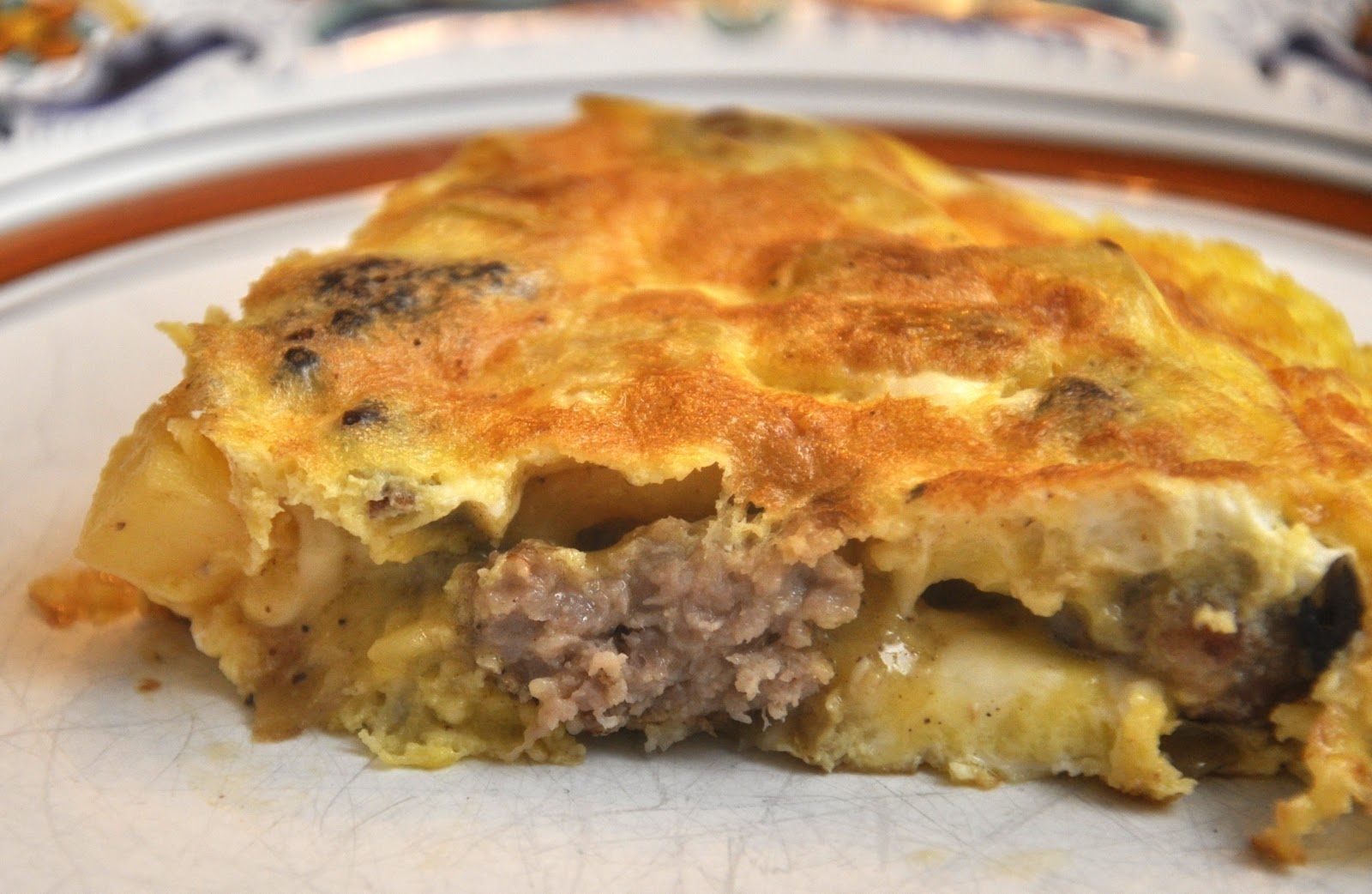
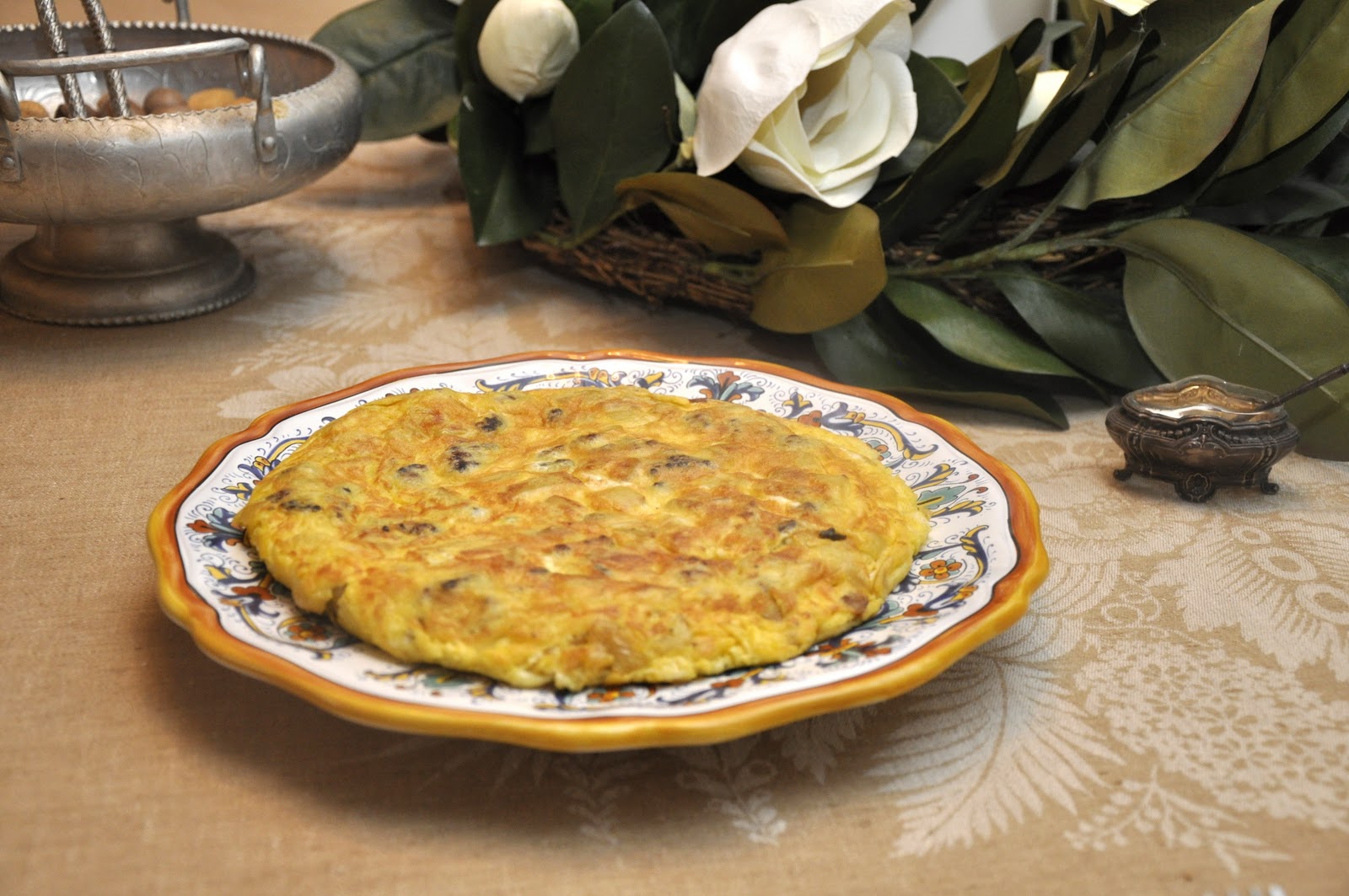
Frittata con patate e salsiccia


One of the wonders of Italian cuisine is its incredible variety, and much of that variety comes from the mix-and-match nature of so many of its dishes. You take a staple base ingredient like rice or pasta, and you pair that with all sorts of flavoring ingredients and come up with literally hundreds of variations on a theme. So pasta or risotto are not a single dish, but a whole category, a whole world of dishes that could literally fill a book, and has.

The same goes for the flat omelette known as the frittata. The combinations are endless, as we have already featured a few on these pages: frittata di patate e cipolla (with potatoes and onion), frittata ai carciofi (with artichokes) and frittata ai peperoni (with bell peppers). Here's another example, one of my favorites on a chilly winter's day when I want something a bit more substantial: a frittata with sausages and potatoes.

Ingredients (to serve 2-3 as a secondo, 4-6 people as an appetizer, snack or part of a buffet)

2-3 sausages, removed from their casings and broken up into smallish pieces
3 medium waxy potatoes, peeled and diced
1/2 onion, sliced or diced
Salt and pepper
6 eggs
100g (3-4 oz) of grated parmesan or pecorino cheese
A few sprigs of fresh parsley, finely chopped (optional)
Olive oil


Directions

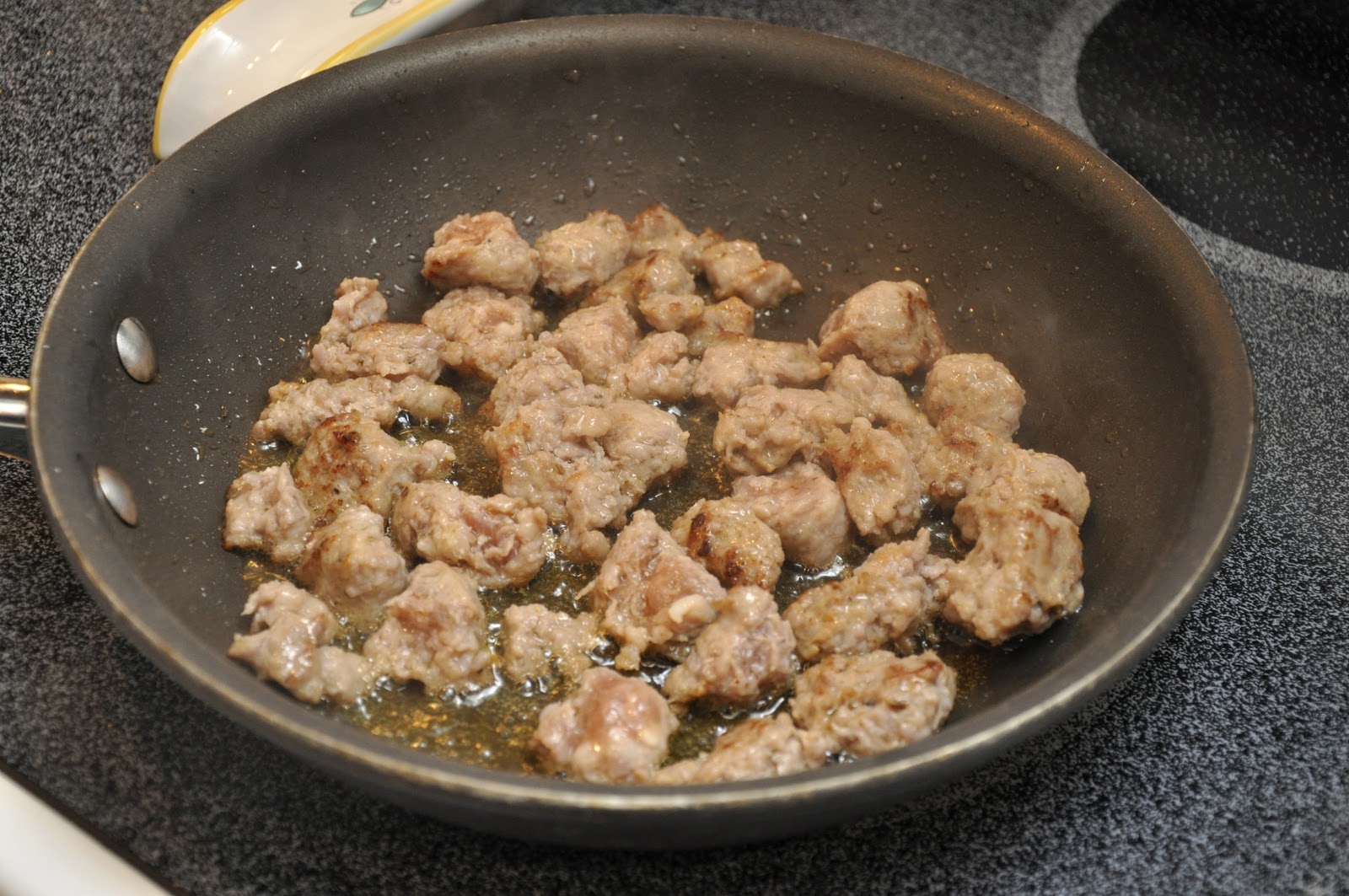
Start by taking a non-stick skillet and sautéing your sausages in a bit of olive oil over moderate heat. When they are nicely browned, you can remove them to prevent them from getting too brown, or just keep them in the pan.


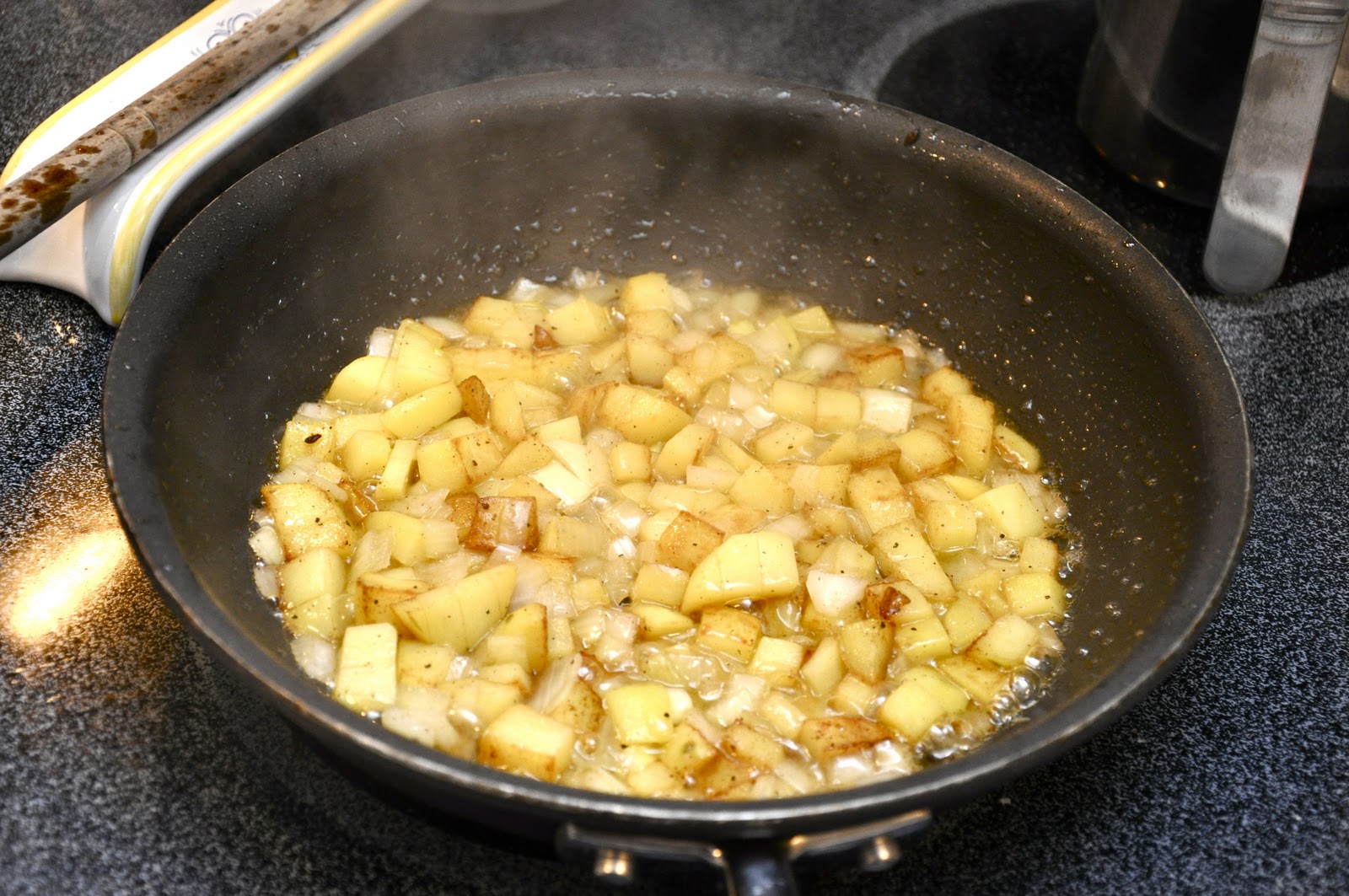
Now add your onion and potato and let them go until they are nice and tender, and not too brown. Season with salt and pepper as they sauté. I find that it helps to add some water and cover the skillet for a few minutes. This speeds up the cooking time and prevents burning.


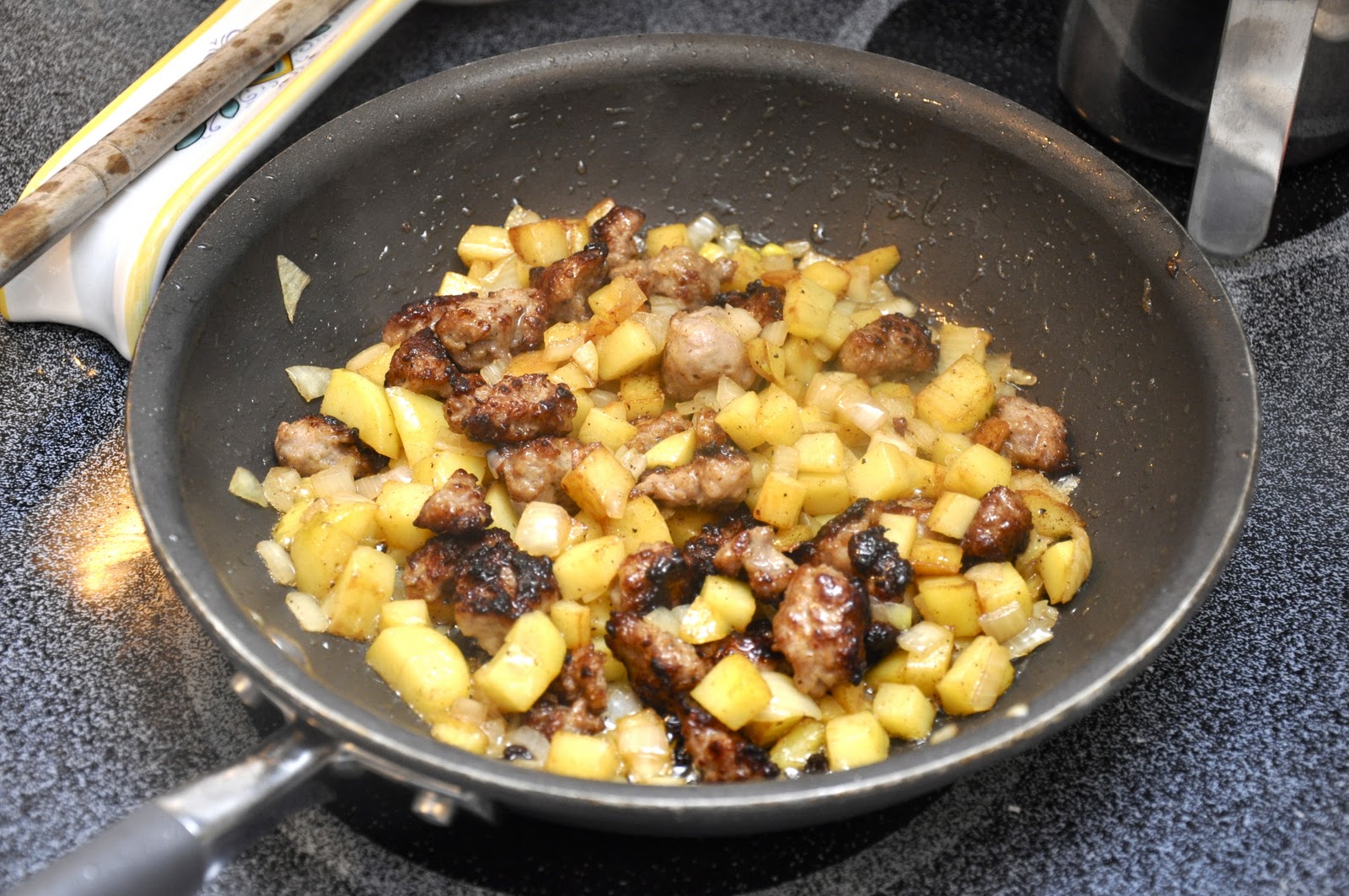
Once the potato and onion mixture is done, add back the sausage pieces if you've removed them. Let them sauté together and get to know one another for a minute or two. If you are using the parsley, now is the time to add it to the mixture.


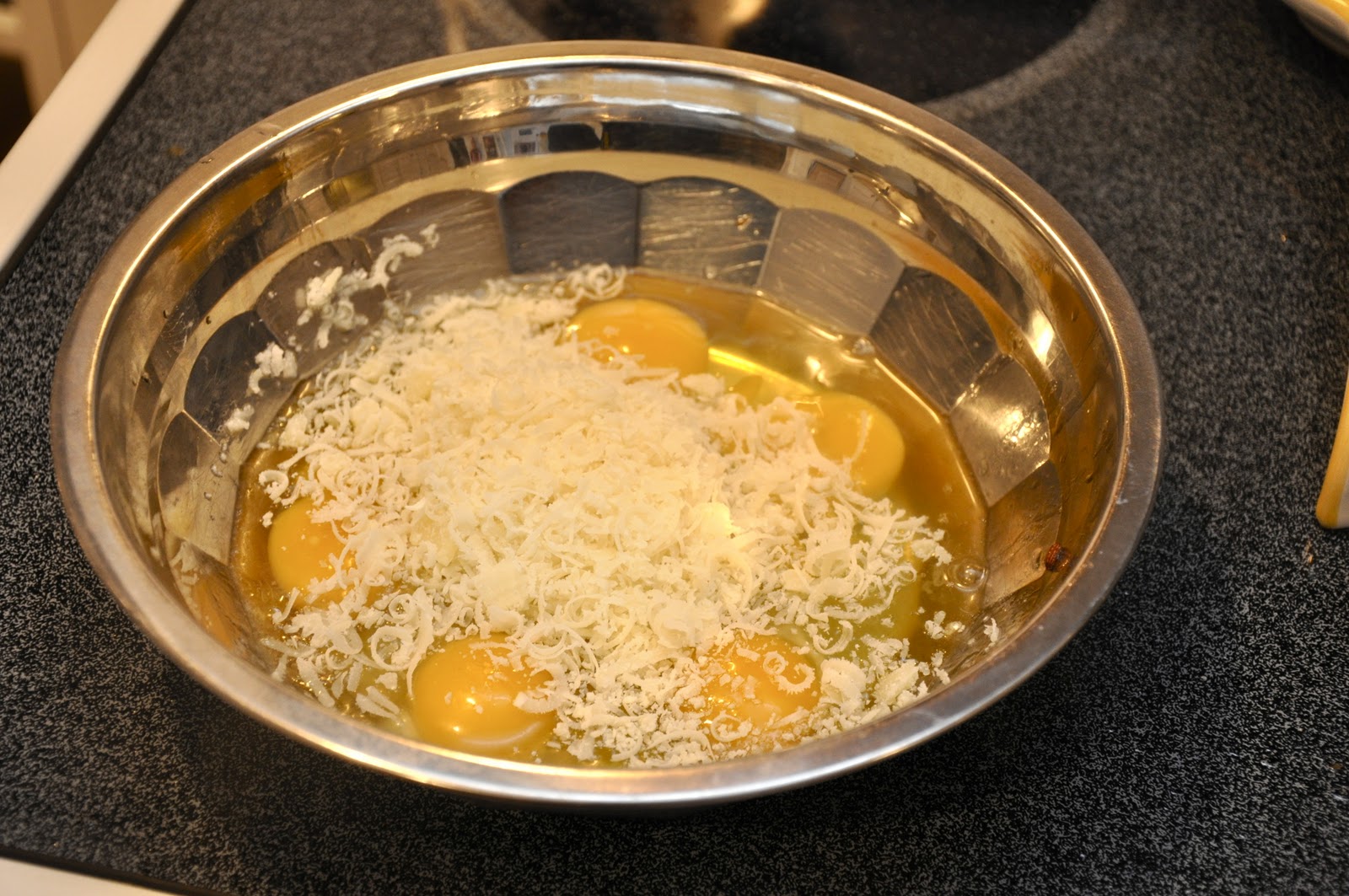
While those ingredients are getting acquainted, beat your eggs and grated cheese together in a bowl. If you are using pecorino, you should not need much salt, but with parmesan you will want to season the eggs a bit.


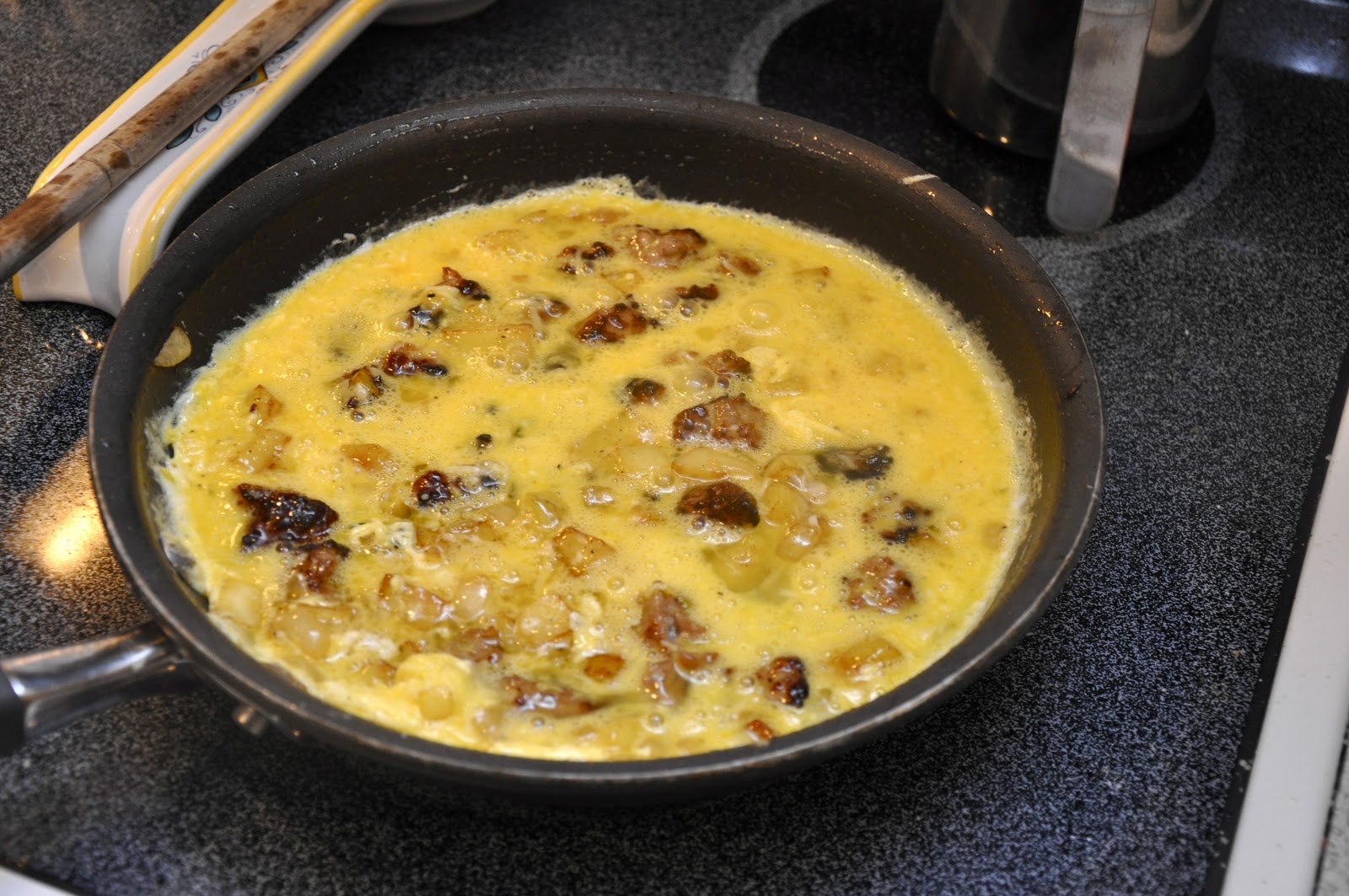
Pour the egg mixture over the flavoring ingredients in the skillet and mix once with a spatula or wooden spoon.


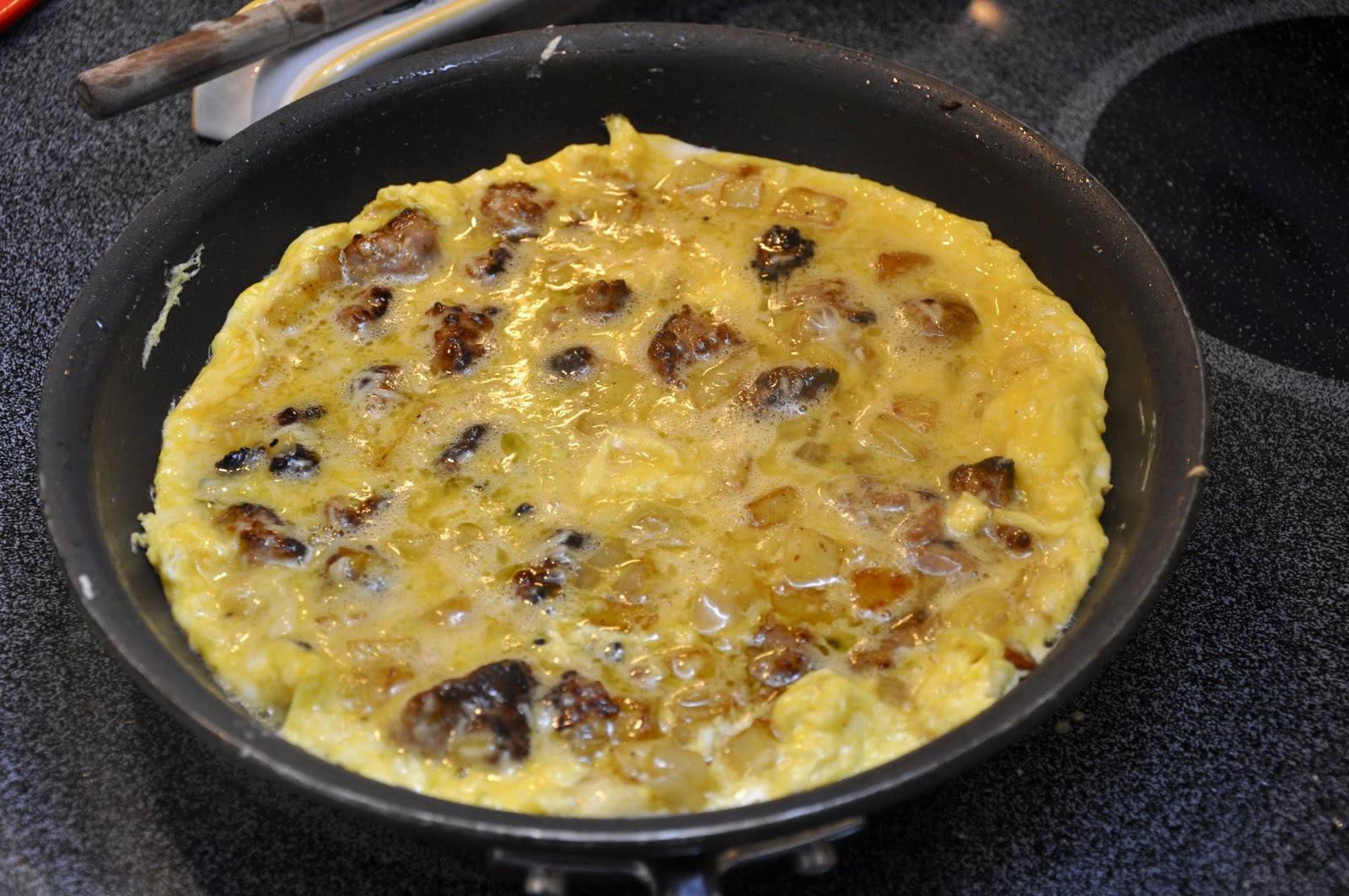
Once the flavoring ingredients are more or less evenly distributed though the eggs, stop and let the eggs cook, still over moderate heat, until they have almost entirely set, except for a thin layer of raw egg on top, and the bottom has nicely browned (but not too much). During this step, too, you can cover the skillet with a lid to help the eggs set. The whole process should not take more than 8-10 minutes. Use a spatula to check the bottom to make sure it's browning nicely but not burning. Regulate the heat if need be.


Now comes the tricky part: you need to flip the frittata over. I do this by using two plates. You slip the frittata out, cooked side down, onto a dinner plate. Then top that plate with another, and flip the two plates over, so that the frittata is now upside down, with the runny, uncooked side facing up.

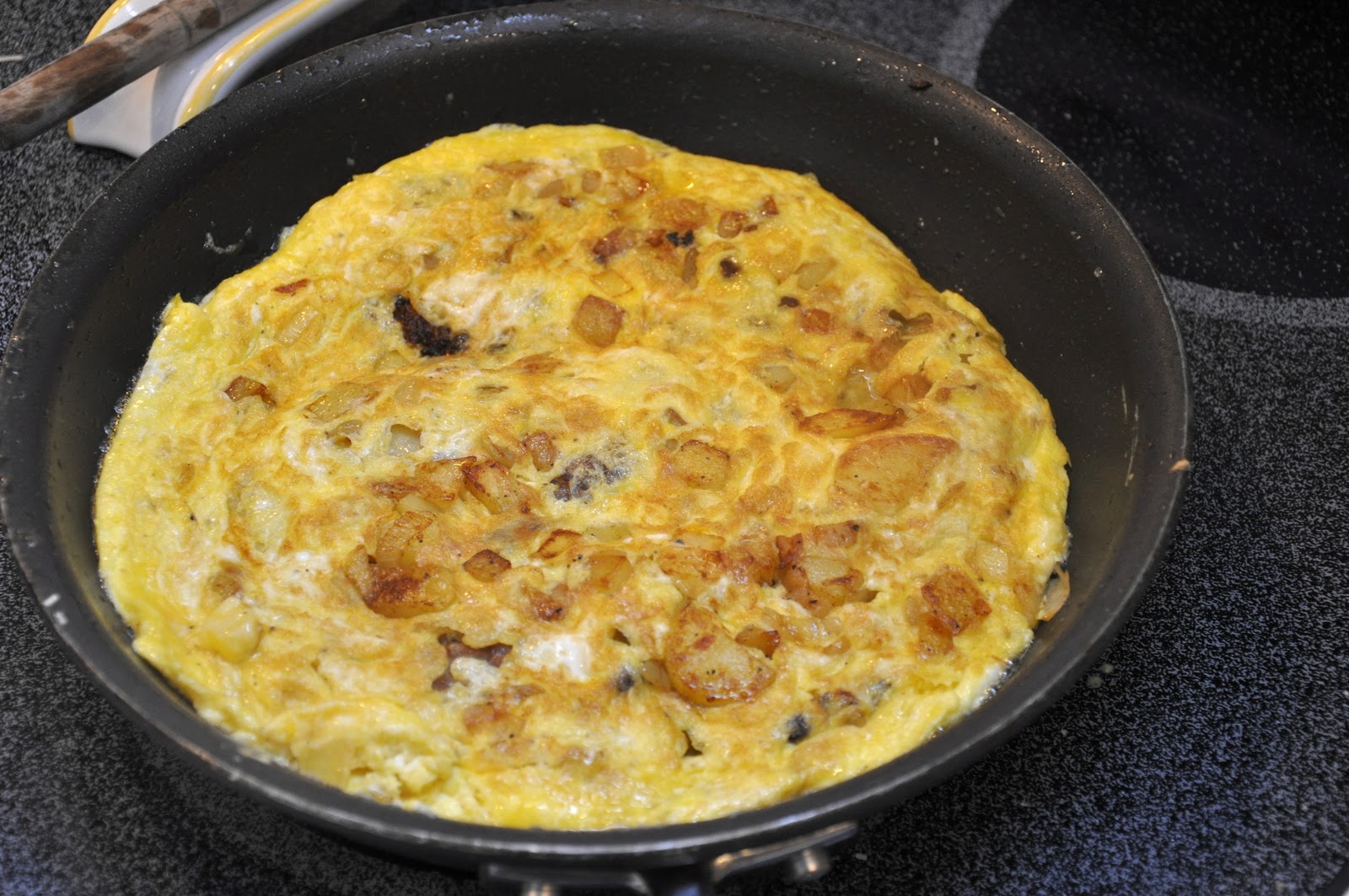
Add a little more olive oil into the empty skillet, then slide the frittata back into the skillet. You will now want to let the runny side cook. This will take a lot less time than before, as you eggs should have already almost completely set, perhaps 3-5 minutes more. Again, check the bottom by raising a bit of the omelette with a spatula and take a peek underneath. It may look a bit misshapen at this point, but not to worry, all will be well in the end.


When the frittata is done, slide it out onto a dinner plate again. I find that the last-cooked side is the most attractive, so once again, I use another plate and flip it over onto its 'pretty' side. Let it cool for a few minutes and serve, cut into wedges.


NOTES: The two-plated flipping technique is one that I  really like, since it is basically foolproof. But if you like, you can use a single plate. You take the plate and cover the skillet, and then flip as described above. This saves you cleaning another plate but be careful, as the skillet is obviously going to be very hot.

Another technique is to run the skillet under a broiler for a few minutes, until the eggs are set and the top is nicely browned. This is even more foolproof than the two-plate flipping method, but don't think that the frittata turns out as attractive, and since the top has not 'tasted' any olive oil, it is a bit less savory.

Finally, they sell special double-skillets with interlocking handles specially-made for making frittata. I have never used one, so I can't comment on how well it works.

The recipe is a classic one, and admits a few variations. Besides the choice of cheese (which could also run towards fontina or another creamy cheese instead of a grated one), you can, of course, achieve a lot of variety by just your choice of sausage. And you can leave out the onion if you like, or substitute shallot or, if you want to get fancy, some chopped leeks.  And some recipes will call for parboiling the potatoes before sautéing them with the onion. That's an extra step that I've never tried and, to my mind, it takes away from the peasant character of the dish. But, of course, no one is going to  stop you if you like the idea...

A frittata can be eaten warm or at room temperature. Leftover frittata is perfectly delicious, and can be used to fill a sandwich—in the old says, this was a favorite lunch of Italian workmen and field hands. A frittata is a versatile dish. It makes a lovely and light secondo, but can be a snack or antipasto, or serve as part of a buffet. The one thing it never is—at least in Italy—is breakfast. But then again, why not? 

Sunday, January 23, 2011

Risotto alla milanese


Risotto is one of the staples of northern Italian cooking, nowhere more so than in Lombardy. Here is the risotto that typifies the cooking of Milan, the capital of Lombardy region and the economic and financial capital of Italy.

This risotto follows the classic method for making risotto, which we have gone over before, but it has two defining ingredients that give it its special flavor and character. As many of you will already know, it is flavored with saffron—which gives it a beautiful gold color—but perhaps fewer people know that in a true risotto alla milanese, the soffritto must include beef marrow. The marrow lends a beefy background flavor to the dish, as well as a subtle richness and unctuousness. The ingredient is so characteristic of the dish that I have seen this risotto listed on menus in Milan as risotto al midollo, the word 'midollo' being Italian for bone marrow.

Ingredients (for 4-6 people)

400g (7 oz.) rice for risotto (arborio, vialone nano or carnaroli)
40-50g (1-1/2 or 2 oz.) bone marrow, removed from the bone (see Notes) and finely chopped
1/2 onion, finely chopped
40-50g (3 Tbs.) butter (plus a bit more for the mantecatura)
A splash of white wine
1 liter (1 qt.) broth, or q.b.
A pinch of saffron
50-60g (2 oz) grated parmesan cheese, plus some more to serve at table

Instructions

Make a soffritto by sautéing the onion and marrow in the butter. When the marrow has melted and the onion is well wilted, add the rice and let it 'toast' in the soffritto without browning. Add a splash of white wine and let it evaporate.

Proceed with the risotto in the usual way—with one little catch: While the rice is simmering, take your saffron and simmer it very gently with a ladleful of broth so it releases its flavor and color into the broth. Then, either about halfway through the cooking process, or if you prefer a more assertive flavor, about 5 minutes before the rice is done, add the saffron and its broth into the risotto. Continue to cook as usual.

Risotto alla milanese is usually served all'onda, which is to say, rather more loose than firm, so begin the final enrichment, called the mantecatura in Italian, while the rice is stlll fairly brothy. Add the cheese and, if you like, a dab of butter for extra richness (never cream!) to the rice, then stir to toss the rice around vigorously for about two minutes. (Skilled risotto chefs are a marvel to watch as they work the rice, they toss the rice into the air while they stir—not something I've tried at home., though.) If you like your risotto a bit firmer, let it sit, covered, for a minute or two before serving.

NOTES: All bones have marrow, of course, but there are particular good marrow bones (also often called soup bones) that you can buy sawed in half to expose the marrow, like these:


To prepare bone marrow for use in risotto, I like to simmer the marrow bones for just a minute or two to loosen the marrow a bit. Then, using a small spoon or knife, scrape out the marrow from the bone. Depending on how long you've simmered the bone, the marrow may also just slip out on its own.


Now for those of you who may be a bit squeamish about bone marrow, it can be left out of the dish, adding perhaps some additional butter during the mantecatura to make up for it. What you will have made is more properly called risotto allo zafferano rather than a true risotto alla milanese—but it will still be delicious! 

Saffron, as we all know, it very expensive, but a little goes a long way. It is sold in threads (the stigma of the crocus flower) and also ground into powder. Avoid the powder if you can. It melts more easily but it tends to have a rather faded flavor. A powder also allows for extraneous 'filler' or substitute ingredients. With the threads, you can be sure you are getting the real thing.

As for the rice, we've covered the three main varieties before: arborio, the most common and usually least expensive of the three, will work fine, but for this dish I would prefer Carnaroli, although many recipes call for vialone nano, which is an excellent risotto rice from the Veneto. For details, check out my post on the Italian Pantry.

There are some subtle variations to this dish you can try as you like: The broth is usually a rich beef broth, but you can equally try a mixed meat broth, a chicken broth or a vegetable broth. Some cooks use shallots rather than onion, a variation that I find particularly nice. And some avoid making a soffritto, putting the shallot or onion into the simmering rice and removing it before serving, which they claim make the risotto lighter. The famed Milanese chef Gualtiero Marchesi calls for making the onion soffritto separately, adding white wine to it, and allowing the onion to simmer until creamy. The onion cream is added at the very end of cooking to add 'acidity and aroma'. An intriguing idea, but one that I have not yet tried.

Risotto alla milanese is an ancient dish, with its origins going back to the Middle Ages, although the modern recipe apparently only goes back to the early 19th century. (See this article for a brief history.)

Risotto alla milanese is perhaps most commonly served together with ossobuco, as a piatto unico—one of the very few examples of rice being a 'side dish' in traditional Italian cookery. But it is equally good as a primo, followed, say, by a cotoletta alla milanese or perhaps a brasato.