Thursday, July 9, 2009

The ABCs of Making Risotto

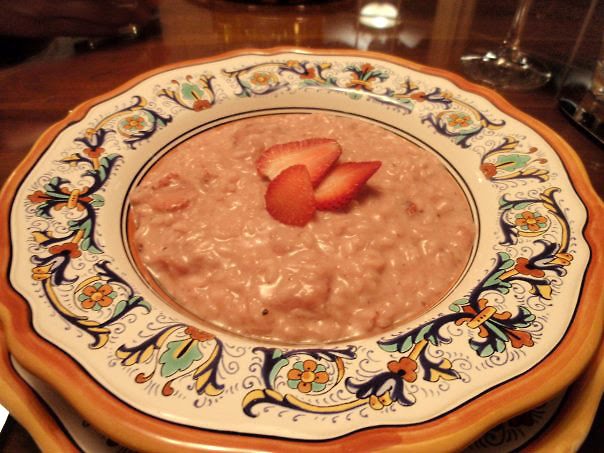
Strawberry Risotto

It's actually not the kind of thing that Angelina made, she being from a small town in southern Italy and risotto being a traditionally northern Italian dish, but still, risotto is one of my favorite things to make, and one of the most versatile of dishes. You can use almost anything--meat, fish, shellfish, vegetables and even fruit--to flavor a risotto. In the past few weeks, I've made four kinds of risotto: a risotto with bacon and belgian endive, one with ham and asparagus, one with red pepper and, just last night, a strawberry risotto.

There is a basic recipe that is common to all risotti: You begin by gently sauteeing chopped or finely sliced onion in butter and/or or oil. (As I've mentioned before, you can add a pinch of salt and a drop of water to soften the onions as they cook to make sure they don't burn.) Then add the rice--a bit more than a handful, or 70-100g
(1/3-1/2 cup) per person, depending on how hungry you are--and let it 'toast' in the soffrito for a few minutes-- just until the grains turn a chalky white color. Then add a splash of wine--almost always white, but red is possible in a few instances and, for a very special risotto, you can use champagne. Then add broth, ladle by ladle, allowing each ladleful of broth to evaporate before adding the next ladleful, stirring often. (There are some cooks who say it's only necessary to stir when adding the broth.) Repeat until the rice is 'al dente', which should take around 20 minutes. You then take the risotto off heat and, for most risotti, add a generous amount of grated parmesan cheese and, if you like, a bit of butter, mixing vigorously to create a creamy consistency. (This last step is called mantecare--the idea being that by agitating the rice kernels and releasing their starch, you give the risotto a rich, creamy texture.) Serve immediately or, for a slightly firmer risotto, you can cover and let it sit for a minute or two. If conversely the risotto is too stiff for your taste, stir in a bit of hot water, broth or cream to loosen it up.


Risotto with red pepper

If you follow the above recipe, you wind up with the most basic of all risotti, risotto in bianco or 'white risotto'. Most risotti, however, are flavored with some other ingredient. If you add a bit of chopped bone marrow to the butter at the beginning, and saffron dissolved in broth to the rice while it is cooking, you have the classic risotto alla milanese, ambrosial on its own as a primo piatto and the invariable accompaniment to ossobuco--one of the few instances where rice is used as a sort of side dish in Italian cooking.

But most often, the flavoring element is added (cut into small dice or thinly sliced) to the soffrito and allowed to insaporire for a few minutes before adding the rice. This is how I made the risotto with bacon and belgian endive: I added the bacon to the butter to render its fat, then added the onions and endives cut in julienne to saute for a few minutes, then the rice, before proceeding with the basic recipe. For the risotto with ham and asparagus, I added both ingredients, cut into small dice, to the already sauteed onions, and continued from there. Most risotti work this way, and, as I mentioned, there is almost no limit to the variety of risotti you can make this way. It's a great way to use up spare vegetables and other stuff. Even leftovers can be used as the flavoring element for a risotto.

But when the flavoring element is particularly delicate in flavor or texture, it can be added either while the rice is cooking (peas or some seafood, for example) or even at the very end, just before you begin to mantecare--and this is usually how you make strawberry risotto. In this case, the flavoring element is sometimes cooked separately before being added to the rice. For example you saute thinly sliced strawberries in butter, added cream, and then added the resulting 'sauce' to the risotto at the very last minute.


Risotto with bacon and belgian endive

 
You have a great deal of flexibility when decided how much condimento to add your rice. Anywhere between a 1:1 to a 1:2 ratio by weight of condimento to rice will work, depending on how 'emphatic' you want to flavor the risotto and the nature of the condimento. Generally speaking, I would use less meat, for example, than I would vegetable, or the risotto will become too heavy. You can use more of foods that tend to 'melt' while cooking, in particular leafy vegetables. Very strongly flavored foods like pancetta or saffron, of course, do not follow this rule--add just enough to lend flavor.


NOTES: There also some variations at the mantecare stage. For a number of risotti, especially those using slightly bitter winter vegetables like radicchio, belgian endive and 'elegant' vegetables like asparagus, I like to add cream (still on heat) and let it reduce before proceeding with the cheese (off heat), in which I case I omit the butter. A friend of mine from Milan told me that she liked to add--believe it or not--Philadelphia cream cheese in addition to the parmesan cheese to finish the dish. For seafood risotti, you usually do not use butter or cheese at the end (it is a fairly strict rule for Italians not to mix seafood and aged cheese--the sight of non-Italians sprinkling grated cheese on their spaghetti and clam sauce can still make me gag!), but some cooks add olive oil instead to finish the dish. But, personally, I don't object to cream, cheese and/or butter in a shrimp risotto--in fact, I rather like it that way.

The main trick to making risotto is the proper regulation of the heat. Cook it too fast, and the outside will be soft while the inside of the rice grains will still be chalky. Cook it too slow, and you will wind up with a stodgy mush... yuck! The other essential for a successful risotto is to use the right kind of rice. Here, there is simply no substitute for imported Italian short grained rice: most commonly, arborio, but also carnaroli and vialone nano. Both of the latter two are more expensive (and can be harder to find), so I usually stuck to arborio, but was recently converted to vialone nano which has wonderful absorptive qualities and produces a creamy, but never stodgy, risotto.

If you're living in the US, I don't recommend using American-grown arborio rice. I've tried it, and it just does not give satisfactory results. If you use long grain rice, it may taste good, but it will not be risotto, which is characterized by the creamy texture that you can only get with the shorter grained variety.

And now I'll let you in a little secret: I'm usually too lazy to make risotto the traditional way, adding broth ladle by ladle and stirring all the time, for 20 minutes. In fact, you can make risotto in about 5-10 minutes using a pressure cooker--yes, that's right, a pressure cooker. You follow the basic recipe until it is time to add the broth. Instead of adding just a bit, add enough to cover the risotto by about 1 cm or so, bring to a full boil, stir well, then cover and bring up to pressure. Lower the heat and allow it to cook under pressure for about 5 minutes, then release the pressure. The broth should have been entirely absorbed, and the rice almost done. Continue with the dish, adding a bit more broth if the rice is still too al dente. If it's just right, then proceed to finish off the dish (mantecare). And another dirty little secret: although risotto will always taste better with homemade broth, if you are using a flavoring element, you can get away with using commercial bouillon. (Shhh....!)

Origins and Regional Variations. Risotto originated as a northern Italian peasant food. Italy is a major European rice producer, and most production is in the Po valley--which runs west to east from the Piemonte, through Lombardy (where Milan is) to the Veneto into the Adriatic Sea--with its center on the plains of Lombardy. (There is a great film of the neorealismo movement, by the way, called Riso Amaro, about the hard life of rice farmers.) It is in this band across the top of Italy that risotto got its start and where it is still most common today. Milan is perhaps the 'capital' of the risotto, where they make it creamy but fairly firm, while in Venice and the rest of the Veneto, they make risotti usually with seafood and almost runny--all'onda as they say, or 'like a wave', as it should flow into the plate as you serve it.

While risotto is associated with the north, one of the classic (and most elaborate) dishes of Neapolitan cuisine is sartu' di riso, a baked risotto timbale filled with little meatballs, chicken livers, sausage, peas and tomato sauce. And while Rome is not really risotto country, two wonderful risotti often appear on Roman menus: risotto alla crema di scampi, made with a puree of sauteed shrimp, and risotto nero, made with squid ink. (The latter is actually a Venetian dish, I believe.) Try both next time you're in Italy, you won't regret it!


Post scriptum:  Here's an excellent video lesson on the basics of making risotto. It's the best treatment of the subject I've seen on the web.


Monday, July 6, 2009

Linguine con zucchine e ricotta


Here's another quick pasta and zucchine dish. While tagliatelle alle zucchine is delicate and refined, this dish--using similar ingredients--has an entirely different character, rough and ready and full of flavor.

Fry zucchine sliced into disks in olive oil with a slightly crushed clove of garlic and a few fresh bay leaves. Season with salt and pepper. When the zucchine slices are lightly browned (see photo below left) turn off the heat and remove the bay leaves. In the meanwhile, boil your linguine in well salted water. When done, turn them into the pan with the zucchine and add a generous dollop of ricotta cheese and abundant pecorino cheese. Mix well, adding a ladleful of pasta water to make a 'sauce' that will coat the linguine well. Serve immediately topped with some more pecorino.

That's all there is to it, but the result is incredibly satisfying.

Fried zucchine, ready for the pasta

NOTES
: I 'invented' this dish at the spur of the moment, using things that I had on hand: zucchine, some ricotta left over from making the gnocchi nudi last Thursday, a bit of pecorino cheese--which I always have around--and the fresh bay leaves, which caught my eye while shopping. Of course, this dish isn't really original--the combination of pasta, zucchine and ricotta is a classic. But my riff on the classic recipe was to substitute linguine, fresh bay leaves and pecorino for the usual penne, basil and parmesan. Shows you what you can do at the spur of the moment, with a bit of imagination and some knowledge of classic dishes.

Baccala e ceci (with notes on other ways to make baccala)

Everyone knows that Friday is fish day for Catholics (even for some lapsed Catholics like myself). A traditional Friday dish in Rome is baccala' e ceci, salted cod fish with chick peas. (I love fried baccala', and there was a well-known place on via dei Giubbonari, close to our apartment, called Filetti di Baccala' that I loved to go to--whenever I could convince my fish-shy significant other.) Anyway, I still make baccala' from time to time and on a recent Friday I decided to try my hand at baccala' e ceci, which I had never made before. The recipe is actually very simple: you cut pre-soaked baccala (see note below) into fillets, dip them in a simple batter of water and flour (I added a bit of olive oil) and fry them until golden brown.

You serve these fried fillets over a bed of chickpeas stewed in oil seasoned with garlic and rosemary. Chickpeas come canned or dried. They are simple to cook--like other beans, you need to soak them first for a few hours or overnight, then simmer them in water very slowly until tender. But cooking dried chickpeas takes a long time--several hours to soak and several more hours simmering in water until they're tender (using a pressure cooker speeds things up, but it will still take an hour or so)--so I usually resort to canned chickpeas, which are actually quite a decent substitute. But the problem with canned chickpeas is that you lose the 'broth' that results from the long simmering, which gives any resulting dish a wonderful deep chickpea taste. So on Friday, being too lazy as usual to use dried chickpeas, I decided to add tomatoes to the garlic and rosemary cooking base for some more flavor. The result was quite good--cod fish and chickpeas are a great taste combination--, but, if I had to do it over again, I'd add a bit more water to 'loosen' the peas. And one day I'll need to try it the old-fashioned way. By the way, if you have leftovers, you can make another classic Roman dish, pasta e ceci. (I'll post that recipe one of these days.)


The classic way to make filetti di baccala', by the way, is with a different kind of batter (pastella in Italian) that includes eggs and yeast. The result is a much thicker, almost fluffy crust that resembles a fritter. The delicious Roman answer to fish and chips. Whether you use this batter or the simpler one described above, you should let the batter 'sit' out for two hours or so to allow its elements to meld. I'm not sure about the chemistry, but it just doesn't come out right if you skip this step. The other thing to remember about making a batter is that the more liquid it is, the lighter the resulting crust will be--which I prefer. But too much liquid and the batter will not stick to whatever piece of food it is meant to cover, so don't overdo it! I find a batter that is just a bit thicker than heavy cream works well.


Since I had too much fish for a dinner for two, I used the rest of it to make my favorite salt cod dish, brandade de morue, one of the classics of Provencal cooking. It is very simple to make if you have a food processor: just simmer the pre-soaked salt cod in water (with some potato if you like, even if purists apparently call this inauthentic) for a few minutes, until both fish and potato are soft. Add the cod (and potato, if using) into the bowl of the processor, add chopped garlic (or chop it in the processor before you add the cod fish) and begin processing. Begin adding milk (or cream if you're feeling extravagant) and olive oil alternating between the two a little at a time, until the mixture is smooth and fluffy. Adjust for salt if needed. If you like you can pass it under a broiler until it forms a nice crust (see photo), a good way to reheat it if you make it ahead. Brandade is absolutely wonderful served with toasted baguette slices (rubbed with garlic if you like), accompanied with some green salad and washed down with some cold white wine, it makes a marvelous quick and easy light supper.

There are many, many other ways to make baccala'. In the south, baccala' is often lightly fried and stewed in tomato sauce, while one of my other favorite ways to make it is baccala' alla vicentina, baked in a sauce of onions, parsley, olive oil and milk, from the Northern Italian city of Vicenza. Next time we have baccala' I'll post some more recipes.

NOTE: Baccala' is cod fish that has been preserved by being salt-cured and dried. When you buy it dry, it is quite hard to the touch and very, very salty to the taste. In other words, you can't eat it that way--it generally needs 24+ hours of soaking in various changes of water. In Italy, it is really easy to make as a lot of places will sell you pre-soaked baccala' on Fridays. Here in the States, I've only seen pre-soaked baccala' once, in an Italian neighborhood in New York. You can probably find it in Little Italys in other cities. Most places, though, you'll need to pre-soak the salted cod fish yourself. It's no big deal, but you need to plan ahead. Some types of baccala' need less time to soak. The kind I buy at our local Whole Foods is not that salty, so if you start soaking in the morning, it's more or less ready for dinner. I find that if I soak it for 24 hours, it loses too much of its saltiness, which is typical of baccala'. But for those who prefer a less salty baccala', just soak it longer and remember to change the water more often. Friends have reported that their grandmothers also used milk instead of water to soak the baccala'.

Orecchiette ai broccoletti


This (and a piece of fruit) make a fine supper--pretty typical of the kind of thing we like to eat in our house on a weeknight when there's not much time to make dinner. A quick pasta dish with vegetables that you can whip up in less an 30 minutes. The pasta is orecchiette or "little ears", a pasta that is typical of Puglia, the region of Italy that my grandpa Fariello came from. Little disks of pasta made from durum wheat and water are pressed with the thumb so they come out concave, giving them the appearance of little ears--well, at least, if you have some imagination they do.

You cook the orecchiette with an equal amount of roughly chopped broccoletti (broccoli rabe) in well salted boiling water. Meanwhile, saute lightly crushed garlic cloves, dried red chili pepper (peperoncino) or red pepper flakes, and a few anchovy filets in olive oil. (Don't allow the garlic or the red pepper to brown too much or it will turn bitter.) When the orecchiette are done (about 15 minutes if you are using store-bought dried orecchiette) transfer them and the broccoletti with a slotted spoon into the seasoned oil. (For a more 'refined' dish, you can remove the garlic and peperoncini but I never bother.) Simmer until the pasta and broccoletti are well seasoned by the oil--a process known in Italian as insaporire. The broccoletti should have more or less disintegrated by now into a kind of 'sauce'. (This is definitely not nouvelle cuisine!) Add salt to taste and serve hot. Drizzle a bit more olive oil on top of each portion if you like. This is not a dish that calls for any kind of grated cheese.

Enjoy!

NOTE: Orecchiette can be found at Whole Foods and most Italian food shops. They are, unfortunately, quite expensive (around $6-7 per lb.) as real ones have to be made by hand. There are cheaper imitation orecchiette made by Barilla, but don't bother! If you can't find real orecchiette, or would rather not pay that much for pasta, better to use another kind of short pasta like rigatoni or conchiglie. Or you can make them at home: here's a post and a YouTube video that show you how they're made. I've tried it a few times--it's not as easy as it looks. Freshly made orecchiette take a lot less time to cook, so boil the broccoli rabe for 10 minutes or so before adding them to the pot.

While orecchiette is most commonly paired with broccoli rabe, you can use the same recipe using cauliflower instead of broccoli rabe (in which case, add a little chopped parsley for color). They can also be sauced with ricotta cheese softened with a wooden spoon or a lightly cooked marinara-type tomato sauce into which a dab of ricotta is mixed at the last minute. I've also heard of (but never made) orecchiette with clams or mussels. Since orecchiette have recently become 'chic', you'll also find all sorts of fancy recipes for orecchiette around with goat cheese and asparagus and such. Orecchiette are typically cucina povera and I find such extravagances absolutely absurd.

Aglio, olio e peperoncino

Here's another super simple pasta that I call the "mother of all pasta dishes" since its garlic and oil base forms the foundation for countless other pasta sauces. It's also the quintessential impromptu spaghettata. I'm sure all the Italians and Italo-Americans out there have grown up with this pasta, but I have always been surprised at how many non-Italians have never had it, or even heard of it.

The essential recipe is as follows: Put water on to boil, then saute several cloves of garlic in olive oil, with broken up pieces of of dried red pepper (peperoncino), on low heat until the garlic is lightly golden brown, then turn off the heat. (Do not let it burn, or it will turn bitter.) Add some chopped parsley at end (some people omit the parsley but I like the subtle flavor and color it adds). Meanwhile, when the water comes to a vigorous boil, salt very well and add your pasta--either spaghetti or linguine--and cook til al dente. Drain and pour into a warm bowl, then pour the oil and garlic mixture on top. Mix thorough, taste for seasoning and add more salt if needed, then serve and eat immediately. (You can add a few bits of chopped parsley on top for color.)
NOTES: As simple as it is, there are some tricks to making this dish. First off, because there is nowhere to 'hide' bad ingredients or bad technique when you make "ajo e ojo" (the dialect name for this dish), you need best quality, fruity olive oil and fresh garlic and, of course, imported durum wheat pasta, or the dish will disappoint. (I've discussed olive oil elsewhere, so I won't get into the details here.) The use of whole, dried red peppers is also an important point--I don't really care for pepper flakes in this dish, as it is too easy for them to overwhelm the other flavors. And they tend to burn very easily which, like garlic, turn them bitter. If you only have the flakes around, add them at the very end, just before you turn off the heat.

The key trick to a good aglio e olio, in my book, is to saute the garlic and hot pepper over low heat, then let the oil cool a bit before you add it to the pasta. Turn off the heat as soon as the garlic becomes a light brown (see photo). This technique allows the garlic flavor to permeate the oil more thoroughly and produces an agreeably 'sweet' garlic taste due to the gentle cooking. (This actually runs contrary to some recipes, which tell you to pour hot oil over the pasta--something I find produces gummy pasta.)

Some people, including Jeanna Carola Francesconi in La cucina napoletana, advise that you should add a bit of the pasta water to the oil and garlic, which is supposed to eliminate any greasiness. Personally, I rather enjoy the 'slippery' quality of the pasta when made as directed above. But try it both ways and see how you like it best.

There are other special techniques that are sometimes recommended for making this dish--indeed, everyone seems to have their personal 'secret': One calls for frying the garlic is a minimal amount of oil, and then add raw oil to the pasta and mixing. This technique brings out the olive oil flavor more forcefully, as cooking tends to 'dull' the flavor of olive oil. Another version would have you remove the cooked garlic and red pepper and grind them in a mortar and pestle--seems a bit 'fussy' to me, but perhaps worth a try. Many, perhaps most, people actually remove the garlic and peperoncino before serving the dish but I usually don't bother. To tell you the truth, I like eating the garlic!

A common variant of this dish is to add bread crumbs to the oil. Another variant calls for both bread crumbs and rosemary. Others add anchovies, although this would then, in my book at least, make this a pasta e alici. I have even had some friends from Campania heartily recommend making this dish with grated parmigiano--something I had previously considered near blasphemy.

As mentioned at the beginning, lots and lots of other sauces, in southern Italian cooking especially, begin with this simple oil and garlic base. Drop the hot pepper and add tomatoes and a basil leaf you have the most basic of tomato sauces. Keep the pepper and add tomatoes and you have penne all'arrabbiata. Add pancetta or guanciale and pecorino cheese and you have bucatini all'amatriciana. Add tuna and you'll get pasta al tonno and add capers and anchovies and you have sugo alla puttanesca, add clams (with or without tomatoes) and you have spaghetti alle vongole. And ajo e ojo is the base for many pasta and vegetables dishes--you usually parboil the vegetable and then saute it in the oil and garlic--see my post on orecchiette e broccoletti. Etc., etc., etc...

Angelina, by the way, usually didn't make her ajo e ojo with peperoncino but with copious amounts of ground black pepper. I'm not really sure why, and I never asked her. I've never see it made that way except by her, but it was also very nice, and I occasionally make it that way when I'm feeling nostalgic...

Fettuccine alla papalina


Fettuccine alla papalina, or "Fettuccine for the Pope", is an upscale reinterpretation of the earthy spaghetti alla carbonara. The story goes that the dish was prepared for a certain Cardinal Pacelli, who was soon to be come Pope Pius XII, who had asked the ownder of a restaurante in the Borgo (the area of Rome that lies between the Vatican and the Tiber River) to make him a more delicate version of the classic Roman dish.

The dish is quite simple and despite being more 'refined' is actually easier to make than carbonara. You saute some finely chopped onion in butter (or olive oil) until translucent. (NB: White onion, with its delicate flavor, works best, but ordinary yellow onion will do.) You add chopped prosciutto (or small cubes of ham which is what I used this time round) and allow that to saute for a few minutes, then, if you like and are feeling a bit heretical (see Note below), add some peas and allow to insaporire for a minute or two more. Then add cream and allow the cream to reduce a bit.

Cook fettuccine and when al dente, drain (not too well) and add them to the cream sauce. Then pour over a egg which you will have beaten with grated parmesan cheese. Mix well, letting the egg and cheese mixture to thicken the sauce. Serve immediately, if you like with additional grated cheese.

NOTE: A number of knowledgeable sources say that the additional of peas is not authentic. You will, nevertheless, often find fettuccine alla papalina made this way and I rather like it. I've also seen some recipes that call for sliced mushrooms as well as peas, but this is really going far afield, it seems to me. It must be very nice, but at that point I wouldn't call it papalina...

This is not an ancient dish, by the way. Pope Pius XII was the controversial Pope who reigned during WWII, from 1939 to 1958. As Cardinal, he signed an concordat with Hitler's Germany in 1933 and was, in the eyes of many, excessively deferential to Germany during the war. In any even, the chronology is interesting, since one story for the origins of spaghetti alla carbonara is that it was invented by Italians using the bacon and egg rations that US soldiers brought along with them as they moved up the 'boot' of Italy during the war. If so, then this dish could not have been invented while Pius was still Cardinal prior to his coronation in 1939.

Anyway, whatever its origins, the dish is really delicious!

Thursday, July 2, 2009

Fritto misto di mare


There's a saying in Italian: fritte son bone anche le scarpe, meaning "even a shoe tastes good when it's fried". Well, I couldn't agree more--and seafood tastes especially delicious when it's fried--good enough to convince even the piscatorially challenged.

There are several different ways to make fried fish. The simplest (and my personal favorite) is simply to cut up pieces of seafood and lightly coat them in flour seasoned with salt and pepper (and, if you like, a bit of paprika for color). Then deep fry them --I like to use light olive oil--until golden brown. The fritto misto pictured above was made with a light batter of flour, olive oil and enough water to make a cream-like mixture. Some batters call for adding egg to the batter, which you can add whole or, if you want to get fancy, add the yolk and then (just before frying) fold in the egg white, which you will have whipped into a foam. Egg batters, however, especially if you whip your egg whites, will be quite thick. You need to let any batter sit for about an hour before using. Make sure you're seafood is quite dry before coating with your batter, or the batter will tend to slip off in the frying.

How much you fry is a matter of taste. I like my fried foods 'medium', neither very dark nor very light. But follow your own preference. The main trick to frying is the correct temperature. You want the fish to fry until it is entirely cooked (but not overdone) inside and nice and crisp outside. If you fry the fish at too high a temperature, it will brown on the outside before it is fully cooked inside (although this is less of a problem if you cut the fish into small pieces). Conversely, if you cook the fish too slowly, it will tend to get soggy and greasy... and some seafood like calarmari will become quite rubbery if it's not cooked quickly. As in so many things culinary, practice makes perfect.

Sprinkle your fritto misto di mare with salt and serve with lemon wedges. It is important to serve fried foods as soon as possible after they're done, while they're still nice and hot and crispy. As they say in Naples, frijenno e magnanno--which, loosely translated, means "fry it and eat it!"

Finally, for the choice of seafood. The mixed fry pictured above features shrimp, calamari and scallops--a wonderful combination. In Italy, whole small fish (such as fresh sardines or the tiny fish known as paranza, which I have never found outside Italy) are also typically included. Small crabs (or even better, soft-shelled crabs) make for wonderful additions as well. But let your own taste be your guide.