Showing posts with label Austrian. Show all posts

Sunday, December 26, 2010

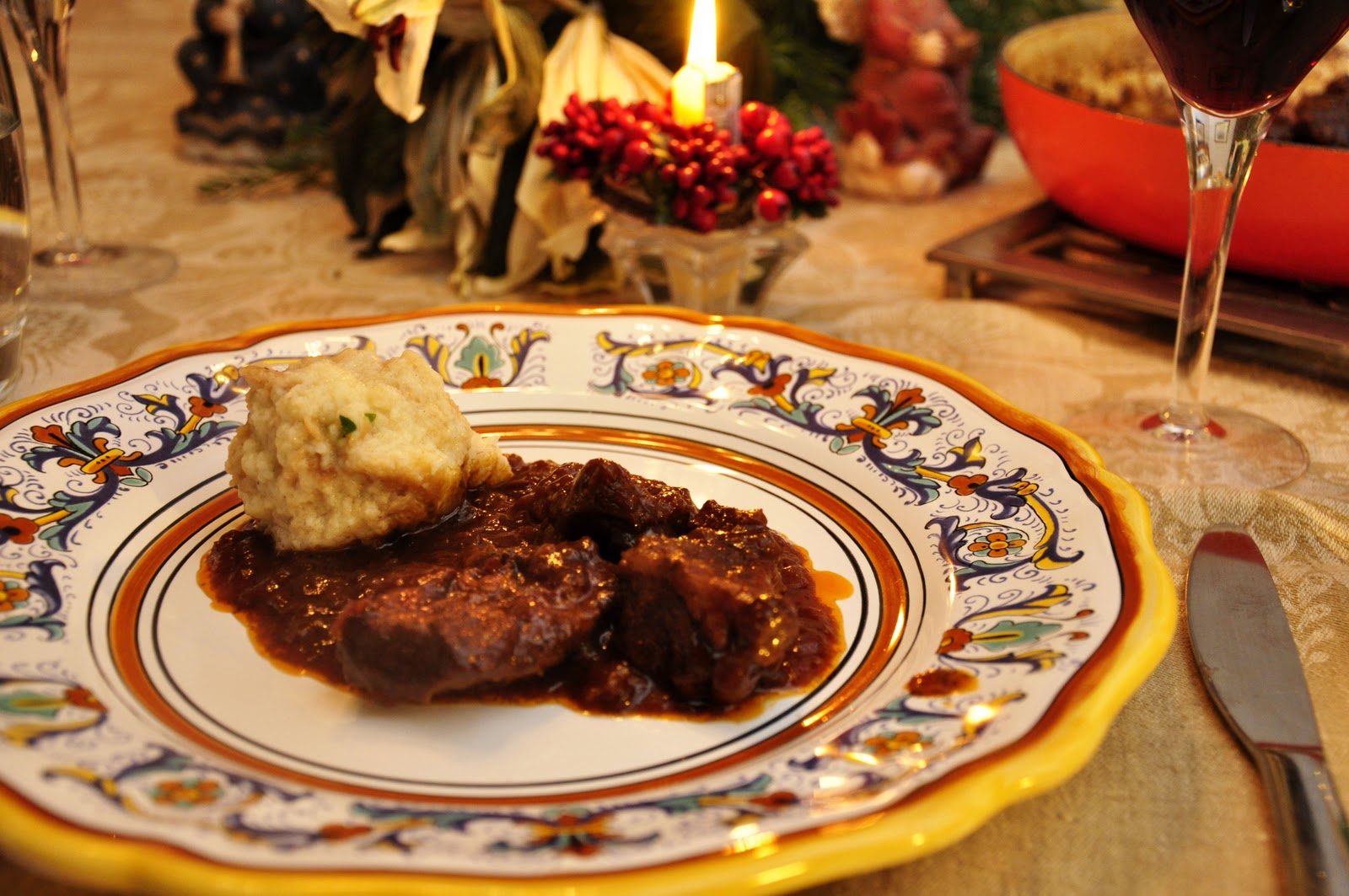
Viennese Goulash


For some reason, I must be feeling nostalgic for my Vienna days as I keep coming back to the dishes I made during those years. Perhaps it's the cold weather that calls out for the hearty cooking of Mitteleuropa. In any event, here's another favorite from that time and place: Viennese Fiakergulasch.

Goulash is a simple beef stew that follows the usual dry followed by moist heat method, but with two twists: the use of lots of onion—half as much by weight as the meat—and, of course, Hungarian paprika. The cooking fat can be oil, lard or even rendered beef fat.

Ingredients (for 4-6 servings)

1 kilo (2 lbs.) stewing beef, cut into cubes
500g (1 lb.) onions, chopped
Oil, lard or rendered beef fat
Salt and pepper
Hungarian paprika, to taste
Beef broth, enough to cover the meat
1-2 Tbs. tomato paste
A pinch of caraway seeds
A sprig of fresh marjoram (or thyme)

A spoonful of flour mixed with some water

Directions

Add enough cooking fat to cover the bottom of a Dutch oven or braiser. Brown the beef cubes nicely in the fat on all sides and set aside.

Now add the onions and gently sweat them in the same pan until they are nicely soft and browned, but not burnt. Season with salt and pepper as you go. Add back the browned meat and mix well. Allow the meat and onions to simmer together for a few minutes, then sprinkle over the paprika. Most recipes call for 1-2 tablespoons, but I just 'eyeball' it, and I'm pretty sure I add more than just a spoonful, as I love the taste of paprika. You then allow the paprika to simmer in the fat to release its full aroma, again for just a minute or two. Paprika can burn if heated too much, so moderate your heat as needed.

Add enough beef broth to just cover the meat, along with the tomato paste, caraway and marjoram. Cover and simmer it all gently until the meat is quite tender, usually about two hours. This can be done over the stove or, if you prefer, in a moderate (180C/350F) oven.

Just before serving, add your flour and water slurry to the pan, a spoonful or two at a time, to give the sauce a nice liaison. If, on the other hand, you find that your sauce is too thick or there is simply not enough of it, add some water.

Serve warm, with buttered noodles, spätle or Knödel.

NOTES: There is a certain linguistic confusion over the name of this dish as it is used in its homeland of Hungary. This article explains, as I had heard before, that gulyás, from which we get our word goulash, actually refers to a soup, which back in Vienna was called Gulaschsuppe. What we call goulash is called pörkölt in Hungarian (but please don't ask me how that's pronounced...)

Many recipes call for you to sauté the onions first, and then brown the beef with onions, which is more straightforward than the procedures outlined above (which is more typical of a French daube). But I like to use the Frenchified method, as you can caramelize the meat nicely without any worried about burning the onion.

There are lots of different kinds of goulash, with or without meat, and with or without vegetables. The Viennese version, in my humble opinion, is by far the best of the lot, although admittedly I am biased. After all, we all tend to like what we know best.

Friday, April 2, 2010

Spargel mit Sauce Hollandaise und Kartoffeln


This dish brings me back to my Vienna days: white asparagus and potatoes with hollandaise sauce. The appearance of asparagus in the markets of Vienna--as elsewhere--is a harbinger of Spring. Austrians (and Germans) have a thing for white asparagus. They prefer it to the green kind that is more familiar in most other places. In fact, ask for Spargel and they will assume you mean white asparagus, you should say Gruener Spargel, or "green asparagus" if you want the kind we're most familiar with. White asparagus are grown by keeping dirt mounded around the emerging stalk, depriving it of light. The plant cannot produce chlorophyll without light, thus there is no green color to the stalks. The flavor is more delicate, and the flesh more tender, than regular asparagus. (The same light deprivation technique is used to keep Belgian endive white as well.)

Anyway, this is another dish of utter simplicity to make, but quite beautiful to behold. Start by steaming some baby potatoes. While the potatoes are steaming, cut the bottom ends off the asparagus, peel them (but avoid the tender tips) and boil them, either in a skillet or in a asparagus cooker filled to an inch or two with water, for 5-10 minutes, depending on how thick they are and how crisp you like them. (Come to think of it, I suppose you could boil the potatoes in the same skillet where you are boiling the asparagus, in which case add the potatoes about 5-10 minutes before as they take longer to cook.)

In any event, when both the asparagus and potatoes are just about the way you like them, make the hollandaise sauce by placing two or three egg yolks in a bowl that is sitting above a pot of simmering water (in French this is called a bain marie), add the juice of half a lemon and a bit of salt and whisk briskly until the eggs are quite frothy. As they heat up, they will begin to thicken. As this happens, quickly begin to add a 1/2 cup of butter, which you will have melted separately, bit by bit, as you continue to whisk. As each bit of melted butter is absorbed by the egg, add a bit more butter, whisking all the time, until you have a nice creamy sauce. Add hot water to thin out the sauce if need be and remove from the heat. (TIP: Make sure to regular the heat so that it is at the simmer. If it gets too hot, the eggs will scramble rather than thicken. If you see this beginning to happen, you can take it off the heat immediately and add a drop of lukewarm water to cool things off, then continue.)

Transfer the asparagus and potatoes to a serving dish (making sure they are well drained--you don't want water on the dish!) and pour over the hollandaise sauce. (You will need to move quickly here, as the residual heat of the bowl will continue to thicken the sauce. If it becomes too thick, whisk in a bit more hot water.) Sprinkle some finely chopped parsley over the dish and serve immediately. Wash down with white wine. Mahlzeit!

NOTES: Those of you who have ever made mayonnaise at home will immediately see the similarities between the two sauces, the main difference being that mayo is made with oil while hollandaise is made with melted butter. In the latter case, to allow the egg yolk and butter to emulsify properly, you need to keep things warm but not hot. The need for temperature control makes hollandaise a bit more challenging to make than mayo.

Obviously, the egg yolks do not fully cook when you make hollandaise from scratch, so if you have qualms about uncooked eggs (salmonella and all that) I suppose you can use hollandaise sauce from a jar, although I have no idea if it's any good. There are also some recipes for mock hollandaise around. I haven't tried them so can't say much about them.

I won't try to sell this dish as healthful, as the hollandaise sauce, made from egg yolks and butter, is something of a cholesterol bomb. But I must say, it looks and tastes wonderful--so why not splurge once in a while?