Showing posts with label Spanish. Show all posts

Sunday, July 4, 2010

Paella mexicana


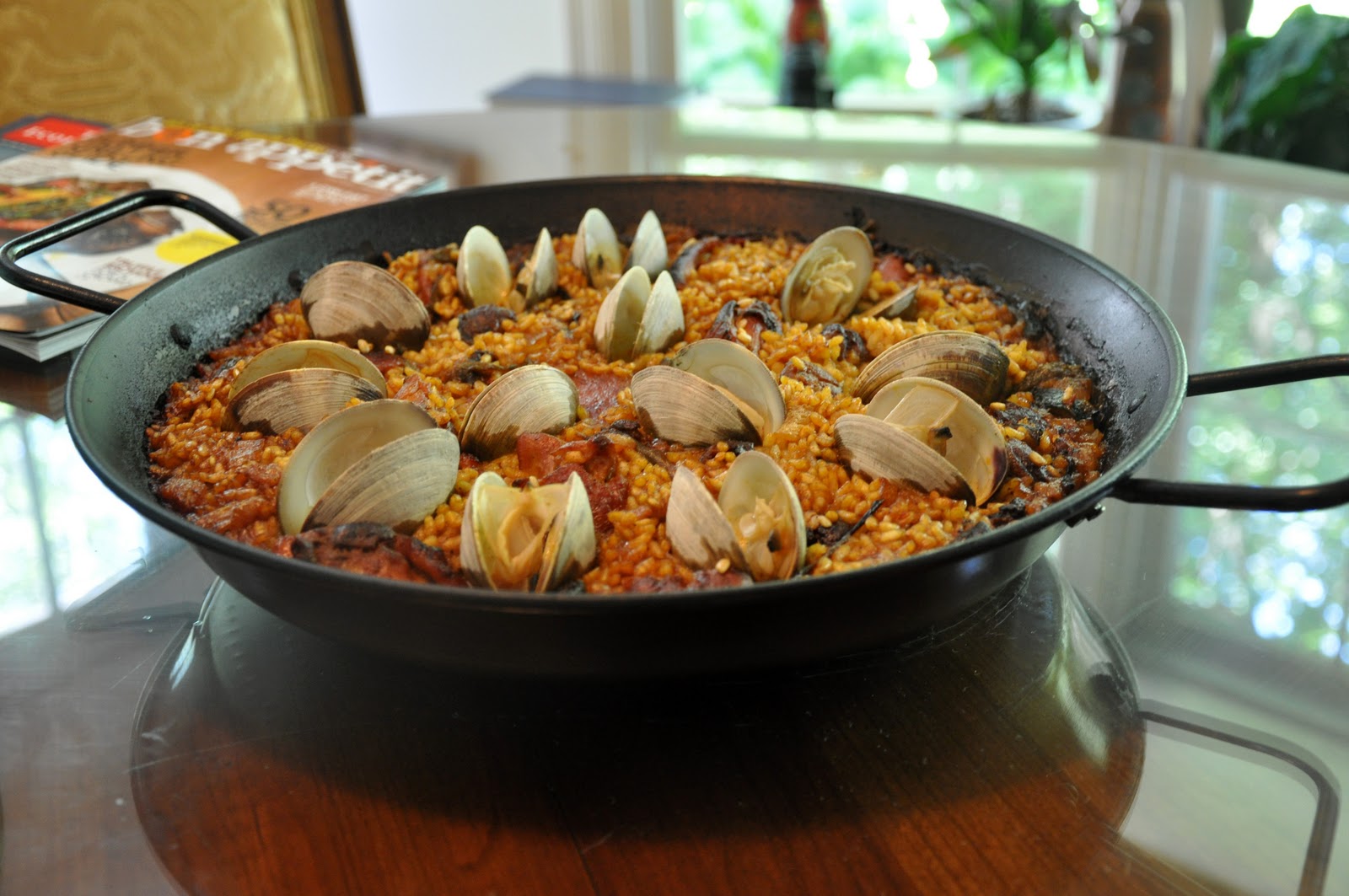
It's the 4th of July here in the US and the national holiday naturally makes me yearn for… paella! Well, not just any paella, but a Mexican-style version inspired by my fellow blogger Non Chef Nick's latest post on "In the Kitchen with Nick". I absolutely love paella. Having not prepared it for quite some time and being on something of a Mexican 'kick' lately, when I saw his mouth-watering recipe for Mexican paella, I knew I had to try it. Sorry, Nick for being such a copycat, but you know what they say: imitation is the sincerest form of flattery! 

Being a man of simple tastes, I have reduced the number of ingredients quite a bit and simplified the technique here and there. Here's my take: 

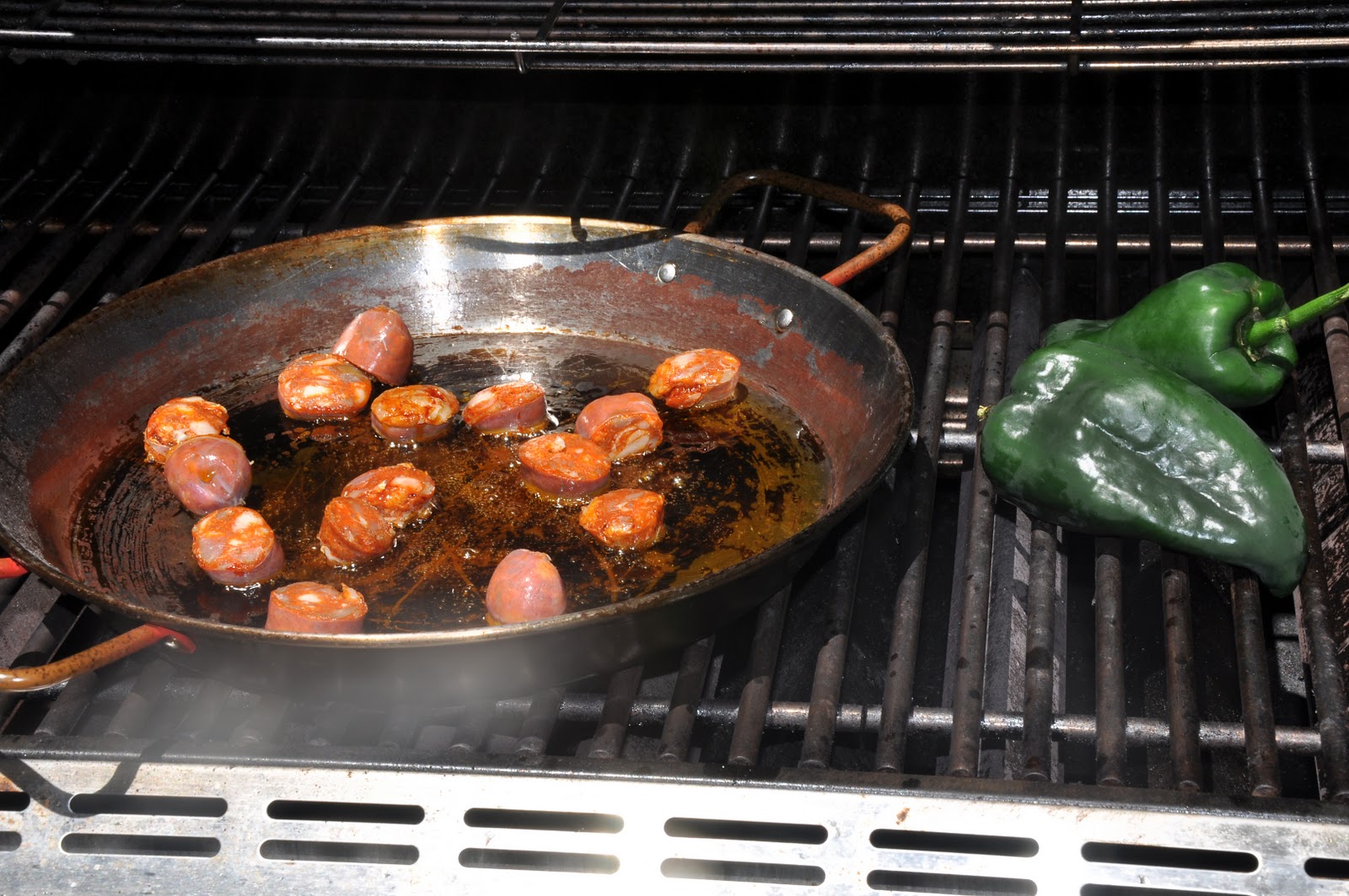
Heat a well-seasoned paella pan over high heat, preferably on a barbecue or, even better, a paella burner. (If you don't' have either, you can make paella perfectly well over the stove, but it will lack that characteristic lightly smoky flavor.) When hot but not burning, add enough olive oil to cover the bottom of the pan and sauté some Mexican chorizo. Meanwhile, char a couple of chiles poblanos over the flame and, when nicely charred on all sides, remove them and let them cool a bit, covered with a cloth or in a paper bag.

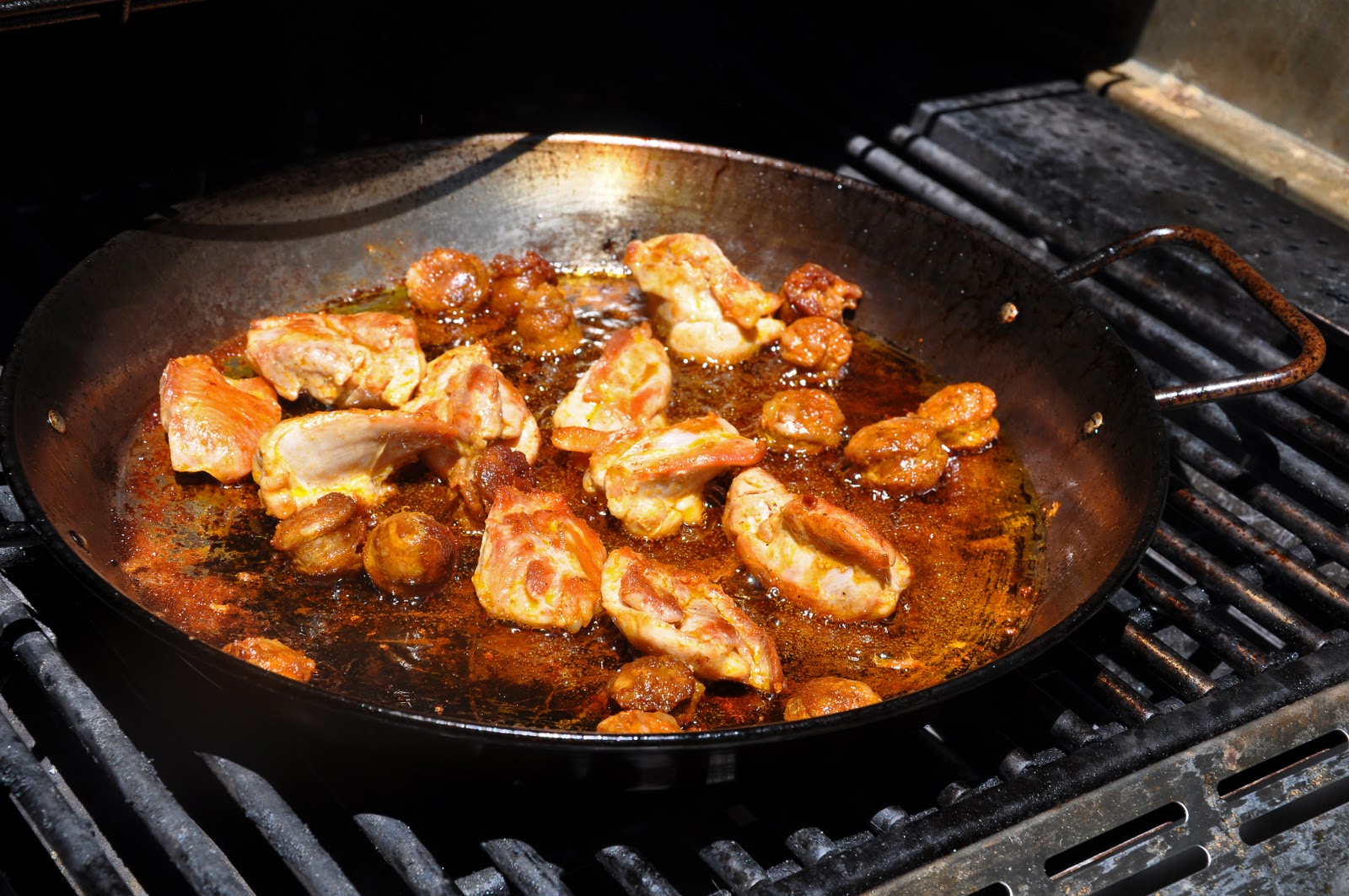
Add some chicken thighs to the pan and brown them very well. You want both the chorizo and the chicken to be very nicely golden brown, which will give your paella deep flavor. 

 While the chicken and chorizo are browning, skin your chiles poblanos with your hands, remove the seeds and cut them into rajas (or strips). When the chicken are chorizo are done, add a chopped white onion and the rajas to the pan. 


When the onion has softened, shove all the ingredients in the pan to the sides, making a 'well' in the middle. Into this well, place a spoonful of cumin (not too much, as cumin has a very strong flavor) and a heaping spoonful or two of pimentón (smoked paprika). Allow the spices to fry in the oil for a moment, until they become nicely fragrant:

As the sun sinks slowly in the West...

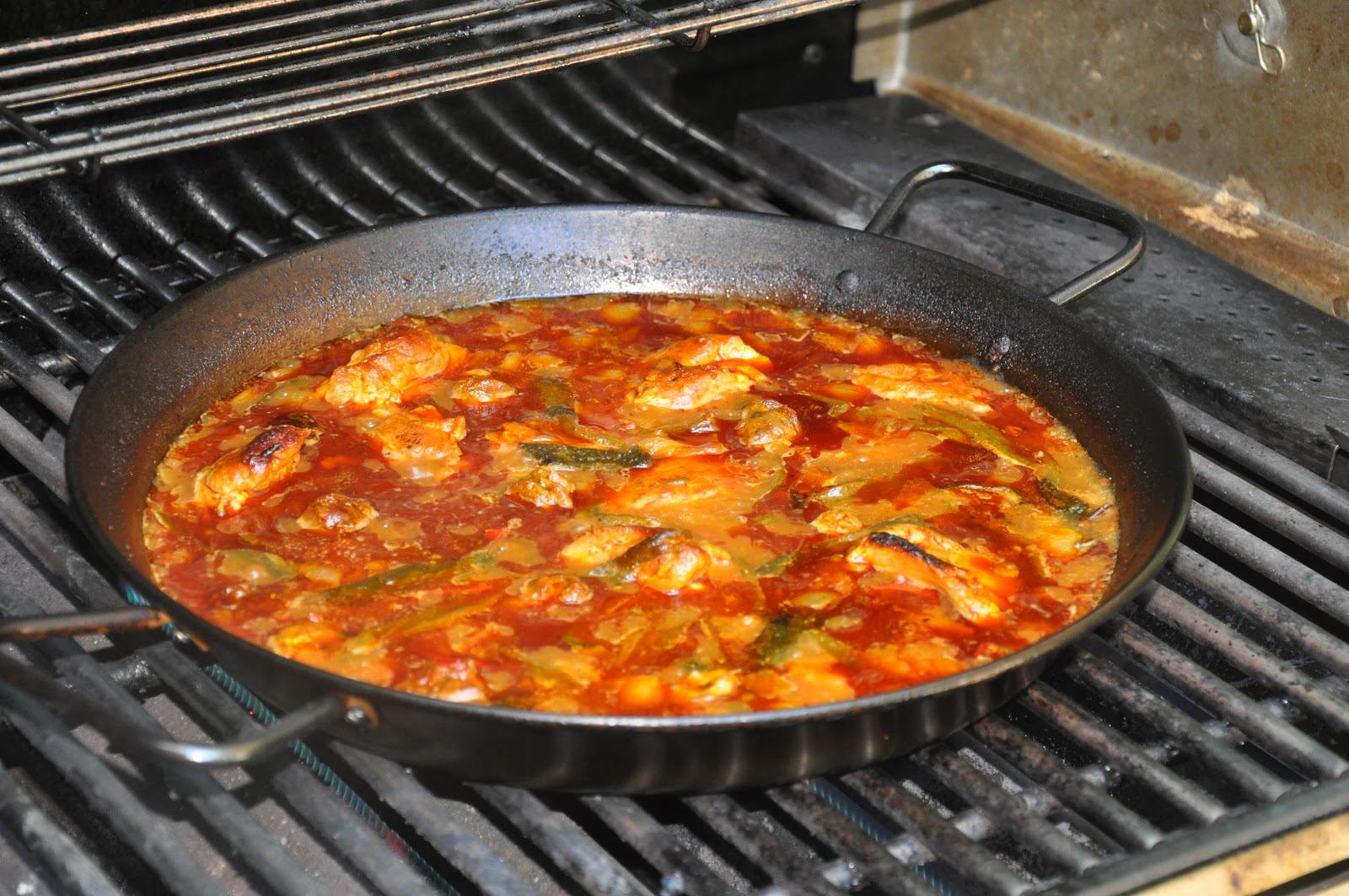
Then add two tomatoes, which you will have puréed in a blender. (For extra flavor, you can char and peel the tomatoes along with the chiles before puréeing them.) Mix the ingredients all together and let them simmer until the resulting 'sauce' thickens nicely.


Add enough water to almost fill the pan. (If using a traditional paella pan, you can use the rivets for the handles as a guide.) Season with salt and add a few threads of saffron—again, not too much as saffron too has a strong flavor and is very expensive to boot!
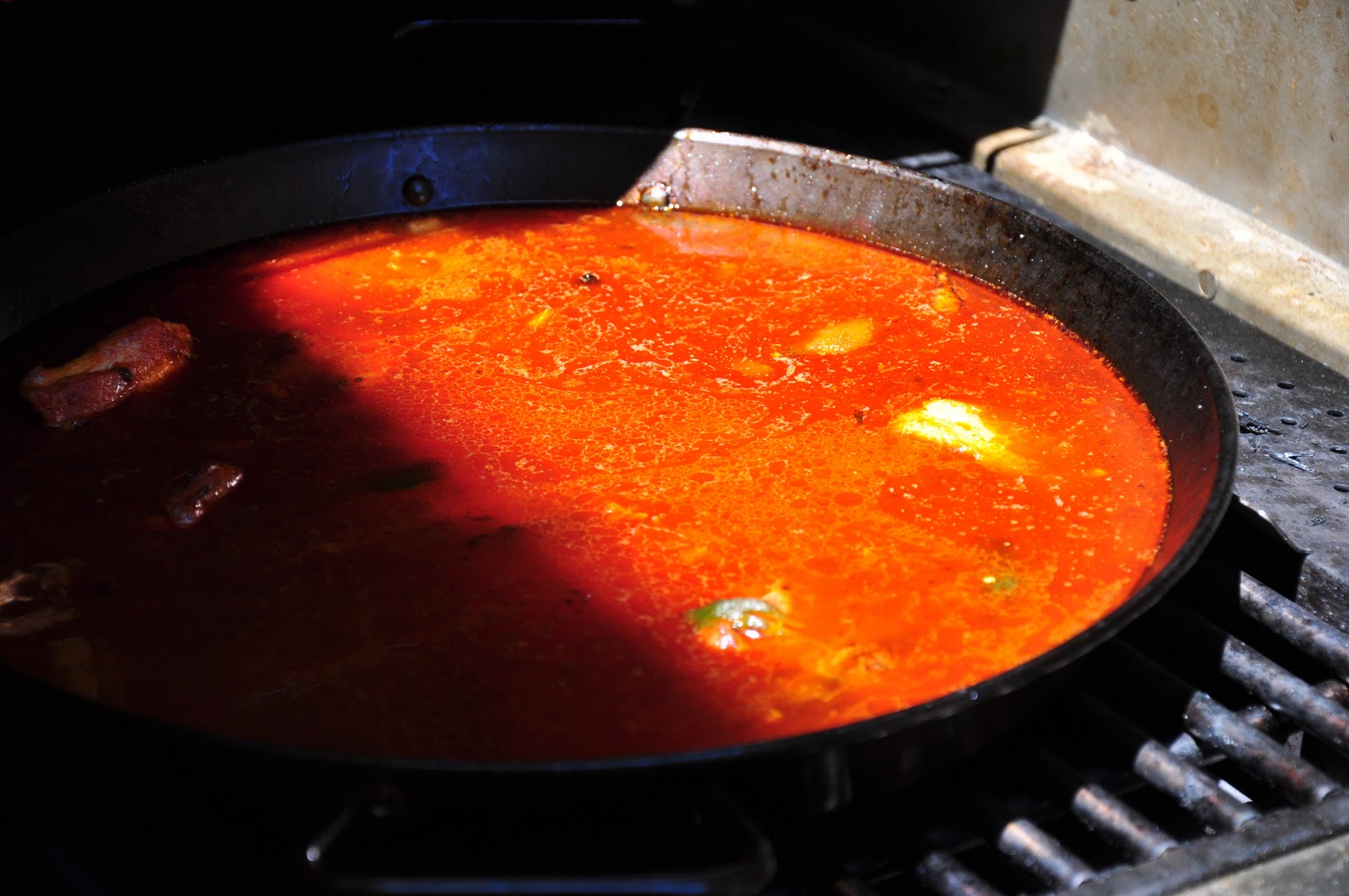

Allow this broth to simmer for a good 10 minutes or more, until it reduces by about half and develops a rich flavor. Taste the broth at this point to see if it sufficiently savory. Adjust for salt if need be and, if it tastes a bit 'thin', let it simmer some more. 
When your broth is ready, add your rice. The traditional Spanish way of adding the rice is by pour a line of rice from top to bottom and then from left to right to form a 'cross' in the pan that just barely rises about the top of the broth. Then you spread it out evenly. I usually simply sprinkle the rice around the pan as evenly as I can manage, enough so that it is just visible under the surface of the broth. 


Either way, let the rice simmer undisturbed for a good 15 minutes or so, until the broth has almost but not quite entirely been absorbed. Taste a bit of the rice—if it is still quite hard, add a bit more water. Then add some clams here and there, as many as you like without overwhelming the dish:


Let the rice continue to cook until the clams have opened and the broth entirely absorbed. (NB: You may need to raise the heat a bit at this point so the clams open.) The rice should 'crackle' a bit, meaning that it is forming that delicious crust called socarrat. Remove the paella from the heat, sprinkle it with a shot or two of tequila and let it rest for 10 minute or so before serving. 

¡Buen provecho!

NOTES: The paella turned out to be truly delicious, if I do say so myself! If I had one thing to change, though, I would have held back about half of the rajas and placed them on top of the paella along with the clams toward the end of the cooking time. While the poblanos had lent their wonderful flavor to the dish, they had essentially disappeared as a separate ingredient when all was said and done. Reserving some for the end would have also added a bit of contrast and color to the final dish. 

Nick's version is a bit more elaborate than this, with shrimp, tomatillos, green beans, shallots, chicken stock, peas in addition to the ingredients used here. And he uses chicken wings instead of thighs, chili powder instead of cumin. He also 'toasts' the rice in the oil before adding his stock. It looks perfectly delicious, too. 

For detailed tips on making paella, including the right type of rice, the proper pan to use, more details on cooking technique and some online resources, see my post on paella valenciana. 


 Post scriptum: We had some fun trying to think up a name for this dish made for the 4th of July. Paella cuatro de julio was an obvious choice, but didn't seem right. Then why not paella Pancho Villa? Paella Benito Juárez? Paella Frida Kahlo? Then I suggested paella Emperatriz Carlota, at which point we realized we should quit while we were ahead and settled for plain old paella mexicana… ;)


Saturday, September 5, 2009

Quick Note: Gazpacho «mejicano»


Gazpacho is such a wonderful invention: salad in liquid form! I love it, but I have an aversion to the taste of raw peppers, in particular raw green peppers, which is one of the standard ingredients in gazpacho andaluz. So I decided to invent my own variation of gazpacho.

There are tons of recipes on the web, but the one I like best is one that was contributed by a member of the Gnocchi ai funghi Recipe Exchange Club: it calls for 5 very ripe tomatoes, 1 peeled cucumber, a garlic clove, 70 g of white bread (crusts removed), 15ml of sherry vinegar, 50ml of olive oil and 125ml of cold water (add more water to thin out the gazpacho to your taste) and salt to taste. You cut up the vegetables and add them, along with the other ingredients, to a blender and blend until perfectly smooth. Taste it to see if it needs more salt, or a bit more vinegar or (if the vinegar is too strong for your taste) some more oil. Chill for 2-3 hours and serve. In Andalucía, they garnish their gazpacho with finely chopped hard boiled egg and croutons. Here's a photo of the classic version (sans garnish):


That's the classic recipe. My "Mexican" variation is easy: instead of the green pepper, use a whole jalapeño, and, instead of egg and bread croutons, garnish with avocado slices and, if you like, some cilantro leaves and some chopped white onion. Voilà!

NOTE: The original recipe calls for peeling and seeding the tomatoes before they go into the blender. But if your blender is powerful enough, I find that this bit of work is not necessary. If you want a less picante version, you can seed the jalapeño before adding it to the blender.

Tuesday, August 25, 2009

Paella «Reina Sofia»

Well, I suppose that it is paella week at our house. I just couldn't resist trying out another kind of paella—a vegetarian paella that I have dubbed paella «Reina Sofia», after Spain's Queen Sofia, who happens to be a vegetarian.

The basic method is the same as that for paella a la valenciana, with the critical difference that there is no 30 minute simmering of the meats with water—after all, there are no meats—but rather you add your rice directly to the sautéed vegetables, allow it to toast lightly, and then add water or broth. In any event, here is a step-by-step guide to the making the dish for 3-4 people:

Step 1: Cut up and and set aside all the vegetables that you will need for Steps 2 through 4 (In professional circles, this is often called the mise en place or the 'putting into place' of your ingredients):

Step 2: Set your paella pan on a barbecue with the center burners on high and pour in a generous amount of olive oil—you'll need more than you may think to properly coat all the vegetables and the rice. If you have a sear burner, then use it, too, as it will help to sauté more quickly and, later on, to help form that wonderful caramelized rice crust at the bottom of the paella (called a socarrat). Add your flavor base of aromatic vegetables, consisting of three peeled and slightly crushed garlic cloves, a chopped onion and a chopped sweet red pepper:

Sauté these vegetables until they begin to soften and caramelize slightly.

Step 3: Then add a small eggplant that has been diced into cubes and sauté those until tender:

(If using a larger, older eggplant, salt the cubes for at least 30 minutes in a colander to remove any bitterness; with a young eggplant, there is no need to do this.)

Step 4: Next, add a handful of cherry or grape tomatoes, a handful of green beans (aka 'string' beans) trimmed and cut into two, a handful of peas (frozen is fine) and a handful of baby lima beans. Continue sautéing for a few minutes to allow the vegetables to absorb the flavors of the aromatic vegetables:

Step 5: Clear out a little well in the center of the vegetables and into the well add a tablespoon of pimentón, Spanish paprika (or regular paprika, if you can't find pimentón). Allow the pimentón to sauté for a few moments and, when you begin to smell its rich, smoky aroma, mix it with the vegetables to coat them nicely. Then add your rice (about 250g or 1/2 lb) and allow it to sauté as well for a few minutes:

Step 6: Next, add enough water or broth to cover the rice by at least 1 cm (1/3 inch) together with some strands of saffron that you have dissolved in a bit of warm water:

Allow the liquid to simmer vigorously (but not boil) until it has been entirely absorbed and you hear a sizzling and then a crackling sound. Check with a spatula or other utensil to see if the liquid has been entirely absorbed and—hopefully—a nice socarrat has begun to form on the bottom of the paella pan. Taste to make sure that the rice is just about cooked. If it is, then remove the pan from the fire and allow it to rest for about 10 minutes before serving.

¡Buen provecho!

NOTES: This recipe is my own 'invention'—sort of. It is actually an amalgam of the most appealing aspects of the many recipes for vegetarian paella that you will find on Spanish websites. Almost all of them have some common features: aromatics such as onion, garlic and red pepper, as well as eggplant and green beans, and (often) peas and/or beans of some sort. Artichokes also feature often but, being out of season at the moment, I omitted them. And, as mentioned at the outset, all these recipes omit the preliminary simmering and call for the rice to be added directly to the vegetables.

Without the simmering step, which creates the broth for paella a la valenciana, you have some choices to make up for the loss of flavor: you can use vegetable broth or—straying a bit from vegetarian principles—chicken broth. Or you can simply use water, in which case you will want to season well with salt and perhaps add a bit more pimentón for extra flavor.

Speaking of straying from vegetarian principles, there is a humorous (and possibly apocryphal) story about Queen Sofia and King Juan Carlos' royal visit to Morocco in 2005. The visit was meant to help mend relations between Spain and Morocco in the wake of a territorial dispute over the Isla de Perejil (Parsley Island) off the coast of Morocco. It seems that the Moroccan chefs did not entirely understand what it meant to be a vegetarian, since—as the Queen later told the Spanish press—they insisted on flavoring the 'vegetarian' dishes they served the Queen with little bits of meat! But this is nothing too unusual, actually. In Italy, for example, dishes with a bit of pancetta can still be considered magro, or fit for eating on fast days. In cases like this, the meat is considered a kind of condiment rather than truly 'meat' as such.

Whatever...

Monday, August 24, 2009

Paella a la valenciana


If you're like me, you may have thought that paella a la valenciana was made with a mixture of chicken and seafood and perhaps a bit of Spanish chorizo, onions, red peppers and peas for color. Well, as it turns out, the real paella a la valenciana is quite a different animal.

I recently tried out a recipe that I found on lapaella.net. According to this (and a number of other recipes I found in Spanish across the net) the real thing uses chicken, but no seafood, chorizo, onions, red peppers or peas. The recipe, which is quite easy but involves a number of steps, goes as follows:

Fry lightly salted pieces of chicken (thighs and/or legs) and rabbit in a generous amount of olive oil, in a well-seasoned paella pan (see below). When nicely browned--and a good browning is crucial to the success of the dish--add green beans and, if you can find them, 'romano' green beans (both cut into sections), a Spanish white bean called garrafon--use baby lima beans if you don't have these on hand--and, in season, artichoke, trimmed and cut into wedges. Allow the vegetables to saute for a few minutes. Then clear out an open spot in the center of the paella pan and add one grated tomato (if tomatoes are not in season, use two tablespoons of canned crushed tomato) and a tablespoon or more of pimenton, Spanish paprika. Allow the tomato and pimenton to caramelize a bit, then add water or chicken broth to cover all the ingredients, together with saffron threads that you will have dissolved in a bit of warm water. (The paella pan should be almost full to the brim.) Allow to simmer for about 30 minutes. Taste and adjust for salt. Add rice (see below), distributing it as evenly as possible, and continue simmering for 7 minutes over very high heat, then another 4-5 minutes or so over medium heat, then finally another 3-4 minutes over very low heat. About 5 minutes before the rice is ready, lay a sprig of rosemary over the rice. (If at any point you find that you've miscalculated and your paella is drying out but the rice is still hard, now worries: just add a bit more water.) Allow the paella to rest 5 minutes before serving.

I have not included exact measurements here--the eye is all important--but for measurements and a blow-by-blow illustrated recipe, go to lapaella.net. Elsewhere on the site, you can find lots more information and background on making the perfect paella, as well as recipes for other sorts of rice dishes and some other intriguing recipes the cuisine of Valencia. (The site only exists in Spanish and Italian--but the photographic paella recipe should be easy enough to follow.)

Well, the paella was quite different from any other paella I had had, but it was very, very good indeed. Two of us polished off what should have served four!

NOTES: Paella is best cooked over an open fire. Special paella burners are available, but I have found that my barbecue does a fine job. You can also just cook paella on the stove (finishing it off in a hot oven after you've added the rice) but the dish will lack that semi-smokey flavor that is so characteristic of a real paella. One way to make up for this is to add more pimenton, which will impart a little smokiness to the dish.

Using the right kind of rice is essential for a good paella. The best kind of rice for paella is called "bomba", which is a short grain rice. If you can't find bomba or just don't want to spend the money--bomba rice is quite expensive--try another Spanish short grain rice. (Balducci's carries something they call "paella rice" from Spain, and Spanish rice is also available online on amazon.com as well as sites that specialize in Spanish food like Hot Paella.com and La Tienda.com). I have also used Italian arborio rice with obtained fine results. Whichever type of rice you decide to use--but especially if you use arborio--be sure not to stir the rice after you add it to the pan and distribute it among the other ingredients. Paella is not meant to have a creamy texture, and too much agitation will get the starch going and produce a creamy dish, which is what you want when making risotto, but not when making paella.


The original technique for adding the rice to the paella, by the way, involves pouring the rice in the form of a cross, vertically and horizontally. The rice should just come up slightly above the 'water line'. The rice is then mixed--only once--into the broth. This apparently ensures that you get the right amount rice vs. broth. (The photos on paella.net illustrate.) I usually don't do this and just take my chances, as I find mixing the rice into the other ingredients rather awkward to accomplish.

According to some sources, including the About.com: Spanish food website the original paella a la valenciana also included snails. I have not tried this but it does sound good. If you have an aversion to snails or rabbit, a paella made entirely of poultry and vegetables would no doubt be equally delicious.
The best pan for making paella is called--not by coincidence--a "paella". It can be bought in a lot of good cookware stores (including, for example, Sur La Table) and also available online at the websites mentioned above. The traditional paella pan is made from polished steel and needs to be seasoned. If you have ever seasoned a wok or a cast iron skillet, it works the same way: you wash the pan in soap and hot water first, then dry it scrupulously. Oil the inside of the pan (paper towel is useful here) and then place it over medium-high heat. The bottom of the pan will begin to turn a golden brown as the oil 'burns' into the steel. It won't look very pretty, but don't worry--this is what you want. Rotate the pan to make sure that the entire inside surface of the pan is well seasoned. Let cool and repeat. After it cools for a second time, the pan is ready to use. The seasoning provides a natural non-stick surface. As with other seasoned cookware, you should clean your pan with hot water only--if you use soap or detergent, you will remove the seasoning. After each cleaning, oil the inside of the pan again and let it heat up for a minute. Wipe off any excess oil and store it away until you're ready to enjoy your next paella.

Now, if all of this sounds like too much trouble, no worries. You can buy non-stick and stainless steel paella pans, which require no seasoning or special maintenance, as well as the traditional polished steel. And for years I used a regular non-stick braiser with fine results.

Post scriptum: Some of you may be thinking that you like adding seafood or chorizo or peas--or whatever--to your paella. So what's wrong with that? Nothing at all, of course. But, in the words of one exasperated Spanish food blogger:
EN FIN, CADA UNO PUEDE HACER LO QUE QUIERA A SU GUSTO, PERO AL MENOS QUE NO LA LLAMEN PAELLA VALENCIANA!!!
Which means, roughly: "at the end of the day, each one of us can do what suits their taste, but just don't call it 'paella valenciana'!!!"

Paella Valencia on Foodista